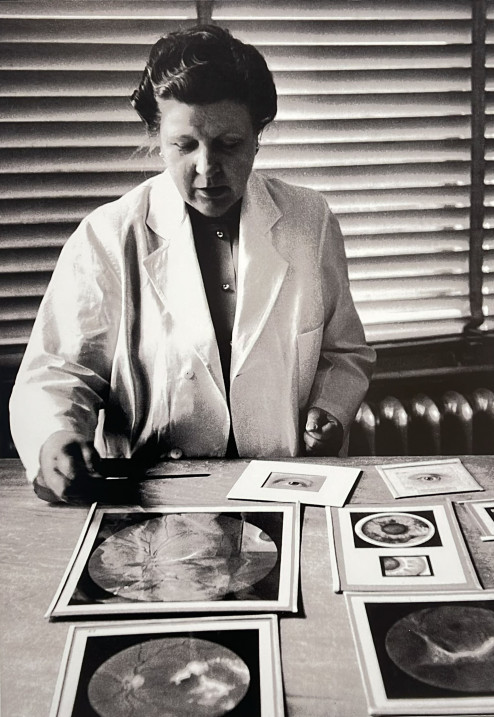
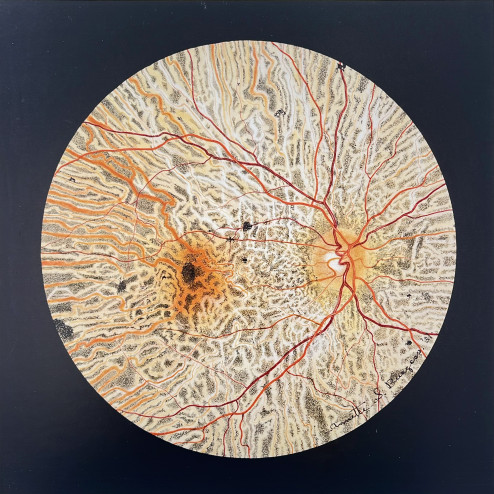
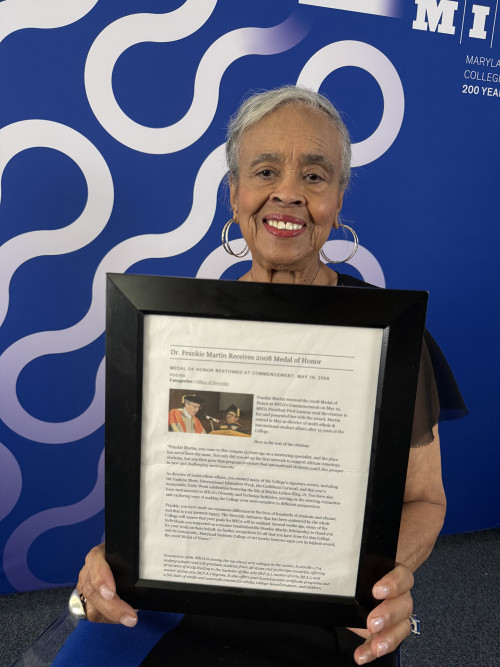
Today, we celebrate two visionary women whose leadership, artistry, and courage expanded what was possible, not only at MICA, but across their fields. Among them are two extraordinary pioneers: Margaret F. S. Glace, a transformative academic leader who guided the Institute into a new era of accreditation and professionalism, and Annette Smith Burgess, a master medical illustrator whose work helped define modern ophthalmology.
Margaret F. S. Glace
Educator. Leader. Architect of Institutional Transformation.
At a pivotal moment in the Institute’s history, Margaret F. S. Glace stepped forward to lead.
Glace joined the Maryland Institute in 1937 as head of the teacher education department and later served as academic dean. In 1948, she became the first woman to hold the post of dean at an American art school—a groundbreaking achievement at a time when few women occupied senior leadership roles in higher education.
Following the departure of Director Albert Maurice, Glace served as acting director, guiding the Institute through a period of institutional growth and structural change. Her leadership was marked not by spectacle, but by steady, strategic progress.
Transforming the Academic Foundation
Under Glace’s leadership the Institute secured full state accreditation in 1948; the bachelor’s degree program was broadened and strengthened; a master’s degree program was introduced in 1954.; the Institute’s first liberal arts courses — history and English — were added to the curriculum; MICA’s foundational first-year program was created, establishing a unified course of study for all students; and photography was added to the BFA offerings in 1959.
These steps laid the groundwork for national accreditation and positioned the Institute as a fully professional, degree-granting college.
In 1959, during her tenure, the Institute formally changed its name to Maryland Institute, College of Art, signaling its evolution and expanding academic ambitions. The campus was consolidated on Mount Royal Avenue, strengthening its physical and institutional identity.
Nationally recognized as an educator of art teachers, Glace also served as a director of the National Association of Schools of Art and Design (NASAD) and played a key role in securing the Institute’s accreditation.
Her impact was later honored with an honorary degree and the Institute’s Medal of Honor. Today, Glace Hall stands as a living tribute to her legacy, a space dedicated to student life, community, and the everyday rhythms of campus experience.
Margaret Glace did more than lead. She built the academic framework that would allow future generations of artists to thrive.

Students and campus guests outside Glace Hall, Founders Green.