On a spring day in 1934, a ten-year-old girl followed her father into Gwynns Falls/Leakin Park, Baltimore, sketchbook in hand. The trees, the light, the patterns of nature—Betty Cooke absorbed it all, and something inside her clicked. Art would be her language.
That language carried her from a Baltimore rowhouse to the studios of MICA. Cooke entered MICA on a scholarship in the early 1940s and never really left. She was a student, then a professor, then a benefactor, and always an advocate. “It was a place that didn’t just train you,” she would later say. “It invited you to see differently.”
A Revelation
MICA in the 1940s was a revelation. For Cooke, it was less about classrooms and more about community, an incubator of ideas where curiosity mattered as much as craft.
“From the start,” she recalled, “it wasn’t just about making something beautiful. It was about thinking about how art lived in the world.”
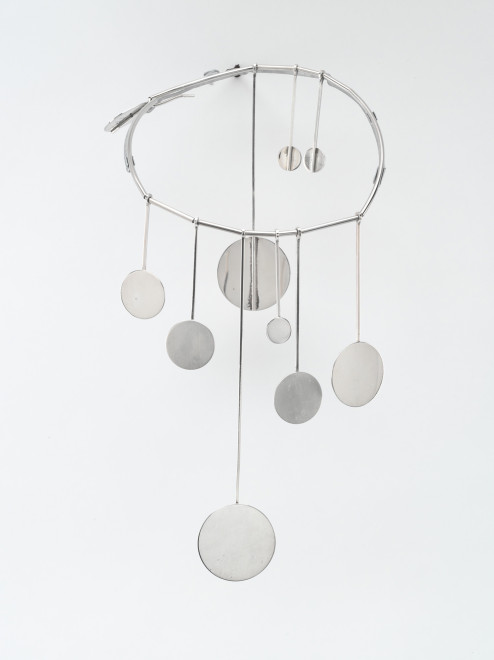
That philosophy—equal parts rigor and imagination—stayed with her. While many considered jewelry a mere ornament, Cooke approached it like architecture. Lines, shapes, and movement were her building blocks. The result? Pieces that were both wearable and sculptural, precise yet alive.
An Artist, A Partner, A School
After graduating in 1946, Cooke joined the MICA faculty, teaching for more than two decades. Her classroom was an extension of her own artistic journey: questioning, clarifying, refining.
It was at MICA, too, that she met William Steinmetz ’50, one of her students who would become her husband, partner, and collaborator. Together, they launched Cooke & Steinmetz Designers and Consultants, tackling projects that stretched from interiors to government commissions. In 1965, they opened The Store LTD in Roland Park, a boutique, gallery, and laboratory for design thinking, decades before the term became fashionable.
Baltimoreans flocked there not just to shop, but to experience a worldview: that design was for daily life, not just display.
Impact Beyond the Studio
Cooke’s jewelry soon traveled far beyond Baltimore. Her pieces entered the permanent collections of the Museum of Fine Arts, Boston; the Museum of Arts and Design, New York; and the Montreal Museum of Decorative Arts. Twice, she won the prestigious DeBeers’ Diamond Award. Retrospectives at MICA and the Walters Art Museum confirmed her place among the world’s foremost jewelry designers.
Yet, for Cooke, recognition was never the point. Her measure of success was simpler: Was the work true? Was it essential? Did it honor the line?
She carried the same clarity into her philanthropy. Alongside Steinmetz, she created scholarships, endowed funds, and invested in facilities. The Gateway’s BBOX performance space bears their names. The Steinmetz and Cooke Endowed Chair in Design at MICA, established in 2019, ensures that their influence will guide students for generations.
The Echo of a Century
Even in her later years, Cooke kept commuting to her store, sketching, soldering, shaping metal into meaning. At 100, she was still refining ideas, still asking the question every artist knows: What is essential?
When she passed, MICA President Cecilia McCormick called her “engaging, witty, brilliant, and formidable in every way.” She added, “Betty was a treasured alumna and a lifelong friend to students, artists, and colleagues. We were all blessed by her energy, her passion, and her unshakable belief in the transformative power of art and design.”
A Legacy of Reimagining Art
Cooke’s story offers an answer. For her, MICA wasn’t just a school—it was a proving ground, a community, a lifelong collaborator. It gave her the space to reimagine jewelry as modern art, to merge design with daily living, and to pass that vision forward through teaching and philanthropy.
“Pure, precise, sculptural,” is how curators describe her work. The same could be said of her legacy at MICA.
As the College marks its 200th anniversary, Cooke’s legacy remains clear: art is not just what we make, it’s how we live.