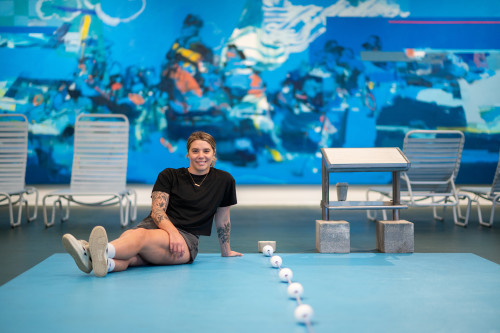
When Tony Lugo first spoke with Luca Buvoli, director of MICA’s Mount Royal School of Art, something clicked. At the time, Lugo’s professional practice was deeply rooted in digital media — algorithmic, precise, sometimes isolated — and he was searching for a program that could expand his thinking beyond the screen. “When I talked to Luca, he wasn’t just interested in my portfolio; he was interested in the philosophical and material questions behind it,” Lugo recalls.
Buvoli’s invitation was simple but transformative: bring your full self. “He said, ‘Yes, you have a design background and a visual arts background, but all those other things you’re curious about, those are things we can discuss.’” For Lugo, that openness to inquiry marked the beginning of something different.
“Other schools were interested in categorizing my work as ‘digital arts,’” he says. “ But MICA was interested in what might happen if I stopped categorizing it at all.”
It was an offer of freedom to explore, hybridize, and reimagine what art-making could be. And that, Lugo says, is what sealed his decision to enroll. “Mount Royal was small, but it had this incredible structure: one core faculty member and dozens of visiting artists. That meant constant exposure to different perspectives, forty or more artists, curators, and thinkers passing through the program. Every week was a new conversation.”
It was the beginning of an education built on movement and multiplicity, the kind of restlessness that has defined MICA for nearly 200 years.
A Culture of Collision
At MICA, Lugo found what he calls “a culture of collision.” The Lazarus Center, where each floor housed a different discipline, became his laboratory. “You couldn’t stay siloed,” he says. “You’d meet someone in fibers or film just by walking down the hall. That proximity of the physical mixing of disciplines changes you.”
He began to see technology not as an end, but as a conversation starter. “Digital programs elsewhere tend to center innovation around the technology itself,” he explains. “At MICA, people weren’t just impressed by the tool. They cared about the tangent, about how technology connects back to human experience.”
That difference crystallized during a visiting artist critique in his final year. Lugo was deep into a project exploring systems, sound, and logic, “all very conceptual,” he says. But the visitor challenged him to step outside the code. “They said, ‘You can study the novelty of these technologies, but there are other technologies that are already part of you, like drums. They’re political, social mechanisms for change.’”
For Lugo, it was a revelation. “That moment reframed everything. I realized that even the most complex systems are human stories in disguise. Our tools mirror us.”
That realization, that the boundary between the mechanical and the human is porous, continues to pulse through Lugo’s work. “MICA taught me that it’s okay to get lost,” he says. “You just have to know how to find your way back through people, through dialogue.”
And at MICA, dialogue was everywhere.
Even critiques, he remembers, had a rhythm of renewal. “If you had a tough crit, it wasn’t the end of the world. You’d have another one or two days later with someone totally different. The speed of change kept you fluid; you couldn’t calcify around one opinion.”
Some of his favorite memories are the Mount Royal potluck dinners with visiting artists. “We’d all cook,” Lugo laughs. “You’d have curators, donors, and students passing plates around a table in the studio. Those nights stripped away the mythology of ‘the artist’ and replaced it with conversation and food and laughter. That’s what made it personal.”
Keeping the Human Mark Alive
After graduating, Lugo carried that same ethos of openness into his teaching and research. Today, he leads Digital Innovation and Creative Media Research at Johns Hopkins University, a role that sits at the crossroads of art, engineering, and human experience.
“I love art schools,” he says with a grin. “I drank the Kool-Aid. Hopkins is different — it’s more scientific, more procedural — but I try to bring the spirit of MICA into that environment.”
That means keeping experimentation at the center and never losing sight of the human hand behind the work. “At MICA, spaces were activated,” Lugo says. “It wasn’t just about hanging art on walls; it was about creating culture. Even today, we have handmade signs taped next to 3D printers in our lab. It’s a reminder that digital doesn’t have to mean sterile. You can keep the creative fingerprint alive.”
He credits MICA for instilling that instinct. “The difference there is that no one teaches you to erase yourself. Whether you’re coding or painting or composing sound, it’s about the mark, the trace of the maker.”
That mindset continues to shape how Lugo mentors emerging artists and technologists. “You can’t talk about digital culture without talking about people — their politics, their humor, their anxieties. MICA taught me that innovation only matters if it’s in conversation with humanity.”
Carrying the Difference Forward
Looking ahead, Lugo sees MICA’s 200th anniversary as more than a celebration; it’s a recommitment to that restless spirit of questioning. “Every generation at MICA has had to navigate new tools, new contexts,” he says. “What ties them together isn’t the medium. It’s the willingness to ask: ‘What does this mean for us?’”
It’s also what keeps it unpredictable. “At MICA, no one’s stuck in a formula,” he says. “Painting isn’t trapped in an atelier model. Everything’s in dialogue with what’s happening right now with contemporary culture, with what’s next.”
That adaptability, he believes, is what will carry MICA into its third century. “As technology keeps accelerating, artists need places that don’t just keep up but keep asking. MICA’s great gift is that it never settles into one way of seeing. It invites you to unlearn and rebuild.”
He smiles, recalling those long potluck dinners in the Mount Royal studios. “We were all just trying to figure things out — artists, curators, donors, everyone. And that’s the beauty of it. MICA doesn’t hand you answers. It gives you people who are willing to ask the hard questions with you.”