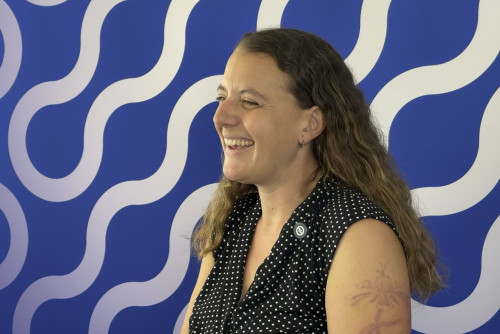
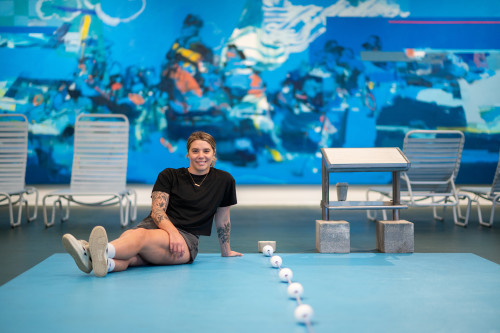
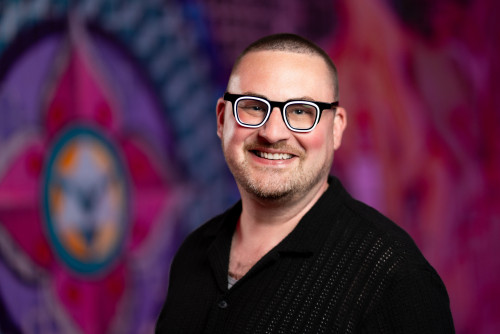
When Julia Di Bussolo ’06, ’07 (Photography BFA, Community Arts MA) first walked onto MICA’s campus as a prospective student, she felt an immediate sense of home. The visit was sparked by a portfolio review at her high school, where MICA outreach staff encouraged her with sharp, useful feedback. But it was Baltimore itself that sealed the decision. “I fell in love with the city right away,” she recalls. “I was drawn to the community feel of the campus, the warmth of the faculty and students, and the energy of Baltimore.”
That feeling carried her through two degrees at MICA and into a career that has become inseparable from the city she first embraced. Today, as executive director of Arts Every Day, Di Bussolo leads a nonprofit dedicated to expanding access to arts education across Baltimore public schools. Her trajectory is an echo of MICA’s bicentennial theme: a story of artists rooted in place, using creativity not only to make but also to connect, to reform, and to build community.
A Sense of Connection
For Di Bussolo, choosing MICA was as much about belonging as about art. She could see herself here, not just in the studios, but in the neighborhood, among the faculty, in the city’s streets and cultural spaces. That sense of connection deepened once she arrived on campus and encountered mentors who would shape her future.
Chief among them was Paula Phillips, founder of MICA’s community arts program. Phillips became both mentor and model, teaching Di Bussolo that community-based arts were not only viable but vital. As an undergraduate, Di Bussolo began working in community arts, work that provided her both income and direction. “I was waitressing and working at a flower shop to cover my living expenses,” she remembers. “The community arts program allowed me to earn money and pursue what I was passionate about: arts education.”
Phillips’ mentorship was marked by tough love and deep belief. “She didn’t take excuses, and I appreciated that,” says Di Bussolo. “She showed me what it meant to be both an artist and a changemaker.”
Staying and Belonging
When asked what makes MICA different from other art and design schools, Di Bussolo doesn’t hesitate: “People stay.”
Unlike peer institutions where graduates scatter to bigger markets, MICA alumni often choose to remain in Baltimore. They build careers here, teach in the schools, start nonprofits, and pour their creativity back into the city.
“It’s really unique,” she says. “It speaks to MICA’s curriculum being rooted in Baltimore intentionally so. And it speaks to Baltimore itself, which is a city of artists with an incredible arts and culture community.”
This “rootedness” is not incidental. From portfolio reviews in local schools to courses that engage students directly with neighborhoods, MICA intentionally orients its artists to the place they inhabit. For Di Bussolo, that grounding in Baltimore transformed art-making from a solitary practice into a public responsibility.
From Studio to Systems Change
That sense of responsibility shaped her perspective as both an artist and an advocate. “I loved making art, but I wanted more,” says Di Bussolo. “MICA opened up a pathway for me to connect with the neighborhood, the city, the community. It showed me that artists can be changemakers, that the arts can be vehicles for advocacy and reform.”
The impact of this realization extended far beyond her personal practice. In 2008, during the housing crisis, Di Bussolo found herself able to pivot within the nonprofit sector thanks to the skills she had honed at MICA. She could write grants, plan lessons, map community power structures, and understand who was missing from decision-making tables. Those same skills have defined her work at Arts Every Day, where she has served as executive director for more than a decade.
Di Bussolo describes Arts Every Day as a movement to make arts education equitable by strengthening teachers, infusing the arts into every subject, connecting schools with Baltimore’s rich cultural resources, and giving young people the power to lead as artists and advocates. To her, the imprint of MICA’s community arts program is unmistakable: art as a driver of equity, students as co-creators, and Baltimore as both classroom and collaborator.
Rooted in Place
Looking ahead, Di Bussolo sees MICA alumni as vital to the continued strengthening of Baltimore’s arts and education ecosystem. Already, many graduates become arts teachers in city schools, and she hopes that number grows. “We need more generations of students who choose to stay, give back, and make the city better,” she insists.
She also believes the lessons she absorbed at MICA, the critical analysis of systems, the insistence on asking who’s at the table, the conviction that art connects to the greater good, remain crucial for future artists.
“Artists shouldn’t only do their own work,” she says. “They should connect to their neighborhoods and communities. That’s a lifelong lesson, and I hope it’s still a big part of what students take away from their MICA experience. This ethos is rooted in Baltimore, and it gives back to Baltimore.”
Her life’s work, in classrooms, in neighborhoods, and in citywide advocacy, embodies the same principle that drew her to MICA as a teenager: that art and community are stronger together.