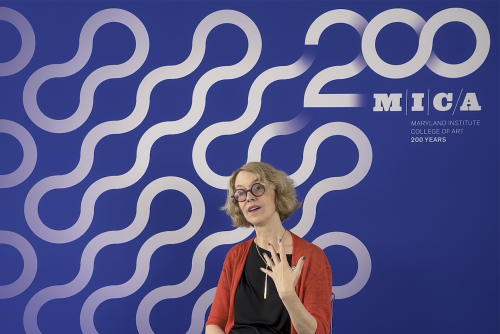
When Ellen Lupton walks across MICA’s campus, she feels the weight of history pressing gently but persistently against the present. “I grew up in Baltimore,” she reflects. “The opportunity to return here and teach in a city I love, at a school I always loved—it was just a perfect opportunity.”
Her first connection to MICA wasn’t as a faculty member or curator but as a teenager. Like many Baltimore high school students with a hunger for art, she enrolled in MICA’s pre-college program. The experience left a deep impression: the energy of peers testing out their voices, the seriousness of being in a space dedicated to art, the sense that ideas mattered. That early taste of MICA set her on a path that would wind through Cooper Union in New York, fifteen years of work and study in the city, and eventually back to Baltimore—back to MICA.
A School That Lives Its History
For Lupton, the heartbeat of MICA lies in its ability to hold history and innovation in the same frame. “I love history,” she says. “I love to see the legacy of people and ideas, and I love to see how the past builds the future. And MICA has a lot of both. We can see it in the architecture, in the city, in the alumni, and in the people.”
That layered legacy—the way the College’s physical presence and its intellectual spirit are intertwined with Baltimore’s own story—sets MICA apart from other art schools. Lupton points to the way MICA classrooms serve as “laboratories for design research.” They are places where students test, stretch, and sometimes overturn conventions, but always in conversation with the long line of artists and designers who came before them.
What makes MICA different, in Lupton’s eyes, is that the College is never content to rest on its reputation. Even in disciplines like graphic design—where tools, technologies, and cultural references change almost overnight—the school cultivates both craft and a sense of curiosity. “When I started in graphic design, we were doing galleys and paste-up. It’s a different world now,” she recalls. “But the spirit of experimentation remains the same.”
Teaching, Writing, Curating
Lupton’s career has unfolded at the intersection of scholarship, teaching, and curation. She is the author of numerous books on design that are used worldwide, but she insists that her primary audience has always been her students. “I write books sometimes with my students, always for my students,” she explains. “Learning how to teach and learning how to learn as a faculty member here at MICA has been an adventure alongside my students.”
Her classrooms, she says, are not hierarchical stages where knowledge flows one way; they are circles of inquiry where students and faculty learn together. “Our students have always been curious,” she notes. “They come to MICA with a lot of skills and interests already. But they leave transformed—new ideas, new ways of working, new people they’ve met. And that transformation comes largely from their peers.”
Typography is one of Lupton’s areas of expertise, and she has seen firsthand how students shift their understanding of the field. “Young students often think typography is just fonts—designing fonts or choosing fonts. But actually, it’s layout, scale, hierarchy, systems. There’s a moment when you see somebody switch their point of view—it’s not just the shape of letters, it’s content coming to life.”
That moment of transformation, when students suddenly see themselves as part of a living conversation about design, is what she treasures most about teaching at MICA.
Global Perspectives, Local Ties
MICA’s student body unites artists and designers from across the globe. Lupton describes her amazement at the courage of international students who travel thousands of miles to immerse themselves in Baltimore life. “They come here to experience a different life, a different city. And then many of them stay and work in the United States, or go home and take their education with them. Many of our students become educators themselves, contributing to the world of design in that way.”
She notices clear differences in how international students approach their studies. “Generally, they come with strong technical training,” she says. “What then changes for them is a more open view of what the educational process is, what creativity is, what learning is. We kind of open up the clamshell.”
At the same time, MICA’s deep roots in Baltimore mean students are never cut off from the city around them. “MICA is in a city. We are in a neighborhood. And our students become part of that neighborhood,” Lupton says. Students have the option to engage in local programs or to take a global perspective on their work. That flexibility, she notes, allows MICA students to shape their own pathways while still being anchored in a community.
Looking Toward the Next Century
As MICA celebrates its bicentennial, Lupton is keenly aware of what it means to be part of a milestone moment. “I’ve known MICA most of my life,” she says. “And I expect to finish my career in this environment. Seeing the institution continue to grow and hit this milestone—it’s extraordinary.”
The bicentennial, for Lupton, isn’t simply a celebration of longevity. It is a marker of resilience and relevance. “All our students transform,” she says. “That’s the essence of what makes MICA unique: it’s a place where people change—where their vision of the world, their understanding of art and design, even their sense of themselves, is reimagined.”
Looking to the next hundred years, Lupton hopes MICA continues to be a place where creativity is nurtured not only as a skill but as a way of engaging with the world. She envisions students continuing to bring global perspectives to Baltimore, continuing to learn from each other, and continuing to use design as a way of addressing the pressing cultural questions of their times.
Her personal hope, she adds with characteristic simplicity, is that MICA never loses sight of beauty. “I love design. I love beautiful architecture, beautiful streets, and beautiful buildings. And MICA is just so beautiful. There are so many inventive uses of space, structure, and materials. The environment itself is a source of inspiration.”
As she reflects on her journey from pre-college student to faculty leader, Lupton embodies the cyclical nature of MICA’s story: generations of artists and designers arriving, discovering, transforming, and leaving their mark. In celebrating 200 years, she sees not just what MICA has been, but what it will continue to be.
“MICA is a place where the past builds the future,” she says. “That’s what makes it like no other.”