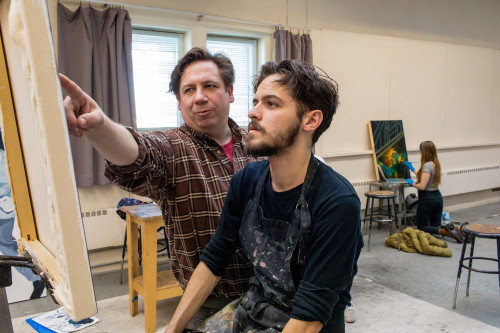
First-Generation Journeys
At MICA, first-generation college students have long brought their unique experiences, determination, and creativity to our community.
Leslie King-Hammond, Professor Emerita
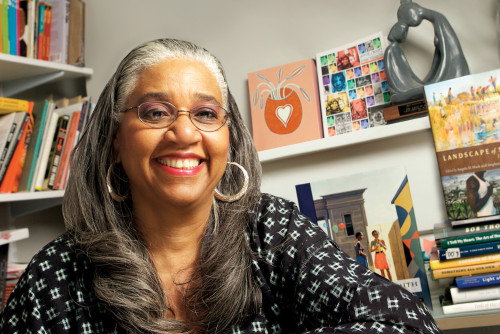
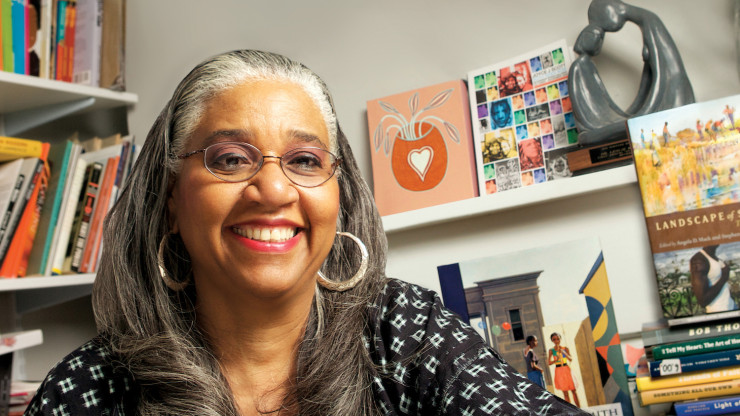
When Leslie King-Hammond arrived at MICA in 1973, she came through what she calls “a kind of serendipitous surrender,” a willingness to say yes whenever art opened a door. “Windows opened,” she recalls, “and whether I was banging on the doorframe or falling through the window — forward, backward, or upside down — I decided that as long as it had anything to do with the arts, I wanted to be involved and see where the journey took me.”
As she was completing her doctorate, a classmate told her that MICA needed someone to teach art history, specifically, the history that wasn’t being taught. Black students wanted a curriculum that reflected their stories and heroes. She started by teaching one evening class. Two weeks later, she was asked to teach another section for day students “who were concerned they couldn’t take it.”
From that point on, her classes were overflowing. Students from Johns Hopkins University began taking them too, drawn by the magnetic force of her storytelling and the long-overdue truth-telling she brought to art history. “It showed how deeply people hungered for this knowledge,” she says. “People were ready for an honest conversation about art and humanity.”
King-Hammond found a place where her energy and her focus on social justice were encouraged. “That’s the joy of being at MICA,” she says. “You get to do things that make a difference.” In that freedom, she built spaces that hadn’t existed before based on race and culture perspectives, post-baccalaureate programs that welcomed nontraditional and international students, and classrooms where every lecture became a conversation about being fully human.
Her pedagogy was grounded in radical partnership. “I’m 50% of the contract,” she told her students. “You’re the other 50%. You bring your full self. You’ll be uncomfortable at times, but you’ll grow.” Everyone started her class with an A; the only question was whether they could keep it. “I didn’t grade on fear,” she says. “I graded on mastery.”
This, too, is the MICA difference: the belief that art education is about courage and creating the conditions where discomfort sparks discovery and truth-telling becomes a creative act. “MICA was a place where you could experiment and take risks,” King-Hammond says. “You could mix and match who you were and still be effective, as long as you had vision, energy, and someone to pass the torch to.”
King-Hammond’s impact on MICA is visible in the students she taught and in the very architecture of the institution. When two recently divorced women walked into her office in the 1970s, no appointment, just determination, she saw opportunity. They wanted to finish their education in the arts. “I thought, this is interesting,” she laughs. “Their husbands were paying their tuition as part of the settlement!”
Hammond created a program for them, the post-baccalaureate program, which grew rapidly to include international students, career changers, and artists in transition. “It was flexible, tailored to each student’s interests and skills,” she says. “It gave them agency.”
As the program exploded, space became an issue. King-Hammond approached to the administration with a blunt message: “You need to centralize the programs.” Her persistence helped spur the purchase of what became key campus buildings, the old Cannon Shoe Factory and later the London Fog building. “Buy the building,” she told them. “Invest in the future.” And they did.
Her vision always extended beyond MICA’s walls. When Hurricane Katrina hit in 2005, she turned a national tragedy into a campus-wide act of solidarity. She persuaded the College to welcome displaced New Orleans art students and brought artist Willie Birch to campus as an artist-in-residence. The community’s response culminated in a New Orleans–style second line parade—complete with jazz, costumes, cocoa, and police escorts. “It was beautiful, joyful, and profoundly human,” she says. “That was MICA at its best.”
King-Hammond’s leadership has never been about titles or recognition. “I didn’t care if the credit went somewhere else,” she says. “As long as they didn’t cut my budget!” Her laughter fills the room, but the message is clear: the work was always for the students and the future.
Now Professor Emerita, Hammond looks back at MICA with awe for its ongoing capacity to evolve. Her legacy is visible in the Leslie King-Hammond Graduate Award, which supports emerging artists committed to community engagement and social change. “Being in the arts is about discovery and experimentation,” she says. “It’s an adventure.” She also contributes to the Scott Kelly ’87 Fund, a grant and scholarship program for graduate students facing financial hardship.
That spirit — adventurous, irreverent, deeply human — is what she hopes MICA carries into its third century. “Even today, people have forgotten what it means to be human,” she warns. “Why do we see injustice, greed, cruelty? Because we’ve lost that baseline. Being human is the most extraordinary thing, and we have to fight to remember it.”
As MICA approaches its 200th anniversary, King-Hammond sees continuity between the school’s founding ideals and its present mission. “Every generation has to redefine what creativity means,” she says. “For me, it meant fighting for inclusion. For today’s students, it might mean fighting for the planet. But it’s all the same spirit. It’s about using your gifts to make the world more humane.”
MICA, like King-Hammond, has always been a place of serendipitous surrender: open to chance, to change, to the urgent call of history. It’s a place that understands, as she does, that art is not only about what we make, but who we become.

Join the festivities as MICA honors its 200-year history, recognizes its present success, and looks forward to a bright future. Throughout 2026, the College will be sharing community stories and announcing one-of-a-kind events on campus, in Baltimore, and beyond.