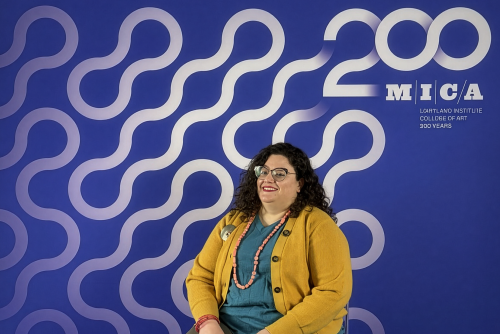
In her History of Modern Design class, Victoria “Vicky” Pass, PhD, doesn’t just talk about chairs or teapots. She asks students to trace the materials back to teak forests or ivory markets, to colonial trade routes and industrial revolutions. “Nothing is ever entirely new,” she tells them. “History doesn’t repeat, but it rhymes.” For Pass—fashion historian, design scholar, and now chair of MICA’s History of Art, Design, and Visual Culture department—this insistence on context is more than academic. It’s what makes MICA’s classrooms distinctive: alive with dialogue between the past and the present, powered by students whose curiosity keeps history fresh.
Journey to MICA
Pass’s MICA journey began at a moment of uncertainty. Freshly graduated from the University of Rochester with a PhD in Visual and Cultural Studies, she returned to her hometown of Baltimore during a tough academic job market. A colleague invited her to teach part-time at MICA.
“I ended up moving back in with my parents,” she recalls. “I tell my students that an illustrious career can start that way.”
Those first classes lit something in her. She found herself energized by students who weren’t like others she’d taught. “The MICA students were really different,” she says. “Their curiosity and commitment stood out.” After two years part-time, she left for her first full-time position, but when a design historian role opened at MICA, she leapt at the chance to return. She’s now taught full-time for eight years and, more recently, taken on the role of department chair.
The MICA Difference
For Pass, what sets MICA apart isn’t just what is taught, but how the students and faculty engage with it. “Students here are incredibly curious, but also incredibly kind and compassionate,” she says. In critiques, she sees them rooting for each other, not competing. “If my friend shines, I shine too, that’s how they think about it.”
That collaborative spirit makes teaching design history more than a lecture series; it becomes a dialogue between generations. Students bring what’s current into the room, she brings the history, and together they find the connections. “Even if I’m teaching similar material, it’s always fresh, because they’re looking at it from a different perspective,” she explains.
She also values how MICA welcomes unconventional scholarship. Pass shares much of her research on social media, where thousands follow her insights on fashion history. “At other institutions, that might be dismissed as fluff,” she says. “But here, it’s valued. MICA recognizes that scholarship can take many forms.”
Practice & Impact
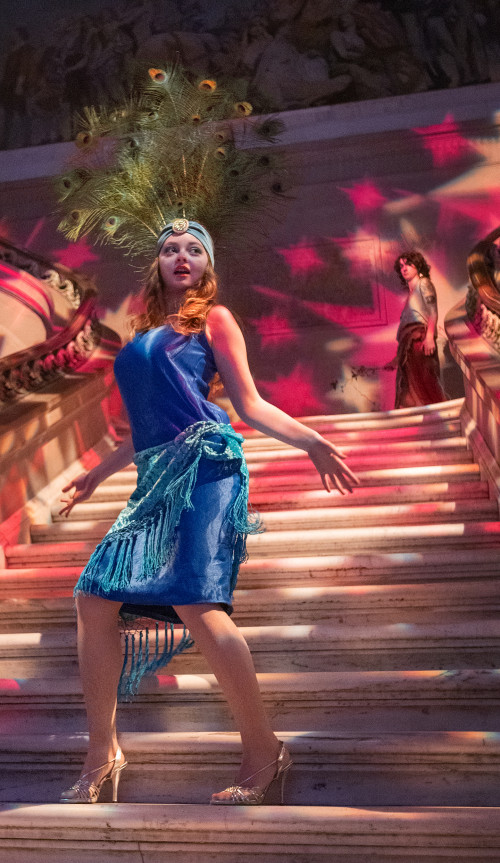
Pass’s research focuses on the intersections of race, gender, and fashion—especially how whiteness and white femininity have been constructed through clothing and style. She examines recurring patterns of cultural appropriation, asking not only what happened but why. “It’s one thing to point out that something is racist or problematic,” she says. “But I want to know: Why was this a trend in the 1920s or 1930s? What was happening in the culture that made people express themselves that way?”
Her work filters directly into the classroom. In History of Modern Design, she begins with the Industrial Revolution—rooted, she insists, in slavery and colonization. “You can’t get around that,” she explains. At first, not all students are comfortable. She remembers one student telling her, “I didn’t sign up for a class on race—I thought this was design history.” After a long conversation, he gave the class a chance. By the final week, he admitted, “You were right. This changed how I think.”
Moments like that affirm her approach. “The world of design isn’t separate from politics or economics,” she says. “It’s shaped by them.” By teaching students to see those connections, she hopes they carry both critical perspective and resilience into their own creative practices.
Looking Forward
As MICA celebrates its 200th anniversary, Pass sees continuity between the school’s origins and its future. “In 1826, Baltimore was a bustling port city in the Industrial Revolution,” she notes. “This institution was founded to give people tools to thrive in a changing world. That’s still the challenge today.”
She hopes her students, decades from now, remember MICA as the place that taught them not just content, but how to learn. “Careers will change in ways we can’t predict,” she says. “But if you know how to research, how to ask questions, how to hold tight to your values—you’re prepared.”
For Pass, the institution’s endurance rests not in its buildings but in its people. “We’re the stewards of this place,” she says. “The faculty, staff, and students—we are MICA. What sustained this community for 200 years is what will sustain it for the next 200.”