On this day in 1848, the overwhelming response to the Maryland Institute’s opening exhibitions made one thing clear: Baltimore was ready for something bigger.
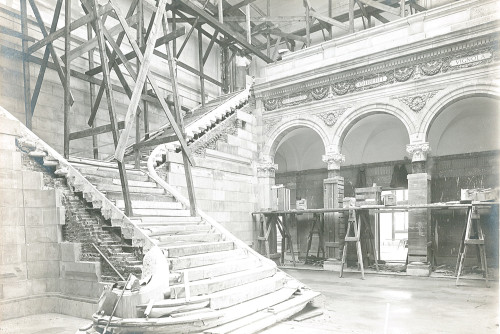
Just a few blocks north of the harbor, above the city’s oldest public market on Baltimore Street, once known as the “Broadway of the Monumental City,” a bold vision began to rise. Designed in the Italianate style and stretching an entire city block, the new Center Market building would feature a soaring Great Hall 250 feet long, 55 feet wide, and 32½ feet high, at the time, the largest clear floor in America. It could hold 6,000 people for lectures, exhibitions, machinery displays, and celebrations of innovation.
The site posed challenges. Marshland near the Jones Falls required 650 steel pilings to secure the foundation. But confidence matched ambition. Modeled after Boston’s Faneuil Hall, the structure symbolized civic pride: classrooms, library, reading rooms, offices, and a bustling market below.
When the cornerstone was laid on March 13, 1851, up to 10,000 people filled Baltimore Street. Spectators crowded windows and rooftops. A band played. City leaders gathered. A time capsule, filled with documents, coins, newspapers, and artifacts of the era, was sealed inside the stone.
A newspaper declared it one of the most orderly and successful public ceremonies the city had ever witnessed.
Though the Great Fire of 1904 destroyed the Center Market building, the cornerstone survived — its contents intact — and was later placed in the Institute’s new home on Mount Royal Avenue.
From the beginning, this was more than a building. It was a declaration of belief in education, industry, creativity, and the future of Baltimore.