In a painting by Shinique Smith, color moves like breath. Fabric folds into a gesture. Paper, ink, and acrylic collide and settle into a kind of visual rhythm that feels both exuberant and deeply considered. Her work, whether painting, sculpture, installation, or performance, does not announce itself with a single message; instead, it invites attention, patience, and empathy. It asks viewers to look closely, to sense the histories embedded in materials, and to recognize the quiet power of care.
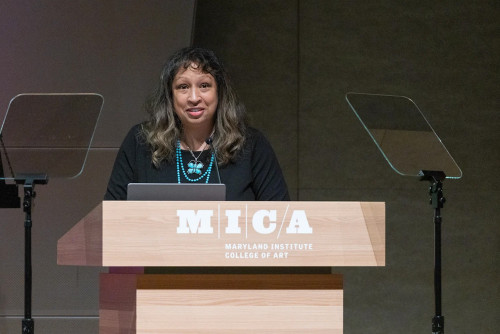
Smith ’92, ’03 (General Fine Arts, BFA; Mount Royal School of Art, MFA) has spent more than two decades expanding the possibilities of contemporary abstraction. Born in Baltimore and now based in Los Angeles, she is widely recognized for transforming everyday materials — clothing, textiles, paper, personal belongings — into works that merge the personal with the universal. Her art has been exhibited at institutions including the Los Angeles County Museum of Art, the Whitney Museum of American Art, the Museum of Fine Arts, Boston, the Guggenheim Museum, and the Brooklyn Museum, and she has completed major public commissions for transit systems, universities, and civic spaces across the country.
Yet Smith’s work resists grand declarations. “Each piece starts with touch,” she explains. “A reverent attention to the histories these materials carry.” That attentiveness to objects, to people, to place has been central to her practice since childhood.
Finding the Arts Early
Smith was introduced to the arts almost as soon as she could walk. Raised by a mother who was deeply invested in fashion, art, and culture, she began studying ballet at age four and attended summer camps that blended theater and visual arts. “My first contact with art was ballet,” she recalls. “Movement, discipline, expression, it all mattered.”
Growing up in Baltimore, Smith absorbed inspiration from both formal education and the city itself. Living in Edmondson Village, she was captivated by large-scale murals along Edmondson Avenue, one depicting two men playing chess, another showing a man planting a tree. “Seeing those murals regularly was inspiring,” she says. “They stayed with me.”
Equally formative were moments spent making art with her mother in Baltimore’s parks and arboretums, coloring and observing nature. These early experiences laid the groundwork for a practice that would later bring together movement, materiality, and environment.
Smith’s artistic education deepened at the Baltimore School for the Arts, where she received rigorous training and encouragement. She also began taking summer courses at MICA while still in high school, enrolling in the college’s portfolio preparation program between ninth and tenth grade. “That was influential,” she says. “I was working alongside students about to enter college.”
Outside the classroom, Smith and her friends explored Baltimore’s graffiti scene, another lasting influence that shaped her relationship to gesture, line, and rhythm. “Those experiences directly influence my work today,” she recalls.
After completing her high school education early at just 16, Smith entered MICA on a scholarship, beginning a relationship with the institution that would shape her creative life for decades.
A Foundation at MICA
Smith’s undergraduate years at MICA were a period of discovery. Enrolled in the General Fine Arts program, she had the freedom to design her own course of study, focusing heavily on drawing while also engaging with painting, three-dimensional work, and required foundation courses.
“MICA undergrad for me was about finding myself,” she says. “And laying a foundation for the ability to go in different directions.”
Classes in collage and assemblage proved especially influential, as did senior courses that encouraged exploration across materials and ideas. Smith experimented with installation, fabric, and objects, approaches that would later become central to her mature work. “The program gave me room to fail and figure things out with guidance and support,” she recalls.
Critical mentorship played a key role. Faculty advisors helped Smith develop her voice, while courses taught by Leslie King-Hammond offered essential engagement with African American and women’s art history, areas Smith also continued to pursue independently.
That balance of rigor and permission, paired with freedom, remains one of Smith’s defining takeaways from MICA.
Returning with Purpose
After earning her BFA, Smith spent a decade away from Baltimore, working in film production on projects including films by John Waters and Barry Levinson. She later moved to Seattle, where she founded and ran a Black film festival for five years, creating a platform for filmmakers of African descent.
She also pursued teaching, earning a Master of Arts in education from Tufts University and working at the Walters Art Museum. But it was during this period that Smith realized something essential: art needed to be her full-time endeavor.
Encouraged by mentor Jan Stinchcomb, Smith returned to MICA to pursue her MFA in the multidisciplinary Mount Royal School of Art. Under the guidance of Stinchcomb, Dennis Farber, and Timothy App, she began developing a new trajectory in painting and material exploration.
“Mount Royal was truly interdisciplinary,” Smith says. “I began relationships with artists and kindred spirits that continue to have a significant and positive role in my life and in my work.”
That community, which was built through shared inquiry, critique, and support, has remained one of the enduring gifts of her graduate experience.
Materials That Carry Memory
Today, Smith’s work spans painting, sculpture, installation, video, photography, and performance. She is inspired by the environments she inhabits and the objects that circulate through her daily life. Having lived primarily in cities before relocating to a more rural setting, Smith draws from both urban and natural landscapes.
“Household objects, past experiences, the human environment, and the spaces we inhabit are part of what inspires me,” she explains. Clothing, fabric, toys, paper, flattened cans, jewelry, stickers, and posters, collected from everywhere she goes, become the building blocks of her compositions.
While her work is not strictly narrative, each piece carries its own story through material choices and arrangement. “There may be a story of me in each of my pieces,” Smith says. “They are so much my hands and thought process.”
Underlying this process is a belief in connection—a “romantic notion,” as she describes it, that people are linked through the objects they touch, discard, and cherish.
Art, Justice, and Education
Smith believes deeply in the role of art as a bridge to empathy, understanding, and voice. While justice requires systemic change, she sees art as a powerful means of distilling complex realities and encouraging deeper reflection. “The best art doesn’t preach the truth,” she says. “It encourages viewers to discover what truth is on their own.”
Her commitment to education and community engagement is evident in her public projects, including murals and collaborative programs that bring artists, poets, and young people together to explore issues of race, citizenship, and truth through creative expression.
“Within education, art is essential,” Smith says. “It can bring people, politics, and poetics together.”
Defining Success
For Smith, success is not measured solely by exhibitions or accolades, though she has received many, including awards from the Louis Comfort Tiffany Foundation, the Joan Mitchell Foundation, and the American Academy of Arts and Letters. Instead, she believes, success is rooted in contribution, continuity, and care.
Smith continues to maintain a close relationship with MICA, serving as a board member and advocate for the institution’s evolving role within Baltimore and the broader arts ecosystem. “There’s so much potential to be a positive contributor to the city,” she says.
Smith is also clear-eyed about the value of art education. While one does not need to attend art school to be an artist, she emphasizes the importance of community, mentorship, and shared history.
“You go forth into the world with a group of people who know where you started,” she says. “That support lasts.”
A Living Practice
Across her career, Smith has built a practice grounded in attention to material, to movement, to people, and to possibility. Her work holds space for joy and resilience, for memory and transformation. It reminds us that abstraction can be intimate, that care can be radical, and that the everyday, when held with intention, can become something luminous.
In Smith’s hands, art is not only an object or an experience. It is a way of listening.