First-Generation Journeys
At MICA, first-generation college students have long brought their unique experiences, determination, and creativity to our community.
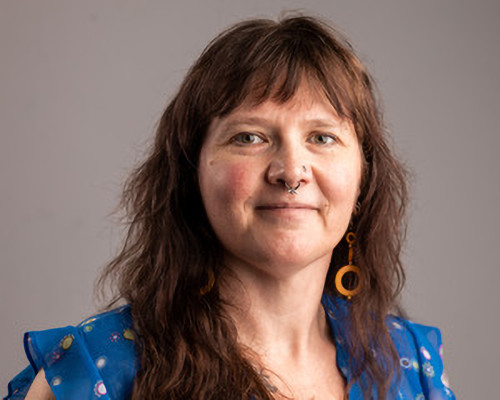
Yumi Hogan ’08 (Painting BFA); Former First Lady of Maryland; Adjunct professor, MICA Drawing program; Honorary Doctor of Fine Arts
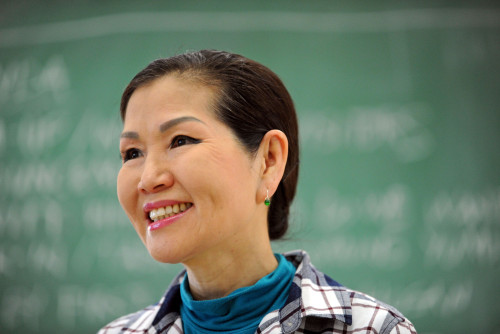
The persistence that defines Yumi Hogan’s artwork began long before paint or paper, on winter mornings in rural South Korea, where a two-mile walk to school became an early lesson in endurance.
The youngest of eight children, Hogan developed an insistence and perseverance that decades later live in her work: layered Sumi ink on resilient Hanji paper, landscapes that feel both intimate and boundless, like memory itself.
This tenacity also lives in the story she carries into MICA’s bicentennial year: an artist who came to Baltimore with an immigrant’s hunger for possibility, returned to school later in life as a single mother, taught in MICA’s Drawing program for more than a decade, and used her public platform as Maryland’s First Lady to advocate for healing through the arts. Her biography is a bridge between past and present, Korea and Maryland, private grief and public service, craft and community.
Hogan entered MICA not as a conventional undergraduate rushing toward a first career, but as a mother who had already spent years building a life out of necessity. When the responsibilities of raising her family began to ease, she returned to school later than most, but with no less resolve, earning her BFA in Painting in 2008.
There’s a particular courage in stepping into a studio classroom with a life that resists easy summary. Hogan brought a world to MICA: rural schooling, the dislocation of immigration, and the lived education of survival. Art was not a luxury for her; it was a language.
After graduation, she stayed in Baltimore and became an adjunct professor in MICA’s Drawing program, teaching for more than ten years. In time, MICA would also honor her with an Honorary Doctor of Fine Arts, a recognition that, for Hogan, signaled something more expansive than personal achievement. It marked belonging across roles: student, teacher, collaborator, honoree.
When Hogan speaks about what sets MICA apart, she doesn’t reach for prestige. She reaches for a relationship.
“MICA is always in my heart,” she says, before turning outward. “What makes MICA special is its relationship with the community—helping the city, working with people. Art doesn’t exist alone.”
That ethos mirrors her work. Hogan’s paintings are not declarations but invitations: meditative, patient, attentive to the overlooked. Even her materials reflect this philosophy: Hanji paper, strong yet receptive; Sumi ink, fluid and deliberate; layers that build slowly, like time passing on a surface.
In graduate school, when oil paint no longer made sense, she adapted. Ink and mixed media shifted from necessity to signature. Today, viewers describe her work as quietly luminous and prayer-like, qualities Hogan traces not to style, but to memory and the resilience of making.
Hogan’s path widened in ways few artists can anticipate. In 2015, she became First Lady of Maryland. The role carried expectations, visibility, ceremonial duties, and endless handshakes. Hogan, the painter, chose a different kind of public life. “I always focused on community, not politics,” she says. “Everywhere I go, I listen to people and work with them.”
When her husband was diagnosed with cancer that same year, her public platform and private life collided. She spent long hours in hospitals, meeting children undergoing treatment. “It broke my heart,” she says. What followed was not a press release, but a program: “You & Me,” a creative recovery initiative for pediatric cancer patients. She brought art-making into hospital spaces so children could paint, build, and imagine, so they could forget they were patients and remember they were kids.
Here is where Hogan’s MICA story becomes a case study in MICA’s long-standing insistence that art is not separate from civic life. MICA shaped Hogan’s belief that creativity belongs wherever people are in studios, but also in hospitals, farms, museums, and community rooms. In moments of fear and fatigue, art becomes an alternative kind of oxygen.
That same belief fueled her work with natural dyes and indigo, an initiative rooted in her childhood and realized through collaboration. Indigo, for Hogan, is not simply a color. It is a memory of hands stained blue; a lineage of women — mother, grandmother — turning plant knowledge into fabric and meaning. “Indigo was everywhere in my childhood,” she says. “Later in life, I started thinking back to those memories.”
Out of that return came the MICA Indigo Project and the broader Baltimore Natural Dye Initiative, a partnership that joins artists, students, farmers, and community partners in cultivating dye plants and learning the complex histories natural dyes carry. Hogan invited expertise to Baltimore, worked with MICA’s Fiber department, and helped seed a community-based project that extended beyond the classroom: planting, harvesting, cutting branches, working through seasons, and — even more challenging — through the pandemic.
The gesture matters. MICA could have treated indigo as a technique. Hogan helped frame it as a connector: between cultures and generations, between land and learning, between Baltimore and Korea. It was art education as an ecosystem.
Hogan carries a bicentennial truth that feels especially relevant now: MICA’s legacy is not only in what it has produced, but in what it has made possible, across ages, across cultures, across roles. A school like MICA does not just train artists; it authorizes reinvention. It makes room for students who arrive with full lives behind them and still dare to become new.
That is the story Hogan embodies: a child walking miles to school; an immigrant learning how to belong; a single mother choosing her own education; an alumna returning as faculty; a First Lady using art to heal; a collaborator bringing indigo from memory into community practice. Her paintings, with their “no beginning, no end,” mirror the institution she loves, an unfolding story of continuous time.

Join the festivities as MICA honors its 200-year history, recognizes its present success, and looks forward to a bright future. Throughout 2026, the College will be sharing community stories and announcing one-of-a-kind events on campus, in Baltimore, and beyond.