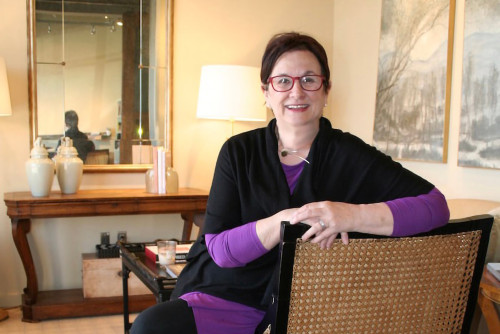
By the age of twelve, Suzanne Levin-Lapides knew she wanted to be an interior designer, a bold dream for a young girl in the 1950s. “There weren’t many opportunities for women in architecture,” she says. “Most worked as illustrators, but I saw my path early.” That clarity led her to MICA, where she found not just her place, but her people.
Born and raised in Baltimore, Levin-Lapides grew up in a family that valued perseverance more than pedigree. Her mother fled Denmark as a refugee in 1939; her father’s family had deep roots in East Baltimore. Neither had gone to college, but both encouraged curiosity and hard work. “I was the loudest kid in the family,” she laughs. “I knew what I wanted early, and my parents—who never went to college—encouraged me anyway, even though they didn’t understand art school.”
From her first semester, MICA felt electric. The studios buzzed with energy and conversation; critique sessions stretched long into the night. “I belonged here,” she simply says. “It was beautiful.” She also learned that education wasn’t just about mastering technique; it was about discovery through dialogue. “MICA combines critique with care,” she explains. “You’re challenged but supported. Faculty might ask, ‘Have you tried this?’ or suggest that maybe your medium isn’t quite right yet. That kind of mentorship changes everything.”
Her professors became touchstones for her growth. They modeled what it meant to be both rigorous and kind, passionate yet humble, qualities that stayed with her. Those lessons in respect, listening, and collaboration became central to her approach as a designer. For Levin-Lapides, the difference at MICA wasn’t just what she learned; it was how she learned. Every critique and every conversation invited her to think bigger and trust her instincts. The community she found there—fueled by care, curiosity, and courage—became a lifelong model for how her creative work should feel.
Art, Resilience, and Community
After earning her degree, MICA invited Levin-Lapides to teach sketching and interior illustration in pencil and marker, skills she still practices today. For thirteen years, she taught in MICA’s Continuing Education program, often to overflowing classes. “It was wonderful chaos,” she says. “MICA trusted me to build community within the classroom.”
Then, in 1977, tragedy struck. The Beethoven Building, where she and her family lived, caught fire. “We lost everything,” she recalls quietly. “My children were pulled from the fire by a local police officer. Someone else didn’t make it out. It was the day after Valentine’s Day. I’ll never forget.”
What she remembers most, though, is how the MICA community responded. “Faculty, students—everyone pulled together. People I didn’t even think liked us were suddenly extraordinary. That’s when you realize what it means to belong to this community.”
Paying It Back
That sense of shared humanity became central to her life. For 26 years, she served on the board of the League for People with Disabilities, helping organize exhibitions that celebrated artists of all abilities. She’s also a longtime member of Women Embracing Abilities Now (WEAN), a group of women who have acquired disabilities and continue to create and advocate.
Through MICA Match, she mentors young artists from around the world and also supports young Hispanic women preparing for college and careers. Her service on MICA’s Board of Trustees rekindled the sense of purpose she first found in the studio. Her commitment to giving back extends beyond campus through the Baltimore Women’s Giving Circle and the Jewish Women’s Giving Foundation.
Through these experiences, Levin-Lapides’s understanding of design grew far beyond aesthetics. “Design is about life,” she says. “It’s about freedom and empathy, about creating spaces where people can thrive.”
She sees that same creative courage—the willingness to take risks, to care deeply, to listen—alive in MICA students today, and as the College enters its third century, she hopes that the spirit of shared purpose continues to guide it forward.
“What I hope future generations carry forward is simple: follow your passion. Stay true to your creative soul. Keep learning, listening, and connecting.” She pauses, then adds a line that seems to capture both her own journey and MICA’s enduring ethos: “MICA taught me that art isn’t just what we make; it’s how we live.”