Hooked from the Start
“I came for my interview thinking, teaching anthropology to art students — that could be fun. By the end of the day, I was hooked.”
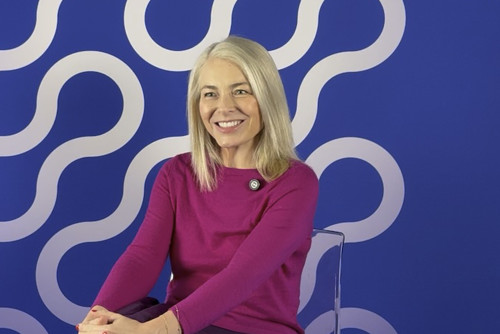
That moment in 2015 marked the start of Ruth Toulson’s (PhD, Studio and Humanistic Studies) MICA story. She had taught at Ivy League universities, liberal arts colleges, and sprawling land-grant schools, but nothing felt quite like MICA. What she encountered here — students eager to grapple with big ideas, unafraid to fail, and always ready to translate thought into form — convinced her that this was the place to do her life’s work.
Ten years later, she remains committed to the institution she describes as “the smart art school,” a place where studio practice and liberal arts don’t just sit side by side but actively reshape one another.
Finding MICA
Toulson’s journey began far from Baltimore. After earning her doctorate at Cambridge and conducting years of fieldwork in Southeast Asia and mainland China, she pursued teaching roles across the United States. She explored questions of death and mourning, of how societies reckon with loss, and how the material body becomes the focus of ritual and politics.
Then came the MICA job posting. Teaching anthropology at an art school wasn’t an obvious path, but it felt like an irresistible one. “I’d been at so many institutions where students were fixated on grades or credentials. Here, I saw a community that treated learning as a form of making. That difference was powerful.”
MICA Magic
For Toulson, the difference crystallizes in the classroom. In “The Corpse Class,” students confront the materiality of the dead body, probing what it means to live, die, and remember. In “Very Bad Things,” they examine contested museum collections, asking what power objects carry and what histories they conceal.
“I’ve been able to design courses that track directly with my research, but the magic happens in what students do with the material,” she explains. “They turn readings into graphic novels, translate theory into senior theses, and ask questions that push my own scholarship further.”
MICA students, she insists, approach academic work with the same creative intensity as studio projects. “They aren’t afraid to try things out, to fail, to be inventive. They treat writing an essay the way they treat learning to throw a pot — curious, experimental, and fearless.”
Students and Scholarship
Toulson believes that uniqueness has rippled outward in extraordinary ways. She has mentored students who went on to Oxford’s Visual, Material, and Museum Anthropology program, to the Winterthur Program in American Material Culture, and to curatorial positions at the Smithsonian.
She recalls one student, who wove together questions of gender and reproduction in China with her own printmaking practice. “It was a perfect integration of liberal arts and studio work, and it reminded me why MICA is so singular,” Toulson says.
Another student, fascinated by textiles, used behind-the-scenes access at the Smithsonian to study an Inuit waterproof jacket made of seal gut. Linking anthropology, design, and fabric technology, the project became a vivid example of how MICA’s location and ethos enable students to bridge worlds.
These projects echo what inspires Toulson most: MICA students take anthropology’s central questions — What does death mean? How is power shaped? What futures can we imagine? — and channel them into art and design.
Beyond the Studio
When asked why anthropology matters at an art school, Toulson points to the hunger students show for intellectual depth. “People assume I teach the anthropology of art, but that’s not it. I teach what I research — death, power, politics, culture — and students want that space to think. They want to ask: ‘Why is the world the way it is? ’ ‘What does the afterlife mean? ’ ‘What can communities shape?’”
Her collaboration with the Social Design program adds another layer. “Anthropologists are about asking better questions. We don’t prescribe answers. Social Design students, on the other hand, are focused on working with communities to change things. Seeing how they connect the two is inspiring. It stretches my own understanding of applied work.”
A 200-Year History
In her administrative role as Assistant Dean for Research, Toulson has been immersed in MICA’s Bicentennial planning. What she has found in the archives only deepens her conviction that MICA is unlike any other school.
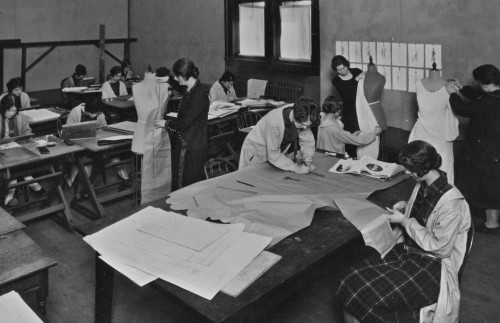
“The history of MICA is, in many ways, the history of the nation,” she reflects. “From its beginnings, it wasn’t just a fine art academy. It trained students in practical skills — mechanics, applied arts, ways to build careers. That blend of vision and pragmatism has always defined [MICA].”
She sees the same balance in her students today. Some know from the start they want to be painters or animators. Others plan to be designers or entrepreneurs. Still others discover paths they never imagined. “That range has always been part of who we are,” she says.
Designing Futures Not Yet Imagined
As MICA enters its third century, Toulson is excited by programs like Design and Innovation, which prepare students for futures that don’t yet exist. “There’s a lot of anxiety about AI and technology reshaping art and design. But MICA has always been visionary. We’re preparing students not just for today’s careers, but for jobs, economies, and creative worlds that haven’t been invented yet.”
She believes the key is MICA’s dual commitment: rigorous studio practice and liberal arts education as strong as any elite university. “Every semester, students take as many liberal arts classes as studio ones. That balance means they graduate not only as skilled artists but as deep thinkers, excellent writers, and imaginative innovators.”
Why MICA Is Like No Other
For Toulson, the defining moments of her career at MICA often arrive at senior thesis presentations, where students integrate research, writing, and studio practice. “Every year, I’m astonished. They take anthropology’s hardest questions and turn them into something visually brilliant. That’s MICA: fearless exploration, intellectual rigor, and creative synthesis.”
Her journey — from Cambridge to Baltimore, from anthropological fieldwork to classrooms filled with artists — underscores a truth she sees repeated across generations: MICA is different because it dares to ask better questions and empowers its students to shape answers in ways no one else can.
“MICA is the smart art school,” she says. “But more than that, it’s a place where students imagine new worlds — and then start building them.”