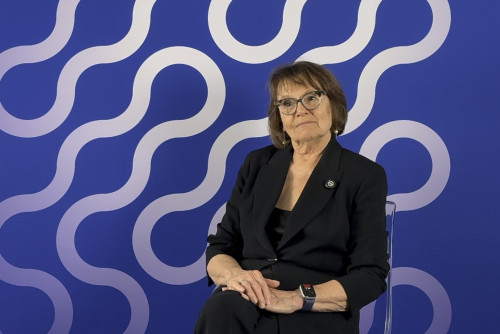
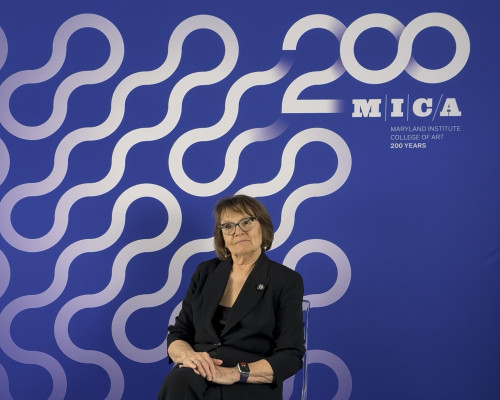
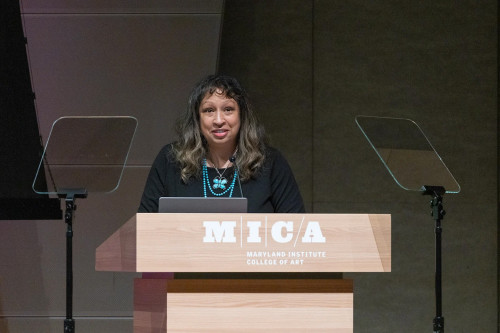
When Karen Carroll reflects on her three decades teaching in MICA’s Department of Art Education, one metaphor rises above all others: family.
“We had people who really were very caring, supportive,” she recalls. “When anybody needed help, they were never looked down upon. They were always given the support needed by colleagues. And the same is transferred down to students. They felt like a family as well.”
That sense of shared care and belonging—woven with humor, hard work, and joy—became the hallmark of Carroll’s tenure. For her students, many of whom affectionately call her “Art Mama,” that spirit of mentorship continues to ripple outward into classrooms, communities, and creative spaces across the country.
The Right Time
Carroll joined MICA in 1987, fresh from completing her doctorate at Teachers College, Columbia University. She was recruited by Dr. Ellen Hurwitz, a world-renowned art educator coaxed out of retirement to breathe new life into MICA’s art education program, and by then-President Fred Lazarus, whose vision for teacher preparation aligned with Carroll’s own.
“It was the right time to be at MICA,” Carroll says. “We could build new programs, negotiate for the kinds of changes we needed, invent programs no one else had. There was so much support.”
At the time, art education nationally was struggling. Jobs were scarce, enrollment lagged, and programs were shrinking. But Carroll saw in MICA a place eager to experiment, an environment willing to listen to students and reimagine what art education could be.
Listening and Inventing
Carroll was first drawn to MICA’s culture of care, a spirit that made the campus feel like family. What kept her there was the way that care fueled fearless reinvention. She helped launch a program that declared educators must be artists first, a bold vision that rippled far beyond MICA’s walls and confirmed she had joined a community unafraid to dream big.
That daring spirit reshaped what it meant to prepare teachers. Unlike the rigid systems she’d known in public schools and state agencies, MICA led with innovation.
“We had a long history in Maryland and beyond,” Carroll recalls. “Our graduates were already supervisors and faculty members. We had strong ties with the state advisory committee. It was unusual; many states didn’t have that kind of unified force.”
Most distinctive of all was MICA’s insistence that teachers remain artists. At other schools, education training is often sidelined in favor of studio work. At MICA, the studio came first. When undergraduates protested losing their studio practice to meet teacher-training requirements, Carroll and her colleagues pioneered a five-year path: students could complete a BFA in their major, take education coursework, and graduate with an MAT. “It was unusual. We were the first. And it made a difference; our alumni felt like artists, teachers, and researchers,” she says.
From Classrooms to Communities
The impact of that model is visible across Baltimore and far beyond. Carroll points to the Baltimore Design School (BDS), where nearly every art teacher is a MICA MAT graduate, as a striking example. The partnership between MICA and BDS runs deep. MICA served as the fiscal agent that launched the school, supplied student teachers, and created programs like Saturday classes and summer residencies that opened pathways for BDS students to continue their education. Carroll continues to see this relationship as one of the clearest demonstrations of MICA’s difference in action.
Her own scholarship flourished in this environment of innovation. She co-authored Creating Meaning Through Art, secured federal funding to study how young children connect reading, writing, and drawing, and documented over a century of MICA’s art education history.
But perhaps her most enduring impact has been through mentorship. At national conferences, the nickname Art Mama trails her. Former students now serve as deans, supervisors, faculty, and even interim provosts.
Humble Days, Visionary Leaps
Carroll marvels at how the college has evolved since her first days. “When I arrived, my assistant had a typewriter. To make copies, faculty lined up in the basement of the Main Building and gossiped while waiting for the machine.”
From those humble days, Carroll witnessed the launch of trailblazing programs: the first low-residency MFA for working teachers, an MA in Art Education focused on research, and the MFA in Community Arts that seeded organizations across Baltimore. Each program was created not by following trends, but by identifying needs and responding with innovation.
Thirty years on, the “Art Mama” of MICA looks at her alumni, her programs, and the generations still to come and sees the essence of what the Bicentennial celebrates: a school that is singular, inventive, rooted, and profoundly human.