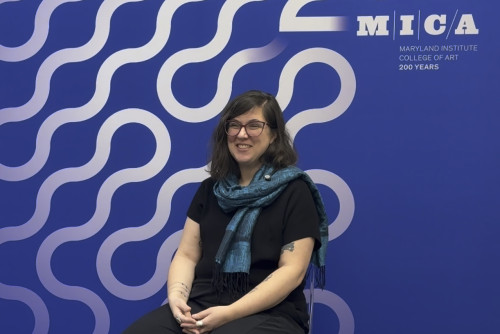
Sarah McCann likes to say she grew up in nonprofits. It’s half a joke, half a biography. Raised on Long Island, she watched her parents devote their working lives to a group home for adults with developmental disabilities, an early education in service, advocacy, and the steady, often unseen labor that holds communities together. Years later, that formative experience still shapes how she moves through the world: with an artist’s sensitivity to language and meaning, and a nonprofit leader’s commitment to equity, access, and sustainable systems.
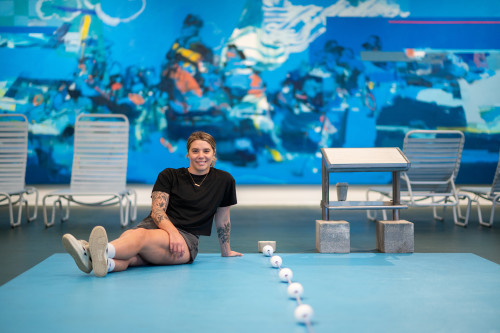
Now based in Baltimore, McCann is a curator, community artist, educator, and consultant whose practice lives at the intersection of creative inquiry and civic connection. She works in text-based mosaics, printmaking, and multimedia, forms that invite reading as much as seeing. Her work has been exhibited nationally, with her first solo exhibition held at Jubilee Arts in 2018. In 2025, the Enoch Pratt Free Library’s Light Street Branch hosted her most recent solo exhibition, Portals, Pathways, and Potentials—a milestone that arrived, characteristically, through relationship, coincidence, and a well-timed nudge.
McCann had facilitated mosaic workshops with library staff and patrons, building trust and shared experience long before the exhibition was proposed. Then one day a librarian asked a simple question: “What if we showed your work?”
Serendipity #1
At the time, McCann’s administrative responsibilities were demanding, and her studio hours had contracted under the weight of leadership. The invitation was a gift, but also a gentle challenge. “That opportunity gave me the push,” she recalls. She had recently traveled to the Southwest, and the landscape became a new visual language in her practice. The resulting show gathered her evolving imagery — transitional thresholds, doorways, and new terrain — into a body of work that felt both reflective and forward-looking. A library talk brought her into conversation with patrons whose questions were thoughtful and engaged, reminding her of what happens when art is placed in spaces meant for the public good: it becomes an invitation rather than a performance.
That belief has guided McCann since her earliest experiments with community-based practice. Before Baltimore became home, she earned a B.S. in Studio Arts, building a traditional studio foundation while also volunteering and working in nonprofit environments. Yet those worlds felt separate: art on one side, service on the other. She began searching for graduate programs that could bridge the divide.
Serendipity #2
Finding MICA was a chain of serendipity that reads like a story meant to be retold. A link on another program’s website led her to explore MICA. Discounted tickets from New York to Baltimore appeared at the right moment. She flew down on a hunch, stayed with her sister’s friend, and ended up meeting the director MICA’s Community Arts program over lunch. While she was visiting, the AmeriCorps director associated with the program ran into her at a coffee shop. A student overheard the conversation and invited McCann to attend a workshop on the spot. She went. Something clicked.
In fact, she purchased her visit ticket before she even knew whether she’d been accepted. She was, and she stayed, first completing the MBA program, a 13½-month model that paired graduate study with off-site nonprofit work, and later returning for the MFA in Community Arts. The throughline was clear: McCann wasn’t trying to choose between art and service. She was building a life where they could strengthen each other.
Since 2010, McCann has curated and organized exhibitions and related programming from conception to completion, with a methodology rooted in collaboration and thematic inquiry. Rather than dictating a concept and inviting artists to fit into it, she often begins with a question, one that opens a door and invites artists to respond in their own language. Her first exhibition began with a prompt: What would you declare war on? McCann and her co-curator put out the call before they even secured a space, and artists began describing what they wanted to make. The show took shape through collective momentum.
The question becomes the catalyst; the artists’ ideas become the engine. McCann’s role is to listen, hold the vision, and build the conditions for the work to exist, finding a venue, shaping the public experience, and creating opportunities for audiences to engage not only with finished pieces, but with the inquiry beneath them.
Serendipity #3
Her projects frequently include youth artists and community components, and her partnerships span a wide range of Baltimore organizations. Across these collaborations, she returns to a consistent commitment: creating space for voices, especially young voices, whose perspective is not yet constrained by the assumptions adults often carry.
McCann loves the way young artists see possibility, how they can glimpse not only what is, but what could be. She talks about young people’s moral clarity as something precious, and as something communities need if they hope to change.
Serendipity #4
That sense of care was at the center of How We Are Healing, a recent exhibition curated in partnership with the Keswick Wise & Well Center. Developed during the pandemic, the show invited artists to respond to collective trauma, grief, and isolation through work that emphasized connection. McCann remembers one artist’s “grief vessels,” small ceramic forms meant to hold tears. Another artist created fabric pieces based on drawings of her brothers. The works weren’t simply responses to COVID-era conditions; they were acts of processing and remembrance.
What stayed with McCann was not only the art, but the partnership model itself. Presenting work in a health center required protocols and structure, systems for safety that came from medical expertise rather than art-world improvisation. For McCann, the collaboration was powerful precisely because it merged skill sets: the health center opened its space to artists and ideas it didn’t typically host, and McCann brought art into an environment grounded in wellness and public care. The result was more than an exhibition; it was a shared framework for healing.
Serendipity #5
If McCann’s curatorial work builds containers for collective reflection, her professional life in nonprofit leadership builds the scaffolding that makes those containers possible. Over time, she discovered fundraising not as a separate administrative burden, but as a creative and strategic discipline. After grad school, she taught extensively in after-school settings, drawn to the ways young people can imagine beyond present limitations. Later, she stepped into a maternity-leave role in development work at Baltimore Clayworks and found she genuinely enjoyed it.
Serendipity #6
Leadership came next: a shift from doing everything herself to creating space for others. McCann describes her career as a cycle through different layers of work, each one deepening her understanding of what communities need to thrive. Today, she applies that experience as Director of Partnerships at Fusion Partnerships and as an organizational consultant, helping artists and arts organizations increase visibility, strengthen networks, and pursue financial sustainability and equity.
If there is a place that embodies this collaborative spirit for McCann, it is Baltimore. She calls it “a place for the arts with a supportive community,” where telling enough people what you want to do often leads to a connection, a space, or a partner. Many of her projects, she says, have happened because she kept talking about them and someone responded with possibility.
She now works in the Highlandtown Arts District, which she describes as a microcosm of Baltimore’s creative ecosystem. First Friday art walks spill beyond gallery doors into businesses and streets; participation is communal. It’s a place where art is not held apart from daily life but woven into it.
Serendipity #7
She speaks with particular gratitude about the mentors who shaped her trajectory. The faculty, she remembers, didn’t just support students’ ideas; they challenged students to think bigger, to trust their capacity, and to make work that matched the scale of their values.
In many ways, that’s the story of Sarah McCann’s practice: building portals between worlds that are too often separated. Her materials may be text, tile, ink, and image, but her deeper medium is connection. She creates spaces where people can gather and see themselves more clearly—where communities can ask questions that matter, and where artists can feel supported not only to make, but to endure.
“I’m just grateful,” she says, looking back on the coincidences and choices that led her here. “It’s been a series of serendipitous moments, but also a willingness to follow them.”