In Baltimore, there’s a glass building that seems to lean forward, listening. The Brown Center’s prismatic planes catch the city’s light and mirror the ornate stone of MICA’s Main Building across Mount Royal Avenue. Between the two, a conversation has been going on for twenty years about tradition and modernity, precision and risk, discipline and play. It’s a conversation that architects Steve Ziger and Jamie Snead have been having with MICA since the day they first sketched the building that would become a campus icon and a civic signal: creativity lives here.
A Serendipitous Encounter
Their MICA story begins the way many Baltimore stories do, with a chance encounter and a willingness to say yes. In 1985, not long after launching their firm, Snead ran into then-MICA president Fred Lazarus outside a lunch at the Maryland Club. “We’d just started the firm,” Snead recalls, “and I told him we’d be honored to be considered for any upcoming projects.” Lazarus, famous for championing Baltimore’s arts and hiring local talent, smiled and said, “That would be fun.”
Fun quickly turned into trust. Their first major commission moved MICA’s library from the Mount Royal Station to the Bunting Center. The project opened doors — literally and figuratively — and soon the young firm, joined by mentor Charlie Brickbauer, was asked to design something unprecedented: MICA’s first new building in a century.
The brief from Lazarus was characteristically bold. Instead of a list of rooms and requirements, he told them, “Do the best building you can, and we’ll figure out what goes in it.” The only fixed need was a 500-seat auditorium. Everything else was freedom.
Where Ambition Meets Bold
That invitation — design excellence first, program second — reveals something essential about MICA’s DNA. Many institutions start with spreadsheets; MICA starts with ambition. The Brown Center didn’t impose novelty for novelty’s sake. The glass is not a veil but a conversation partner; the form is not a billboard but a sculptural counterpart.
“It was important for MICA to make a statement,” Ziger recalls, “to show that it was a thriving, vital, progressive institution.”
That same spirit shows up in smaller choices. For 1801 Falls Road, where Ziger|Snead linked the building to the Lazarus Center, the team conceived a bridge of light, a sculptural connector turning daily movement into experience. On the roof, when convention suggested hiding mechanical units behind costly screens, they did the opposite: they painted them bright colors. It was honest, cost-neutral, and, like MICA, delighted to turn pragmatism into a creative act.
MICA’s difference, they say, is also in its civic posture. The college didn’t wall itself off from Baltimore; it catalyzed it. With big public shows, open doors, and collaborations, MICA treats the city as a studio and an audience, a client and a collaborator. Students come, many stay, and the creative network thickens: professors on boards, alumni teaching in public schools, architects mentoring the next generation. In this ecosystem, risk isn’t a liability; it’s the method.
Elevating how to connect, learn, belong
The Brown Center went on to earn international recognition, not because it shouted the loudest, but because it was both disciplined and inventive. Working with a limited budget, the team of Ziger|Snead, along with the renowned architect Charles Brickbauer, used standard systems and a minimal palette (their rule of thumb: if you can reduce to three materials, you’re doing it right). Simplicity made the building legible; legibility made it generous. And generosity, in architecture, is a form of ethics: the belief that space should elevate how people connect, learn, and belong.
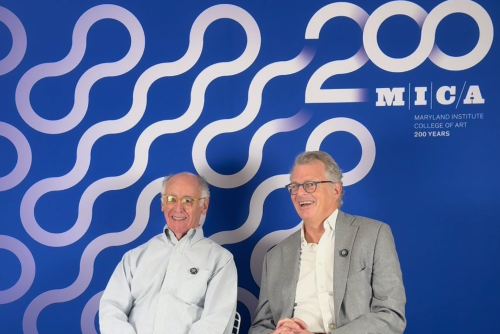
The connection to MICA is personal, too. Ziger and Snead were married on the steps of the Main Building, celebrated with 400 guests in the Brown Center, and, decades later, Ziger’s retirement celebration returned to that same glass vessel. When the places you make become the places where your own life unfolds, you know the work has done its job — turning design into memory.
Mentorship, too, became part of their legacy. When Charlie Brickbauer joined their office after closing his own practice, he brought a rigorous sensibility: let the structure speak, keep materials lean, find elegance in restraint. That knowledge now lives on in Ziger|Snead’s next generation of partners. The lineage of ideas, from teacher to architect to building to student, is part of how a city learns to see.
Writing New Chapters
As MICA marks its 200th anniversary, the Brown Center itself edges toward history. “At some point,” Ziger notes, “it will be considered a historic building.” That feels right for a school that reveres history while continually writing new chapters. The question for the next century isn’t whether MICA will keep building, but how it will keep conversing, between old and new, campus and city, ambition and access.
For Ziger and Snead, MICA remains an incubator for a place where talented people gather, test themselves, and reshape the region’s cultural landscape. Many alumni remain in Baltimore; others move on but keep their ties. Either way, the network radiates outward. The Brown Center’s glass face, angled to catch the city, becomes a metaphor: MICA faces outward to its audiences, its neighborhoods, and to futures its founders could never have imagined.