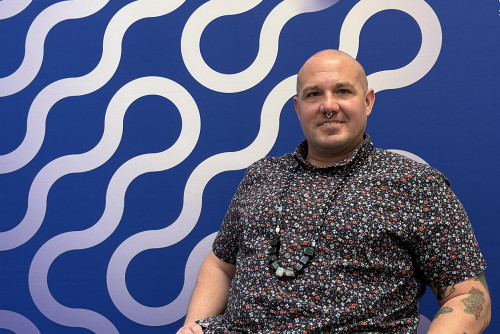
For Christopher Michels, the journey to art school was anything but conventional. At 40, he walks into class alongside students half his age. Some even mistake him for a professor. But Michels is exactly where he wants to be.
After 13 years of service in the United States Marine Corps, a career maintaining heavy helicopters, teaching aviation mechanics, and supporting fellow service members through difficult moments, Michels has embarked on a new mission: reconnecting to art and eventually teaching it.
“When people ask what I do now, I tell them proudly: I’m an art student.”
An Uncertain Start
Michels grew up in Delaware in a family where money was tight, but creativity was always present. His grandmother kept a coffee table stocked with pencils, crayons, markers, and paper, encouraging him to draw whenever he visited. That early exposure planted a quiet but lasting love for art.
Still, college never felt like a realistic option.
Instead, he entered the workforce immediately after high school, taking a job in construction. Starting as a day laborer hauling lumber, he worked his way up to foreman within four years. The work was hard and satisfying, but the housing market crash of 2008 brought the construction industry to a halt. Suddenly, there was no work.
“I remember calling my dad and telling him I might end up sleeping in my truck,” Michels says. “That’s when I realized I needed to do something different.”
On January 21, 2009, he entered Marine Corps boot camp.
Service, Leadership, and Finding Purpose
Michels spent more than a decade in the Marines, serving in several roles that shaped both his skills and his outlook on leadership.
His primary military occupational specialty was an airframes mechanic, working on the Marine Corps’ largest heavy-lift helicopters. Over time, he advanced to become a quality assurance representative, responsible for ensuring that maintenance work was performed safely and correctly. Later, he was selected for a prestigious instructor position at the Center for Naval Aviation Technical Training at Naval Air Station Pensacola.
As an instructor, Michels taught aviation theory, maintenance, repair, and troubleshooting to Marines, sailors, and international service members. Over the course of his assignment, he helped train roughly 3,000 students.
The experience changed him.
“I discovered I really loved teaching,” he says. “It surprised me, because I was not a good student in high school. I never imagined I’d end up being a teacher.”
What he found most rewarding was watching students develop confidence. His dedication earned him the Navy and Marine Corps Commendation Medal at the end of his tour.
But teaching wasn’t the only role that shaped Michels’ sense of service. During one year stationed in Pensacola, he served as the Sergeant at Arms for the funeral detail, helping conduct more than 100 military funerals.
“It was one of the most humbling experiences of my life,” he says. “Seeing families say goodbye to someone who served—it really changes how you see things.”
He also volunteered as a uniformed victim advocate, supporting survivors of sexual assault within the military. These experiences inspired him to pursue a degree in psychology, which he completed through the University of Maryland Global Campus while still serving.
Setting a Course
When Michels left the Marines in 2021, he faced a challenge familiar to many veterans: figuring out what came next. He and his wife moved through several states, from California to Alabama, Mississippi, and Tennessee, searching for a place that felt like home. None of them quite fit.
The turning point came when family members suggested they try living in Maryland. Around the same time, his wife encouraged him to consider art school.
During his years in the Marines, he had created fewer than five pieces of art. Photography, however, had become a portable creative outlet during deployments and travel. His photography portfolio eventually helped him earn a scholarship to MICA. But the moment he decided to enroll came during a student-led tour. The campus atmosphere convinced him.
“Everyone I met — students and staff — was genuinely friendly and supportive,” he says. “I felt like I could be myself here.”
A Veteran-Friendly Campus
For military-connected students like Michels, MICA’s support systems play an important role. The college offers programs approved for GI Bill® education benefits and participates in the Yellow Ribbon Program, helping veterans and eligible dependents cover tuition costs. Students can also receive housing allowances and stipends for books and supplies through federal education benefits.
Equally important is the infrastructure supporting veterans on campus. A dedicated VA-certifying official helps students navigate paperwork and benefits processing, including enrollment certification and required forms. For Michels, those resources, and the campus culture surrounding them, made a difference.
“I’ve never felt judged here for my service,” he says. “When people find out I was in the military, they’re curious and respectful.”
Learning, Creating, and Starting Over
Despite his years of experience, Michels entered MICA determined to approach art with humility. Many of his classmates are teenagers fresh out of high school, but Michels says they quickly made him feel welcome.
“Not one of them made me feel like I didn’t belong,” he says. “I’ve made friendships here I never expected.”
His studies have pushed him to experiment across mediums: spray paint, sculpture, chalk pastels, drawing, and more. Faculty have also encouraged him to expand his thinking. In one class, despite his extensive experience with tools from years in construction and aviation maintenance, Michels told his professor he wanted to focus on something different. The response was exactly what he hoped for: professors challenged him with questions that lingered long after class ended.
“I’d find myself sitting at home later thinking, ‘How do you simulate movement in a stationary object?’” he says. “They really push you to think.”
Looking Ahead
Ultimately, Michels hopes to combine his passions for art and teaching.
The experience he had as a Marine Corps instructor shaped his view of education, and he believes college students are at a particularly important stage of life.
“They’re old enough to form their own ideas,” he says. “But they still have hope and aspirations. They’re still open to being inspired.”
It’s a stage he remembers well, and one he wants to support for future generations.
For now, though, he is simply grateful to be part of the MICA community, especially during a historic moment as the college celebrates its bicentennial.
“I think people sometimes see universities as buildings,” he says. “But what I’ve realized is that MICA is much more than that. It’s a community that extends far beyond campus.”
After years of service, travel, and uncertainty, Michels has finally found a place where everything seems to align.
“Coming here was one of the best decisions I’ve ever made,” he says. “I couldn’t ask for anything better.”