August 28–October 11, 2026
Opening Reception: Thursday, September 10, 5–7 p.m.
Decker Gallery, Fox Building
1303 W Mount Royal Ave. Baltimore MD 21217
ADMISSION: FREE and open to the public
CAMPUS GALLERY HOURS:
Monday–Sunday, 10 a.m.–5 p.m.
BALTIMORE, MD — As a part of its year-long Bicentennial Celebration, The Maryland Institute College of Art (MICA) will bring together–for the first time–the work of 29 women artists who have made lasting connections with the school and its community. Open August 28–October 11, DEVOTED: 20 Years of The McMillan-Stewart Endowed Chair in Painting will feature original artworks with a diverse and intergenerational roster—including science fiction multi-media artist Saya Woolfalk; painter and photographer Jane Dickson, celebrated for her iconic images of 1980s-era Times Square; and nationally renowned portraitist Amy Sherald ’04 (LeRoy E. Hoffberger School of Painting MFA). Presented in MICA’s Decker Gallery, located in the Fox Building, DEVOTED celebrates the open, unstinting exchanges fostered by the chairship. A public reception will take place on Thursday, September 10, from 5–7 p.m.
“By showcasing the creativity of women working at the forefront of art and culture, this exhibition underscores the values of our community at MICA,” explains MICA President Cecilia M. McCormick, JD. “I am grateful for the ongoing partnership with the McMillan-Stewart Foundation in bringing contemporary women artists skilled in traditional painting techniques to our classrooms. The artists spark timely conversations and push disciplinary boundaries—reflecting both MICA’s 200-year history and its bold vision for the future of arts education.”
Established by a 2006 gift from the McMillan-Stewart Foundation, the endowed chairship connects accomplished women artists with undergraduate painting students via weekly critiques, and the larger MICA community through public lectures. Over two decades, this program has nurtured an ever-expanding network of educational exchanges between artists and students—as peers, colleagues, and mentors—that defines the educational experience at MICA.
About the Artists
The show features works by all 29 past McMillan-Stewart Endowed Chairs: Mequitta Ahuja, ruby onyinyechi amanze, Margaret Bowland, Nanette Carter, Zoë Charlton, Dawn Clements (1958–2018), Jennifer Coates, Patricia Cronin, Jane Dickson, Chie Fueki, Judy Glantzman, Kira Nam Greene, Mimi Gross, Phaan Howng’15 (Mount Royal School of Art MFA), Hedieh Ilchi, Lani Irwin, Leeah Joo, Baseera Khan, Hein Koh, Ying Li, Katherine Tzu-Lan Mann ’09 (LeRoy E. Hoffberger School of Painting MFA), Anna Ortiz, Hadieh Shafie, Amy Sherald ’04 (LeRoy E. Hoffberger School of Painting MFA), Patricia Renee’ Thomas, Denyse Thomasos (1964–2012), Shoshanna Weinberger, Saya Woolfalk, and Mie Yim.
Grand Rapids, Michigan-born, Connecticut-based artist Mequitta Ahuja uses pictorial conventions from past eras in Western painting to create historically grounded narrative self-portraits that reflect her South Asian and African American roots.
Born in Port Harcourt, Nigeria, and working between Philadelphia and New York, ruby onyinyechi amanze creates large-scale drawings that explore ideas of play, magic, and hybridity, carrying non-linear narratives across constellations of conjoined sheets of paper.
New York Academy of Art faculty member Margaret Bowland was born in Burlington, North Carolina, and currently lives in Brooklyn, New York. Her meticulously rendered figure studies in traditional media pose questions about societal norms surrounding gender, race, and beauty.
Columbus, Ohio-born, New York-based artist Nanette Carter creates abstract collages using oil paint and biomorphic shapes cut from mylar. Through an art practice stretching back to the 1970s, Carter uses her art to intuitively process and respond to the weight of history, the churn of political upheavals, and the persistence of social injustices.
Born in Florida and based in Baltimore, Maryland, Zoë Charlton creates drawings, collages, installations, sculptures, and animations depicting totemic figures set in culturally loaded landscapes. She uses a mix of found images and traditional drawing techniques to meditate on hidden histories and invisible labor in diasporic communities.
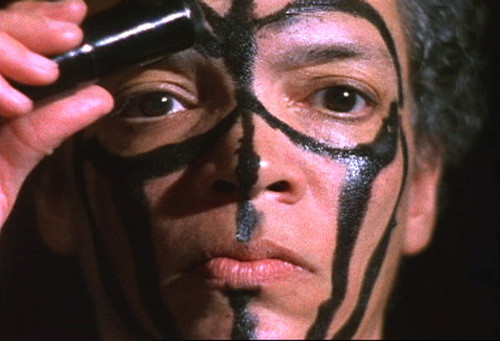
Woburn, Massachusetts-born artist Dawn Clements (1958–2018) created panoramic drawings of interior domestic spaces using sumi ink, ball point pen, and irregular cut-and-pasted grids of paper. She focused on tactile encounters with objects and artifacts—leading to drawings that, as she once explained, function as “a kind of visual diary of what I see, touch, and desire.”
Born in Surrey, England, and currently working in Brooklyn, NY, Jennifer Coates creates luminous imaginary landscapes using acrylic and spray paint. In Coates’s paintings, ghostly figures and mysterious fluorescent animals crowd dreamlike forest scenes influenced by seventeenth-century Dutch Symbolist paintings.
Massachusetts-born, New York-based sculptor, painter, and photographer Patricia Cronin is best known for her large 2002 marble sculpture, Memorial To A Marriage, depicting Cronin and her partner Deborah Kass in bed, embracing. This three-ton statement on marriage equality—carved a decade before Cronin and Kass were legally allowed to wed—specifically refers to Sleeping Children, a nineteenth-century funerary monument by notable MICA alumnus William Henry Rinehart.
In the late 1970s and early ‘80s, Chicago, Illinois-born artist Jane Dickson joined legendary New York-based art collectives Fashion Moda, CoLab, and Group Material. She became known for working on unconventional industrial materials like astroturf and vinyl to paint images of the diners, strip clubs, and sex workers in Times Square, where she lived and worked for almost 30 years.
Beacon, New York-based painter Chie Fueki was born in Yokohama, Japan, and raised in São Paulo, Brazil. She creates densely patterned paintings and mixed media assemblages layered with symbols, grids, and allusions to the female form.
Born in Long Island, NY, Judy Glantzman was part of the East Village art scene of the 1980s, showing her large-scale expressionistic paintings alongside artists Marilyn Minter, David Wojnarowicz, and Keith Haring. Her energetic, intuitively composed images often feature constellations of mask-like faces and torqued human figures.
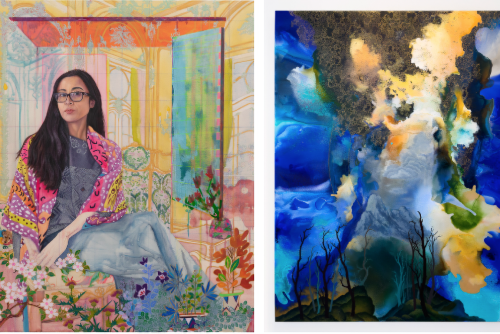
Prior to becoming an artist, Kira Nam Greene received a PhD in Political Science from Stanford University and worked as a management consultant. Born in Seoul, Korea, and currently based in Brooklyn, NY, Greene eventually became a full-time artist—creating detailed illusionistic portraits of women surrounded by household objects and patterns inspired in part by the Pattern and Decoration (P&D) movement of the 1970s and ‘80s.
New York artist Mimi Gross paints gestural, expressive portraits; designs sets and costumes for dance performances; and creates diorama-like installations in galleries and outdoors. In the 1970s, Gross created room-filling cartoonish installation pieces with then-husband Red Grooms—including Ruckus Manhattan (1975), a 6,400-square-foot sculptural rendering of the city and its landmarks.
Providence, RI-born, Baltimore-based artist Phaan Howng ‘15 (Mount Royal School of Art MFA) creates paintings and installations that ask viewers what a post-human world might look like. The lush, semi-abstract plant imagery in her work draws from multiple narratives: from Hollywood sci-fi blockbusters, to histories of endangered plants, to the use of camouflage in modern warfare.
Born in Tehran, and currently living and working in the Washington, DC area, painter Hedieh Javanshir Ilchi juxtaposes blooms of poured pigments with intricate gilt patterns from Persian art—opening portals between histories of western abstraction and Safavid art and architecture. Ilchi’s practice reflects her personal experiences between two worlds, and evokes narratives of invasion, migration, and escape.
Born in Annapolis, Maryland, and having grown up across the US and overseas, painter Lani Irwin has lived in Italy since 1987. She paints in a tightly controlled manner that recalls medieval or early Northern European Renaissance artworks, depicting theatrical spaces crowded with masked human figures, dismembered mannequins, and eccentric animals and objects.
Seoul, Korea-born, Connecticut-based artist Leeah Joo creates trompe l’oeil paintings to investigate forms of pictorial space, concealment, and cross-cultural exchange. In her works, references to traditional Korean textiles and the arts of ancient Greece collide; brightly-colored silks wrap hidden objects or hang as curtains in front of seemingly empty picture frames.
Texas-born, New York-based artist Baseera Khan uses performance, photography, painting, and installation to trace how material economies shape identities and perpetuate trauma. Khan’s materials—unrefined crude oil, walnut wood panels, real and synthetic human hair—evoke her complex experiences as a femme native born-Muslim-American with Indian-Afghani roots.
Born in New Jersey City, and living and working in New York, artist Hein Koh creates surrealist soft sculptures, pastel drawings, and ceramics depicting one-eyed cartoon protagonists consumed by angst and dread. In Koh’s world, sentient fruits and vegetables weep, smoke cigarettes, and struggle with gender stereotypes in absurdly humorous scenarios.
Born in Beijing, China, artist Ying Li immigrated to the US in 1983. Her visceral, thickly impastoed paintings move between plein air representation and urgent abstraction. Li traces the shapes of parks, ponds, and ruined buildings with vigorous brush strokes and palette knife scrapings—producing canvases laden with sculptural outcroppings of paint.
Born in Madison, Wisconsin, and currently based in Washington, DC, Katherine Tzu-Lan Mann ‘09 (LeRoy E. Hoffberger School of Painting MFA) spent her childhood moving between Taiwan, China, Korea, and the U.S. She uses paint, sumi ink, collaged rice paper, and mosaic tile to create graphic, dimensional paintings in which she interleaves Chinese and European image-making traditions.
Brooklyn-based painter Anna Ortiz grew up dividing her time between Worcester, Massachusetts, and Guadalajara, Mexico—where she studied art with her grandfather and aunt, both of whom were professional artists. Ortiz paints with a dramatically limited color palette, creating dreamlike desert landscapes based on real and imaginary places, and populated by creatures from Mayan and Aztec mythology.
Born in Tehran, and having moved to the U.S. in 1983, artist Hadieh Shafie uses ink, paint, and paper—collaged or arrayed in tightly wound scrolls—to create works that sit between two and three dimensions. Using her own writing, abstract mark-making, and cut-up passages of Farsi poetry, Shafie creates intense optical patterns that ask to be read but resist interpretation.
Georgia–born, New York-based artist and MICA graduate Amy Sherald ’04 (LeRoy E. Hoffberger School of Painting MFA) was commissioned by First Lady Michelle Obama in 2018 to paint her now-iconic official portrait for the Portrait Gallery’s permanent collection. Sherald’s distinctive photo-based figure paintings grapple with legacies of pictorial modernism and prompt questions about historical representations of Black Americans in photography.
Native Philadelphia artist Patricia Renee’ Thomas uses painting and drawing to investigate Black hyper-visibility in the U.S. The subjects in her sumptuously painted worlds struggle to navigate supposedly neutral settings, either self-consciously adorning their bodies or donning camouflage—ghillie suits—to conceal themselves in plain sight.
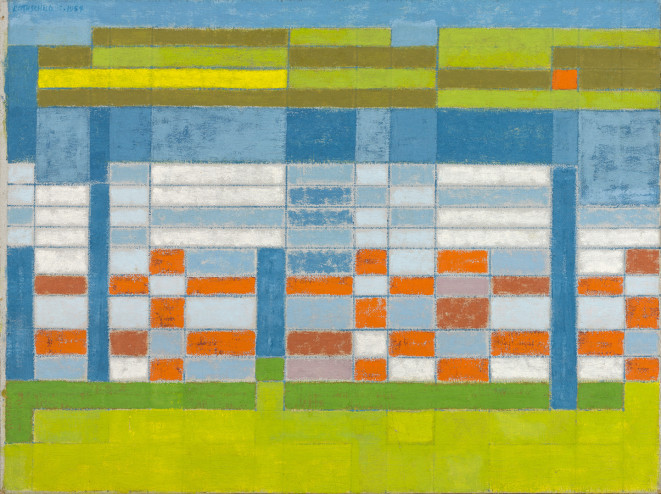
Born in Port of Spain, Trinidad, painter Denyse Thomasos (1964–2012) immigrated to Toronto at the age of six; she spent most of her career as an artist working between Philadelphia and New York City. Thomasos used linear language, stacked grids, and blocks of loosely applied color to evoke different forms of architecture, from spaces of confinement—prisons, slave ships—to indigenous, non-Western structures she encountered in her travels outside the US.
Born in Kingston, Jamaica, and raised in Montclair, NJ, artist Shoshanna Weinberger has lived and worked in Newark, NJ, since 2006. She uses abstraction—and recurring icons for disembodied lips, hairdos, and stiletto boots—to unpack cultural beauty norms and explore the complexities of her Afro-Caribbean-American heritage.
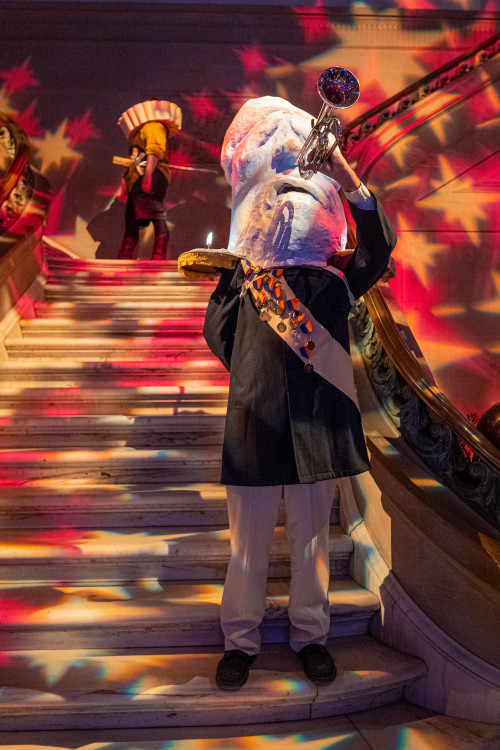
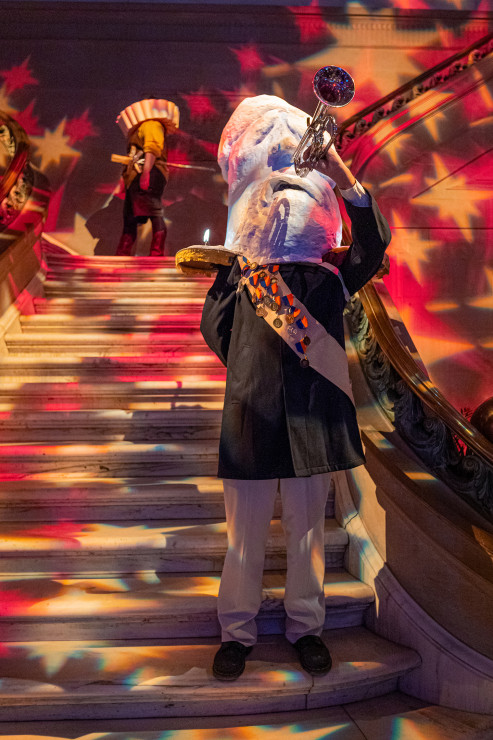
Japan-born, New York-based artist Saya Woolfalk uses performance, video, sculpture, and painting to create complex narrative artworks that reflect her own mixed Asian and African-American heritage. Staging tableaux with wearable soft sculptures and psychedelic science fiction props, Woolfalk weaves stories about the Empathics, an imaginary race of human-plant hybrids.
Seoul-born, New York-based artist Mie Yim creates dreamlike worlds crowded with disembodied eyes, cartoonish animals, and shimmering disco balls. Her brightly colored, expressively brushed paintings manifest strange beauty and wild humor tinged with psychological darkness.
About the McMillan-Stewart Foundation
The McMillan-Stewart Foundation was established in 2005 to realize the vision of its founder, Geneviève McMillan (1922–2008), who supported the arts as a vehicle for understanding the diversity of human experience, and believed that we should work for equality and justice for all.
About Reba Stewart
French-born collector Geneviève McMillan established the McMillan-Stewart Endowed Chair in Painting at MICA in honor of her dear friend Reba Stewart (1930–1971). Born in Hudson, Michigan, trained at Yale, and mentored by modernist Josef Albers, Stewart was a restless world traveler and a strong advocate for Baltimore artists. From 1963 to 1971, Stewart taught at MICA as one of only three women professors on campus. Students remembered her as demanding in the classroom, yet unstintingly generous with her time. Her career was cut short when she contracted malaria overseas and passed away unexpectedly at the age of 41.
About the McMillan-Stewart Endowed Chair in Painting
The Genevieve McMillan-Reba Stewart Endowed Chair in Painting was established in 2006 by the McMillan Stewart Foundation with a $1 million gift to bring annually a visiting female artist in painting for a long-term residency at Maryland Institute College of Art (MICA). The visiting Chair in Painting works throughout the year with students and faculty in the department provides lectures and critiques and brings their experiences and influences into the classroom. The juried selected Chairs are women who are expected to bring work that explores perspectives from diverse cultures and backgrounds.
The McMillan-Stewart Endowed Chairs have not only increased representation for women artists, but also reflected the example of Stewart’s teaching—by, as the program description prescribes, “show[ing] evidence of openness as reflected in devotion to and by students.”
Full Image Credits
Left image: Kira Nam Greene Room of Her Own (Saya) 2022, oil, watercolor, gouache, acrylic marker and colored pencil on canvas, 50” × 40”
Right image: Hedieh Ilchi We Are Whirled Asunder 2024–5, acrylic on Dibond, 72” × 54”
About MICA
Founded in 1826 and celebrating 200 years, the Maryland Institute College of Art (MICA) is a premier epicenter of art and design education and the nation’s oldest, independent, continuously degree-granting college of art and design. Based in Baltimore, MICA is entering its third century with renewed purpose and a deep commitment to its city and the wider world. MICA delivers an education that combines a rigorous fine arts foundation with design, liberal arts, and real-world experience—preparing students to apply art and design to real-world challenges. Through creative entrepreneurship, professional practice, and community and industry partnerships, MICA graduates build sustainable careers, launch ventures, and contribute meaningfully to the creative economy.
About the Curator
North Carolina-born, Washington, DC-based curator, critic, and artist Jeffry Cudlin serves as Professor of Curatorial Practice at Maryland Institute College of Art (MICA). Cudlin is a member of the Board of Directors for The DC Arts Center; he previously served as Director of Exhibitions for Museum of Contemporary Art, Arlington, and as a member of the Board of Trustees for The Contemporary, Baltimore’s nomadic art museum without walls. Cudlin's work as an artist and curator has been reviewed in the Washington Post, Art Papers, and Art in America. His own writing has appeared in the Washington Post, the Washington City Paper, and Sculpture Magazine.
This exhibition was made possible by the generous support of The McMillan-Stewart Foundation.