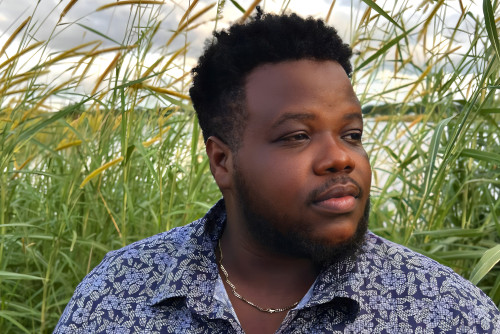
When Morel Doucet arrived in Baltimore as a first-year student in 2009, he carried with him the weight of expectation and the possibility of reinvention. A first-generation Haitian American, the eldest of three boys, and the first in his family to attend college, he had been shaped in the intensity of Miami’s magnet arts scene. His high school sent generations of students to MICA; the pipeline was strong, the standard unspoken but unmistakable.
“I walked in as an Illustration major,” he recalls. “It felt practical. It felt safe. And for a while, that felt like what I was supposed to do.”
Four years later, Doucet would walk across the commencement stage receiving a degree as a Ceramics major with a minor in Creative Writing, poised to become one of the most singular interdisciplinary artists of his generation, one whose work bridges climate justice, diasporic memory, material culture, and the ancestral language of clay.
A Pipeline of Possibility
Doucet’s journey to MICA began long before he set foot on campus. Growing up in Miami, he attended a competitive magnet arts high school whose alumni often traveled north to study at MICA. The school’s reputation, reinforced by generations of graduates, became a lodestar.
He received multiple full scholarship offers from top art schools, but his final decision came down to climate, culture, and possibility.
“Kansas City felt isolated, Detroit was too cold, and Baltimore, Baltimore felt reachable,” he says. “A train ride from D.C., New York, Philly… it felt like a crossroads.”
Finding Clarity
Although Doucet entered as an Illustration major, he struggled with the dissonance between the safety of commercial work and the urgency of his lived experience.
“As a Haitian American, I didn’t see many ceramic artists who looked like me,” he says. “Illustration was safe. Ceramics felt…nonexistent as a career path.”
But his experiences at MICA altered the horizon of what he believed possible.
Work-study positions in the Ceramics studio pulled him toward the material: mixing clay, firing kilns, preparing glazes. Roles in Housing and the Office of Diversity broadened his administrative and leadership instincts. As co-president of the school’s Black Student Union, and later as producer of the annual MICA Benefit Fashion Show, he learned about branding, event production, collaboration, and, most importantly, the importance of confidence.
“It was MICA that pushed me to be more versatile,” he reflects. “To understand how everything connects: the visuals, the language, the audience, the story.”
By junior year, the tension became clear. Mock industry interviews with illustration professionals showed him a future he didn’t want, working under art directors, executing someone else’s vision.
“I wanted to be my own boss,” he says. “I wanted to tell my story.”
That day, he walked into the office of Ceramics Chair David East. The response was something out of a novel.
“He pulled out a folder with my name on it he’d kept since freshman year,” Doucet remembers. “He’d been waiting, hoping I’d make this decision.”
In that moment, everything shifted for Doucet: ceramics was no longer a detour; it was his direction.
Art That Endures
Ceramics, for Doucet, became more than a medium. It became a language, one that bridged the ancestral, the political, and the ecological. For Doucet, clay, with its memory, its alchemy, its permanence, offered a framework for expressing the intertwined narratives of land, diaspora, and identity.
“The role of the artist is to reflect the times,” Doucet says. “And art is inherently political.”
His work explores climate gentrification in Miami, the bleaching of coral reefs, sea-level rise, and the fragility of Black and Caribbean communities in the face of environmental collapse. Through porcelain teapots, sculptural installations, and large-scale public works, he uses a historically elite material to critique power structures and elevate often-erased histories.
Ceramics became his bridge between centuries: “It’s the only medium that transcends time,” he notes. “A ceramic vessel survives fires, disasters; archaeologists piece together entire cultures from what clay remembers.”
As a Creative Writing minor, he honed his narrative voice. A teaching assistantship revealed a new pathway toward arts education. These experiences prepared him to join the inaugural education team at the Pérez Art Museum Miami after graduation.
Today, his work sits in national parks, international museums, and private collections. He is developing his first major public bronze sculpture honoring the Black and Bahamian community of South Florida. His ceramics have been featured on book covers, an echo of the illustrative dreams he once thought he had left behind.
“All the things I thought I’d miss by switching out of Illustration,” he says, “still came true, just through ceramics.”
“MICA gave me the courage to take risks,” he says. “To explore everything. To never settle. If MICA keeps doing that, then the next two hundred years will be even more extraordinary.”