Celebrating MICA’s Faculty
This November, MICA proudly celebrates the transformative power of education and the extraordinary educators who inspire creativity, encourage…
Melissa Webb ’96 (Fiber BFA) / Faculty, 2018-2022
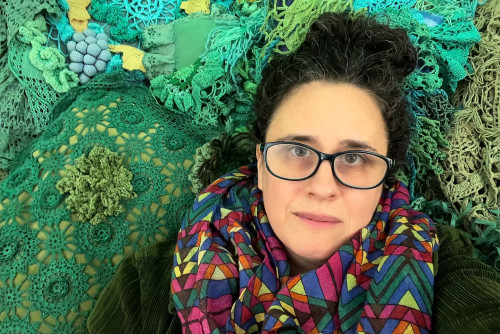
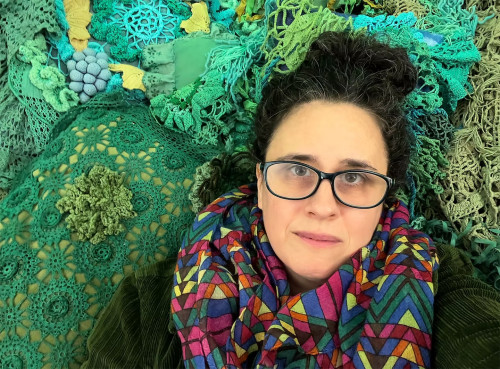
For Melissa Webb art is not something that simply hangs on a wall. It is something viewers step into, an experience that unfolds through space, texture, sound, and light. Within her immersive installations, crocheted textiles may mingle with video projections, historic architecture may become part of the artwork itself, and audiences are invited to move through environments that feel at once dreamlike and deeply grounded in history.
Over a career spanning more than three decades, Webb has become a nationally exhibiting fiber artist, educator, and independent curator known for her site-specific installations that blur the boundaries between sculpture, performance, photography, and digital media. Her work has appeared in galleries, museums, and festivals across the country.
Wherever Webb works, the setting becomes an active collaborator. Her installations have transformed spaces ranging from the former Lee Paper Mill in Vicksburg, Michigan, to the Frank Lloyd Wright–designed Smith House, to Baltimore’s historic Lovely Lane United Methodist Church. She has also created work at Clermont Farm in Virginia, a former plantation now preserved as a historic site. In each case, Webb builds environments that respond to the architecture and history of a place, layering textiles, imagery, and sound to create immersive encounters that draw viewers into a dialogue with the past.
“I consider all of the materials, the space, and the people interacting with the work to be collaborative,” Webb says. “Every building, every object, every textile carries a history. Those histories become another material in the work.”
Webb’s path toward these expansive installations began at MICA, where she earned her BFA in Fiber in 1996. Even as a student, she was drawn to work that crossed boundaries between mediums, combining textiles, costume, performance, and spectacle.
One of her most formative experiences came during a week-long collaboration with visiting artist Pat Oleszko. Rather than treating the residency as a brief workshop, students immersed themselves in creating a collective performance work. That project took on unexpected emotional significance when a devastating fire destroyed studios at Clipper Mill, a historic Baltimore artist space. In response, Webb and her peers staged a performance titled Render, Remember on the site, honoring the artists who lost their work and a firefighter who died in the blaze.
The performance was initially met with skepticism by some in the community, who misunderstood the nature of the collaboration. But when the event took place, many attendees found it moving and cathartic. For Webb, the experience revealed the power of art to respond to tragedy, bring people together, and honor collective memory.
“It was such a catalyzing moment,” she recalls. “It showed me that art can hold grief, history, and community all at once.”
Years later, Webb returned to MICA as an adjunct faculty member, teaching courses in fiber and performance from around 2009 through 2018. Drawing on her experience in garment-making, theater, and installation work, she helped students explore how clothing, movement, and textiles interact with the body and space.
Teaching at her alma mater, she says, was deeply meaningful.
“I had wanted to go to MICA since I was in eighth grade,” Webb says. “Coming back to teach there and to stay connected with the fiber department and that community was a real honor.”
At the center of Webb’s artistic practice is an ongoing dialogue between traditional craft and contemporary technology. Her installations frequently combine handmade textiles — crochet, dyed fabrics, and embellished surfaces — with projected video, photography, and layered digital imagery.
This hybrid approach reflects both the past and the future of fiber art. Historically rooted in domestic craft traditions, fiber practices were long dismissed as decorative or secondary to other art forms. Today, they are gaining renewed attention in contemporary art contexts.
Webb has spent much of her career pushing those boundaries.
“Fiber has always been a space where artists question what art can be, who gets to make it, and where it belongs,” she says. “It’s also connected to generations of makers whose labor and creativity were often undervalued.”
Many of the materials Webb incorporates into her work — vintage doilies, handmade textiles, decorative objects — were originally created for domestic spaces, often by women whose names and histories are unknown. By recontextualizing these items within large-scale installations, Webb sees herself as collaborating across time with their makers.
“My practice involves archiving and transforming objects that hold stories of care,” she explains. “They were created to soften domestic spaces and protect surfaces, but they also represent labor that was rarely celebrated.”
Nature is another recurring presence in Webb’s work. Rich greens, organic forms, and layered textures evoke plant life and ecosystems, while her installations often suggest environments overtaken by growth or transformation. These images reflect her interest in how humans relate to the natural world, especially the tension between idealized visions of nature and the environmental challenges facing the planet.
“I’m drawn to the greens of the natural world and the sense of growth and change they represent,” Webb says. “A lot of the work imagines a future where humans learn to live more symbiotically with the environment.”
A major turning point in Webb’s career came when she moved to Detroit to pursue her MFA at Cranbrook Academy of Art. The transition prompted both personal and creative shifts, encouraging her to experiment with new materials and technologies.
During graduate school, the COVID-19 pandemic forced artists around the world to rethink how and where they worked. For Webb, that meant transforming her apartment into a studio and installation environment.
Out of this period emerged Lichen Vision, an evolving body of work that combines performance, video projection, and layered digital editing. Using green-screen techniques, Webb filmed herself within environments she constructed at home and outdoors in Michigan landscapes, blending the imagery into surreal video collages that blur the boundaries between body, environment, and digital space.
These works later became projections within larger installations—creating what Webb describes as a “third space” where physical environments and mediated images intersect.
“It was a moment when I was literally living inside my work,” she says. “Everything — my materials, my environment, my daily life — became part of the process.”
In addition to her studio practice, Webb has also contributed to the arts community as a curator and arts administrator, including work with Baltimore’s School 33 Art Center. These experiences, combined with her teaching at MICA, reflect her commitment to sharing knowledge and supporting other artists.
Today, Webb continues to create installations that invite viewers to engage directly with the work. In some recent projects, she has incorporated participatory elements, placing textiles onto visitors’ bodies and photographing them within the installation environment.
The reactions have been striking.
“People come in maybe having had a rough day or feeling uncertain,” she says. “Then they stay, they relax, and they interact with the work. There’s something about the tactile quality of these objects that feels comforting.”
For Webb, that response points to something essential about art’s role in society.
“We’re living in a moment when people are craving connection—connection with each other, with nature, and with handmade things,” she says. “Art can create those spaces.”
As MICA approaches its bicentennial, Webb believes artists and designers will continue to play a crucial role in shaping cultural dialogue.
“In a world where so much is commercialized or digitized, creative work that invites people to slow down, reflect, and imagine new possibilities becomes even more important,” she says.
For her own work, Webb is increasingly focused on creating installations that offer moments of healing and reflection. Rather than thinking in terms of a traditional artistic legacy, she sees her role as continuing a dialogue with the many unknown makers whose labor lives on in the materials she transforms.
“I think my legacy is tied to theirs,” she says. “These objects hold histories of care and creativity. When people experience the work, they’re also connecting with those makers and their stories.”

Join the festivities as MICA honors its 200-year history, recognizes its present success, and looks forward to a bright future. Throughout 2026, the College will be sharing community stories and announcing one-of-a-kind events on campus, in Baltimore, and beyond.