Celebrating MICA’s Faculty
This November, MICA proudly celebrates the transformative power of education and the extraordinary educators who inspire creativity, encourage…
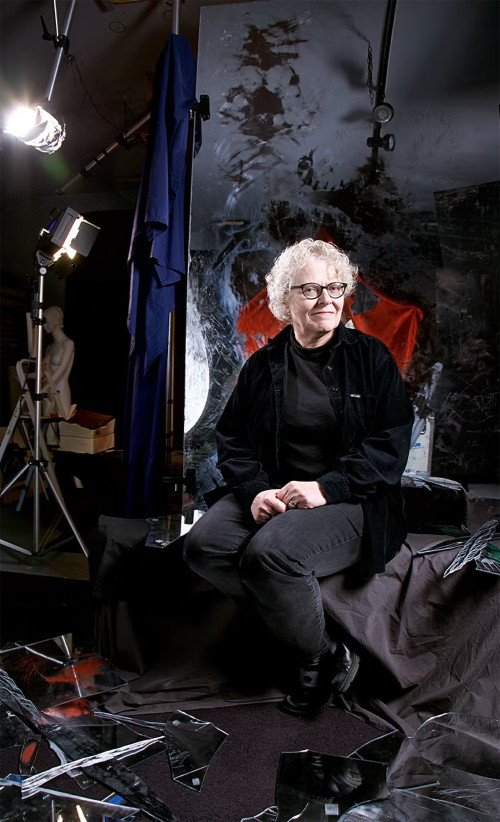
Connie Imboden, Former Faculty, Photography and Former Non-Degreed Photography Student at MICA / President of the Board of Governors of the William G. Baker, Jr. Memorial Fund
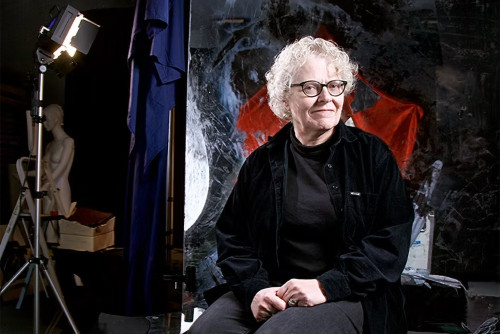
Connie Imboden’s path to MICA began with a mother’s hunch and a teenager’s need to belong. In 1970, after her junior year at Bryn Mawr School in Baltimore, Imboden, feeling out of step with her family, her school, and the world’s narrow rules around identity, walked into a MICA darkroom for Basic Photography with Joe Humphries. “It was like finding my people,” she recalls. Drawing and painting hadn’t felt like home, but the camera did.
In the alchemy of light, paper, and chemistry, she discovered she was a visual thinker, a person who understands the world by seeing it anew. The class, and the community around it, cracked something open. She would spend the next five decades at MICA — first as a student, then as a teacher — carrying forward a way of learning that put exploration ahead of outcomes.
Ask Imboden what made MICA different, and she will tell you it was the combination of radical acceptance and radical curiosity. In the early 1970s, she found a campus where difference wasn’t merely tolerated but welcomed. “It didn’t matter if you were Black, gay, Jewish, tall, or thin,” she says. “Everyone was accepted.” That acceptance wasn’t a slogan; it was a lived culture that encouraged risk, laughter, and the occasional peanut-butter-and-jelly art happening (a five-foot sandwich that devolved into an impromptu food fight at the Station Building). If other schools measured rigor by rules, MICA cultivated it through freedom: the freedom to try, fail, stretch, and try again.
Pedagogically, for Imboden, the difference showed up in a faculty with many lenses, literally and figuratively. One professor focused on landscape, another on history, another on alternative processes; each offered a distinct point of view. The message to Imboden was clear: your vision is not a narrow hallway but an open field.
Richard Kirstel, a beloved mentor, and Jack Wilgus, who later became Imboden’s colleague, modeled a way of teaching that privileged ideas and investigation. Critiques were tough: blunt, unsparing, honest. The point wasn’t to polish a single “great” picture but to cultivate the habits that make a life in art life possible: looking harder, thinking more widely, making again.
Imboden’s career, celebrated in exhibitions from New York to Paris, is anchored in a language she honed at MICA: transformation through reflection, distortion, and the patient orchestration of chaos. In the mid-1980s, she began the body of work that would define her practice, photographing bodies and faces refracted through water and mirrors. The material looks unruly at first — ripples, glass, refractions — but the image that emerges is ordered, uncanny, charged.
“My process involves creating chaos and then finding form within it,” she says. “When I overthink, the work loses its strength. When I let my eyes lead, I tap into an intuitive process connected to the unconscious.”
That stance of trusting the eyes, letting intuition guide, wasn’t an accident of temperament; it was trained. The faculty’s insistence on process over product taught her to love the making, not only the moment something “works.”
“A strong photograph is not the end. It’s the beginning of the next question. You keep exploring because you never know where it will lead,” she says. This is MICA’s difference in action: a pedagogy that builds endurance. Fifty years on, Imboden is still chasing the shimmer at the edge of perception because her teachers taught her how to keep looking.
The impact extends beyond the studio. As president of the William G. Baker, Jr. Memorial Fund, Imboden helps sustain Baltimore’s arts ecosystem through grants to organizations and the Baker Artist Portfolio, a platform launched nearly two decades ago where any regional artist can showcase work, so robust that many use it as their primary website. The program also awards $90,000 annually across six disciplines. “Baltimore’s arts scene thrives because MICA keeps producing outstanding artists,” she notes. The school’s relentless output of makers provides the city with an ever-renewing creative engine. Imboden’s advocacy completes a circle: a student who found belonging in the arts now builds structures that help others find the same.
MICA’s cosmopolitan reach also shaped her trajectory. Visiting artists and speakers brought national and international perspectives into Baltimore’s classrooms, critics like Alan Coleman of The New York Times offered seminars that widened students’ vistas. Those encounters mattered. They signaled that a life in art might be rooted locally and resonate globally, that the path from a Baltimore darkroom to a Paris gallery is not a leap so much as a line.
Every profile in this bicentennial series answers the same question in its own way: What makes MICA different? For Imboden, the answer is both beautifully simple and stubbornly rare. It is a school that treats acceptance as a precondition for excellence; that understands rigor as exploration; that staffs its classrooms with artists who disagree productively so students can discover who they are; that invites risk and insists on honesty. That culture did not just produce Imboden’s art; it produced her resilience, her curiosity, her willingness to keep looking.
As MICA enters its third century, Imboden hopes the next generation encounters exactly what she did in 1970: “An environment that’s welcoming and accepting. A place where you won’t be judged for who you are but supported as you explore who you can become.” She wants students to roam across programs, to “try many things: experiment, take risks, discover what truly speaks to them.” And she appreciates the school’s gentle insistence, sometimes you are required to try something beyond your lane. At eighteen, she says, few students possess a panoramic view of their possibilities. Faculty widens that view. “If you go deep too soon, you don’t know what you’ve missed.”
The echo of her message is practical: keep the doors open, the visiting artists coming, the critiques honest, the majors permeable, the fun alive. Keep the sandwich messy, in other words, because in the mess, students learn to build their own order.

Join the festivities as MICA honors its 200-year history, recognizes its present success, and looks forward to a bright future. Throughout 2026, the College will be sharing community stories and announcing one-of-a-kind events on campus, in Baltimore, and beyond.