From the Heart
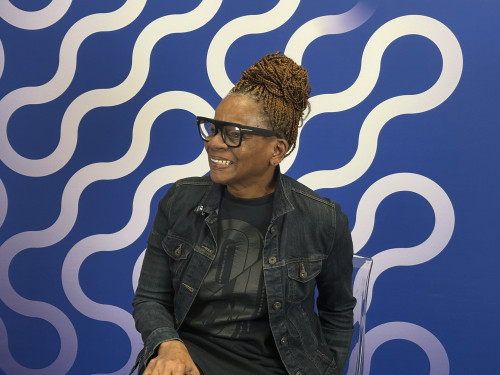
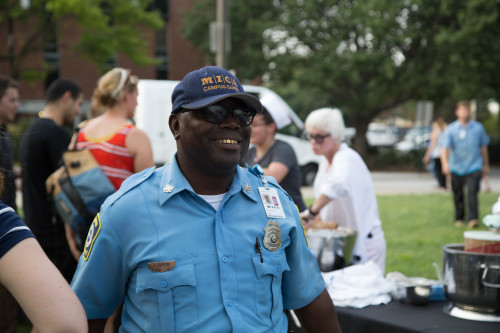
Lawrence Green, Campus Safety Officer
Lawrence Green, Campus Safety Officer
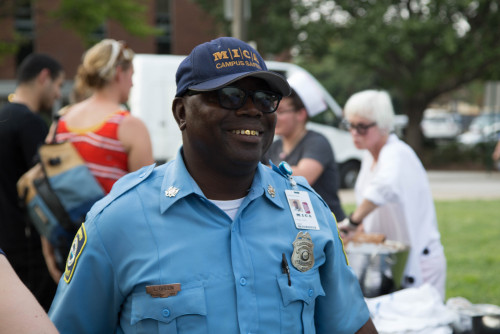
Officer Lawrence Green has a sixth sense. He can instinctively tell when something is wrong.
After 21 years with MICA Campus Safety, he has learned to notice more than whether a student has an ID or someone belongs in a building. He watches faces. He reads body language. He knows when someone who usually says hello suddenly doesn’t.
“When everyone thinks I’m just stopping to check their ID, no, I’m not,” Green says. “I’m checking their body language, too.”
That attention to people has defined Green’s two decades at MICA. Students may know him as the uniformed officer greeting them as they come and go, but Green sees his job in much broader terms. He is a protector, certainly, but also a mentor, an encourager and, when necessary, a big brother.
As MICA celebrates its 200th anniversary, Green’s story reflects the relationships that sustain an institution from one generation to the next, the daily encounters and acts of care that help turn a campus into a community.
An East Baltimore native, Green traces his commitment to service to his childhood, where public service ran in his family. His aunts and uncles worked in the Eastern District, and his oldest sister served in the military. So there was little doubt in his mind what career path he would follow.
By the 1980s, Green was working in security. He later worked at Johns Hopkins and spent years gaining experience at locations around Baltimore, eventually becoming a security specialist.
His arrival at MICA, however, happened almost by accident. Green was working at a medical center at 1501 Mount Royal when MICA acquired the building. Jokingly he admits, “MICA bought the building, and I came with it.”
He would later discover that his connection to the place stretched back even further. His mother once waited for a train at the station that stood on the site. Green remembers looking at a photograph of the station with her and realizing where she had been decades earlier.
The discovery carried special significance for Green. “For me to become part of this community, to work for MICA, and then to know for a fact that my mom once waited for a train at this location, I know that I was sent here by a higher power.”
Green’s mother is never far from his thoughts when he talks about his work. He grew up in poverty with a mother who served as both parents. The family did not have much money, but she taught her children to have faith, appreciate what they had, and take pride in whatever work they were given. He recalls how her advice was memorable: “I don’t care if you’re a trash man. You be the best darn trash man you can be.”
Green has carried that philosophy throughout a career spanning decades. He has received numerous awards and takes pride in having saved lives.
About 15 years ago, HBO offered Green security work, but he turned it down. For him, professional recognition has never meant as much as the ordinary interactions that begin when he arrives on campus.
“My biggest award is when I see the kids come in — or anyone — and they say, ‘Good morning,’ ‘Good afternoon,’ or ‘Good night.’ And when they say, ‘Officer Green, how are you?’ You know what I say? ‘If you all say I’m great, then I’m great.’”
It is also indicative of the way Green understands campus safety. The work is about protecting people, but it is also about knowing them.
“Every parent who comes here should know that the men and women of Campus Safety, we are parents, too,” he says. “We take so much pride, honor, and dignity in making sure that not just their child is safe, but everybody is safe.”
Over the years, Green has met students and their parents during admissions events, move-in day, and the beginning of a new academic year. He knows the mixture of excitement and concern families can feel when they leave a student in a new city. He wants to reassure them that someone is watching out for their children.
“We’re not just here to protect them,” he says. “We’re also like big brothers and sisters to them.”
Sometimes that role has little to do with traditional notions of security. Green remembers a student who was overwhelmed by her classes and ready to leave MICA. The two had a personal conversation.
“You’re not going to quit,” he told her. She didn’t. Today, Green says, she is in Washington, D.C. and has gone on to become “one of Baltimore’s finest.”
Those moments are possible because Green makes a point of getting to know people. Seeing students every day means he recognizes their patterns and notices when something changes.
“When I see [students] every morning, every night, every evening, I get to know their heart and their soul,” he says. “I can tell when they’re not feeling well.”
Sometimes, he says, what a student needs is simply a handshake, some encouragement, or a “big-brother hug” and someone saying, “You can do this.”
The relationships run both ways.
Three years ago, Green underwent critical back surgery and spent 10 days in the hospital. As he began the difficult process of standing and walking again, he had one goal in mind: returning to MICA. “Every night, every minute, every hour, I knew I had to get back to protect these kids and everyone else,” he says.
Green recalls encouragement from a former MICA president who told him that even if he could return at only 80%, the community understood the commitment he brought to the job.
“That never left my heart,” Green says.
Green’s definition of community extends beyond the boundaries of campus. He makes a point of knowing people throughout the Mount Royal neighborhood, regardless of their circumstances. At one point, he says, people began calling him “the Mayor of Mount Royal” because he seemed to know everyone.
His life outside MICA has reflected that same instinct for connection. He has coached and volunteered in the community and has been involved with softball, kickball, and baseball. Whatever the setting, he sees his role in similar terms.
“Big brother and teacher, that’s what I try to be.”
Yet for all the stories Green shares about his own experiences, he is quick to redirect attention to his colleagues. He repeatedly credits the Campus Safety director, the department’s sergeants, and the men and women who work alongside him.
“We’re fathers. We’re grandfathers. We’re uncles. We’re aunts,” he says. “We sacrifice our home lives to protect and serve, and we don’t hesitate for one minute.” That work, he insists, is collective.
“You can’t have just one player,” Green says. “You need all the players.”
MICA’s bicentennial invites the community to look back across two centuries of artists, designers, teachers, students, and ideas. But an institution’s history is also written in quieter ways, through the people who open its doors each morning, welcome new students, reassure worried parents, recognize when someone needs help, and return day after day to care for a place and its people.
For 21 of MICA’s 200 years, Officer Green has been one of those people.
He says he can sleep at night because he knows he has given everything he had that day to help keep the community safe. The next day, he gets up, puts on the uniform, and does it again.
“I don’t do this for the money,” Green says. “I do it because I love what I do.”
Two hundred years into MICA’s story, that kind of devotion is part of its legacy, too.

Join the festivities as MICA honors its 200-year history, recognizes its present success, and looks forward to a bright future. Throughout 2026, the College will be sharing community stories and announcing one-of-a-kind events on campus, in Baltimore, and beyond.