Celebrating MICA’s Faculty
This November, MICA proudly celebrates the transformative power of education and the extraordinary educators who inspire creativity, encourage…
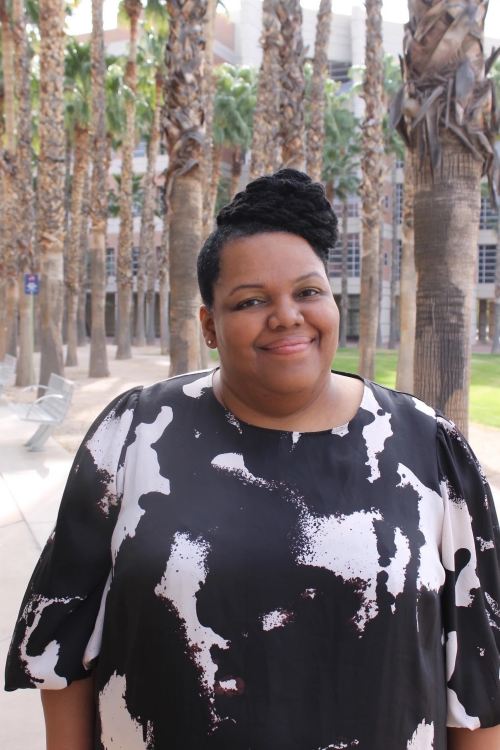
Hope Simpara / Faculty, Fiber, Fashion, and Textile
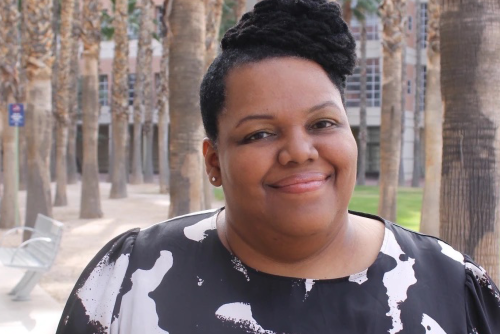
For Hope Simpara, fashion has never been simply about what people wear. As she puts it, clothing communicates. It can build confidence, express identity, carry a protest message, or connect an artist to a community. And in the classroom, the process of making it can give students tools that extend far beyond a sewing machine.
That expansive understanding of fashion is something Simpara brings to her role as full-time faculty in MICA’s newly named Fiber, Fashion, and Textile program. A designer, educator and maker whose career has crossed fashion, technical design, textiles, costume, industrial embroidery, and even automotive interiors, Simpara sees seemingly disparate disciplines as part of the same creative vocabulary.
Simpara’s path began in Maryland, where creativity was encouraged early by her grandmother, an educator who taught her to crochet and sew by hand. Simpara laughs when she remembers one particularly practical motivation for learning the skill.
“I was the chubby kid who always needed to have my pants hemmed, and my mother used to hem them with tape,” she says. “So, one of my first projects was figuring out how to hand-sew a hem on my own pants.”
Soon she was making clothes for dolls and exploring fine art. Then, in high school, someone gave her an old portfolio that had belonged to a fashion designer. Seeing fashion illustrations helped something click: Art and clothing construction didn’t have to occupy separate worlds. That realization eventually led Simpara to study fashion merchandising. The experience provided a strong liberal arts and fine arts foundation, but it also offered something equally important.
“Socially, it was great for me to be in a place where I was motivated and saw other motivated people who looked like me,” she says. “Culturally, I needed that support system.”
Wanting to deepen her technical design skills, Simpara went on to earn an MFA in fashion design from Savannah College of Art and Design (SCAD). There, she found mentors and discovered another dimension of her career: teaching. She worked as a teaching assistant in graduate school and later joined SCAD’s faculty.
Today, teaching and professional practice remain closely connected for Simpara. She maintains a custom design business and has freelanced across numerous areas of the industry. That range of experience has convinced her that creative skills rarely belong to only one discipline, which includes possibilities students might never associate with studying fiber or fashion. Simpara has worked with industrial embroidery, screen printing, leather ,and car interiors.
For Simpara, that is exactly the point: Skills become tools, and tools can take artists in unexpected directions.
Her interdisciplinary approach feels particularly at home at MICA, where fashion students work alongside artists approaching material and form from entirely different perspectives. Simpara has had sculpture students enter her classes, for example, and discovered that their instinct to think first about form translates naturally into fabric.
“The opportunities are kind of endless, and that’s how we get innovation,” she says. “We like to say in fashion that everything has kind of been done before. The things we can innovate are the materials and the approach.”
Color, pattern, and geometric abstraction are central to Simpara’s own creative practice. She is fascinated by how color can influence mood, perception, and a viewer’s response to an object. She gravitates toward graphic imagery, contrast, black and white, and unexpected color combinations. But clothing also offers something that a painting or sculpture cannot: “Everybody wears clothes,” Simpara says.
She believes that makes fashion a particularly powerful form of communication. In her classes, students discuss the statements people make through clothing, whether consciously or not. A T-shirt can announce a political or cultural position. What someone wears to a protest can convey solidarity while also serving practical purposes such as protection. Those conversations inspired Simpara to develop an assignment examining fashion as protest, including the history of the graphic T-shirt as a vehicle for communicating ideas.
“Clothing is sort of a blank canvas for making a statement,” she says. “Sometimes it’s subtle, and sometimes it’s not.”
The same principle applies on an individual level. Through costume and custom design, Simpara has worked with people across ages and body types. She has seen how clothing can change how people carry themselves.
At MICA, Simpara wants students to develop that confidence in themselves as professionals. She remembers asking during her interview process how the panel would characterize MICA students. The response stayed with her: “MICA students are creative and kind.” After joining the College, she saw those qualities for herself.
“They’re curious. They’re up to the task,” she says. “They might get a little nervous, but they push through.”
Simpara describes art school as a space where students can take creative risks within a supportive community. Critique is part of that process and, she argues, an invaluable preparation for life. Students learn not only to receive feedback but to explain their work, articulate their intentions, and defend their decisions.
Professional experience is equally important. Because Simpara continues to take commissions, she brings real projects into the classroom whenever possible. Students might watch her disassemble a garment, examine its construction, or see how techniques practiced as classroom samples translate directly into paid work. She also wants them to recognize themselves as emerging professionals rather than people waiting for permission to become professionals.
“They’re paraprofessionals, and I really want them to get over that imposter syndrome where they think they’re not at the level to do these things,” she says. “Because they are.”
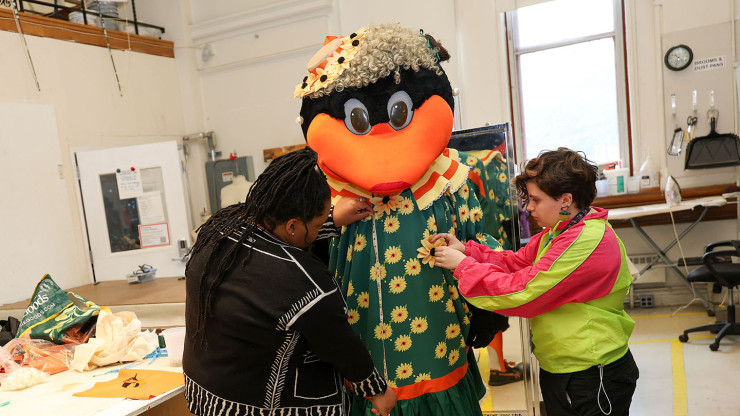
That philosophy became tangible when the Baltimore Orioles approached MICA about designing a new outfit for the team’s mother bird mascot for a Mother’s Day game. Simpara incorporated the commission into her garment production class.
Students researched Maryland and the Orioles, developed concepts and pitched their designs over Zoom. The Orioles selected a design featuring Maryland’s state flower, the black-eyed Susan, created by Angel Forsyth ’28 (General Fine Arts BFA) whose background in drawing and illustration translated naturally into textile design.
Then came another lesson: the deadline. The fabric had to be ordered, and the garment constructed quickly. The compressed schedule gave students an experience that no hypothetical assignment could quite duplicate.
“They needed to know, no matter what, you need to meet that deadline,” Simpara says.
On Mother’s Day 2026 at Camden Yards, thousands of Baltimore Orioles fans watched Mama Bird step onto the field in a brand-new outfit. [...] What most fans didn’t realize was that the costume had begun only weeks earlier inside a classroom at Maryland Institute College of Art, where students were challenged to reinterpret an iconic community character, honor one of Baltimore’s most recognizable brands, and connect generations of fans.
As Fiber, Fashion, and Textile enters a new chapter at MICA, Simpara sees tremendous potential in combining that professional rigor with the experimental spirit of an art school. Students can weave, spin, screen-print, felt, and dye materials, then pattern and construct finished garments, all while collaborating with painters, printmakers, sculptors, and other artists across campus.
“It’s kind of a one-stop shop,” she says. “That’s pretty rare to find in any program.”
Just as important to Simpara is what happens beyond campus.
Having grown up closer to Washington, D.C., she says returning to Maryland has allowed her to rediscover Baltimore and its creative community. She has been struck by MICA’s connections throughout the city and by the network of artists, organizations, and neighborhoods that surround the College.
As MICA marks its 200th anniversary, Simpara believes strengthening those relationships is an important part of carrying its creative legacy forward, supporting community artists, engaging with North Avenue, and finding new ways to “pour back into the city.”
She sees evidence of that connection in students who arrive in Baltimore for MICA and quickly find themselves becoming part of the city. Recently, she met an exchange student who had been at MICA for only two weeks.
“She said, ‘I don’t want to go back home,’” Simpara recalls.
For an educator whose own career began by discovering that art and fashion could belong together, it is a fitting measure of what a creative community can accomplish: giving people a place to experiment, connect and discover possibilities they hadn’t imagined.
“This definitely is a safe space for our students,” Simpara says. “And who wants to leave a safe space where you’re able to create and grow?”

Join the festivities as MICA honors its 200-year history, recognizes its present success, and looks forward to a bright future. Throughout 2026, the College will be sharing community stories and announcing one-of-a-kind events on campus, in Baltimore, and beyond.