Celebrating National Entrepreneurs Week
At MICA, creativity extends beyond artistic expression to drive innovation, strengthen communities, and inspire meaningful change. This entrepreneurial…
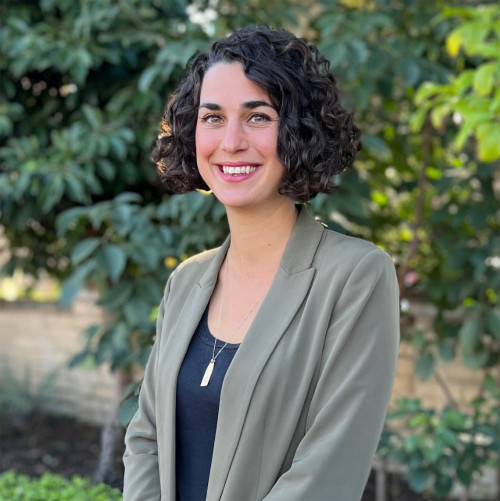
Aviva Paley ’13 (Painting BFA)
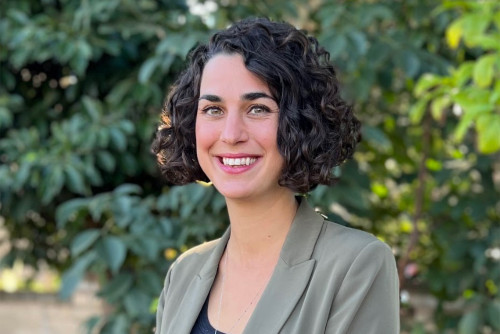
When Aviva Paley ’13 (Painting BFA) asked her MICA classmates how many had voted in the 2010 U.S. midterm elections, she was stunned. In a room of roughly 35 students, hers was the only hand raised. For Paley, it was more than a disappointing revelation. It was a challenge and an opportunity to put her artistic education to work.
Rather than accept the apparent disengagement, Paley transformed her senior thesis into a visually driven voter registration campaign, collaborating with a graphic design student to make political participation more accessible, compelling, and, as she puts it, “sexy, fun, and engaging.” The campaign combined creative communication with grassroots organizing, ultimately registering, by Paley’s estimate, more than a quarter of MICA’s student body.
It was an early glimpse of a defining characteristic of her career: the ability to recognize a problem, imagine a different reality, and create something to make it happen.
Today, Paley is a nationally recognized social entrepreneur and advocate whose work has spanned hunger relief, workforce development, environmental justice, agricultural policy, and political organizing. A co-founder of the San Diego nonprofit Kitchens for Good and a 2019 Forbes 30 Under 30 honoree, she has spent her career tackling some of society’s most entrenched challenges.
Paley credits her MICA education with giving her one of her most valuable professional tools: the confidence to create something that doesn’t yet exist. “When you’re an artist, especially in a discipline like painting, there aren’t necessarily rules,” she says. “There’s no map or step-by-step guide for creating a painting.”
That same spirit of experimentation, intuition, and problem-solving, she discovered, can be a powerful force for social change.
Growing up in Baltimore, Paley attended Carver Center for Arts and Technology, where creativity played a central role in her education. As she considered her next steps after graduation, MICA’s strong reputation made it a natural choice, despite her initial reluctance to remain so close to home. Generous scholarships helped seal the decision.
Once on campus, Paley discovered that her education extended well beyond the painting studio. Liberal arts courses introduced her to new perspectives on history, inequality, and the environment. Volunteer experiences with organizations such as Art with a Heart and local homeless shelters exposed her to the challenges facing Baltimore communities. Her involvement with Students of Sustainability, a campus environmental organization in which she held a leadership role, further deepened her interest in environmental and social justice.
Equally important was MICA’s encouragement of unconventional ideas. When Paley proposed a voter engagement campaign rather than a traditional painting project for her senior thesis, faculty supported her vision.
“I think that’s one of the beautiful things about MICA,” she says. “There’s so much room for creativity and for pursuing your own direction.”
That freedom to explore ideas across disciplines would become the foundation of her entrepreneurial approach.
While still a student, Paley began exploring the intersection of food, environmental sustainability, and economic opportunity. An internship at the Johns Hopkins Center for a Livable Future introduced her to food policy and activism, while a summer fellowship immersed her in food justice work.
After graduating from MICA in 2013, she moved to California for a food justice fellowship at the Leichtag Foundation in Encinitas. There, she became fascinated by an innovative idea: What if a commercial kitchen could simultaneously address hunger, food waste, unemployment, and the barriers facing people returning from incarceration?
Paley began researching the possibilities, conducting a feasibility study and developing a plan. Through that process, she connected with a culinary industry veteran, who would become her co-founder of Kitchens for Good. The ambition was considerable. Her experience running an organization was not.
“I was 22 years old, pitching ideas to millionaires, foundations, and city institutions,” she recalls. “I had no business being in some of those rooms!” But she was undeterred. “My motto during those seven years was ‘fake it till you make it,’ 100 percent!”
Founded in 2014, Kitchens for Good eventually secured a commercial kitchen and developed a model combining culinary apprenticeships, nutritious meal production, and revenue-generating food services. Its mission was to break the interconnected cycles of food waste, poverty, and hunger.
The organization provided culinary and hospitality training to individuals overcoming barriers associated with incarceration, homelessness, foster care, and other difficult circumstances. Participants learned what Paley calls the “knife skills and life skills” needed to build careers and achieve stability.
Alongside technical training, the program offered essential support services. Students and volunteers also prepared nutritious meals for vulnerable community members, transforming culinary education into an immediate community benefit. Over Paley’s seven-year tenure, Kitchens for Good grew from a two-person startup with a $50,000 budget into an organization employing 40 people with an annual budget of $4 million. The work earned national attention, including Paley’s selection to Forbes’ prestigious 2019 30 Under 30 list in social entrepreneurship.
But behind the recognition were years of uncertainty, difficult decisions, and relentless problem-solving. And that, Paley says, is where her art education proved invaluable.
Paley sees a direct connection between the creative process and entrepreneurship. To her, making a painting requires an artist to navigate uncertainty, evaluate possibilities, make decisions, and adapt when something doesn’t work. Building a nonprofit from scratch, she discovered, requires much the same approach.
“It’s about intuition, problem-solving, and asking yourself, ‘What could the next step be?’” she explains. “That approach has served me incredibly well as an entrepreneur.”
Her education also prepared her for another essential aspect of leadership: criticism. At MICA, critiques were fundamental to studio practice. Students learned to present their work, listen to different perspectives, and incorporate feedback without abandoning their creative vision. Instead of interpreting criticism as failure, Paley learned to see it as an opportunity to strengthen an idea.
“I think artists become more resilient when they encounter criticism, rejection, or someone suggesting a different approach,” she says. “I might not know how to do something, but I know how to ask thoughtful questions, and I’m not afraid to try.”
Paley’s latest professional chapter has taken her into another unfamiliar arena: electoral politics. After working as a consultant, she was approached by a friend preparing to run for Congress in 2028. The two had met through a political leadership fellowship, and her friend wanted Paley’s help organizing and launching the campaign. Paley initially questioned whether she was the right person. But her friend trusted her abilities, and Paley agreed. Once again, she found herself learning by doing.
The transition revealed how readily her nonprofit leadership experience translated to political organizing. Budget management, fundraising, hiring, and strategic planning were all essential campaign skills. Even her artistic background came full circle. As the campaign developed its branding and website, Paley found herself drawing directly on her MICA education.
“I had to tell the graphic designers, ‘Just so you know, I have a background in art and design,’” she says with a laugh. “So, my MICA education still comes in handy in very direct ways!”
More than a decade after graduating, Paley’s career bears little resemblance to the traditional trajectory of a painting major. Yet the thread connecting her work in food justice, nonprofit leadership, environmental advocacy, and politics leads directly back to her artistic education. She may no longer stand before a canvas, but she continues to think like an artist: questioning assumptions, challenging conventions, embracing uncertainty, and imagining possibilities others might overlook.
The student who once looked around a MICA classroom and wondered why no one was voting has become a leader asking far bigger questions about hunger, inequality, climate justice, and political power. And her response remains fundamentally the same: Don’t simply accept the world as it is. Find a way to change it.
For Paley, the most enduring lesson of her MICA education isn’t how to make art. It’s how to make something possible. And sometimes, the most powerful thing an artist can create isn’t a work of art. It’s change itself.

Join the festivities as MICA honors its 200-year history, recognizes its present success, and looks forward to a bright future. Throughout 2026, the College will be sharing community stories and announcing one-of-a-kind events on campus, in Baltimore, and beyond.