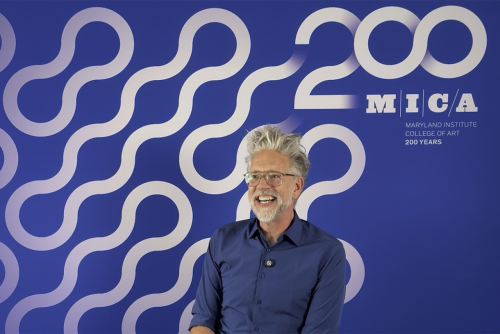
When Lee Davis first trained as a graphic designer, he was eager to use creativity to address pressing social and environmental challenges. But in the late 1980s and early 1990s, the field of “social design” didn’t exist. There was no clear professional path for artists who wanted to merge visual communication with global problem-solving.
“I didn’t really see a way forward as a designer doing the kind of work I wanted to do,” Davis recalls. Instead, he pivoted—first to Baltimore for graduate study at Johns Hopkins in public policy and international affairs, and then into international development work across Latin America and Europe.
Yet the pull of design never faded. And in 2012, when Davis met MICA professor Mike Weikert at a conference, he recognized a moment of return. Weikert had just launched the MA in Social Design, the first program of its kind in the United States. For Davis, it was an opportunity to come full circle—back to Baltimore and back to design. In 2013, he joined MICA, co-founding what would become the Center for Social Design, and today, the Center for Creative Impact.
Coming Home to Design
Davis’s entry into MICA was not a typical academic appointment. With years of nonprofit leadership and global fieldwork behind him, he had never worked inside a college environment. “MICA was exactly the place where I could marry my professional loves—the power of creativity and problem-solving—juxtaposed against big social and environmental challenges,” he says.
From the outset, Davis found a culture of receptivity. MICA embraced the Center for Social Design as an experiment that positioned the College as a pioneer in an emerging field. Together with Weikert and a growing network of partners, Davis began demonstrating how artists and designers could work alongside doctors, public health experts, and community organizers to tackle urgent problems. What began as a small, bootstrapped initiative soon expanded into dozens of collaborations across Baltimore, the country, and the world.
Where Things Start
What makes MICA different, Davis says, is the way it embraces new ideas and brings them to life. “I’ve loved my time here for many reasons, but one of them has been the receptivity to starting things,” he explains. “The College really embraced the idea of the center, putting MICA in a pioneering position in this evolving space of social design and design for social impact.”
That pioneering spirit has carried through MICA’s 200-year history. Few institutions can claim a past as storied: Abraham Lincoln once spoke in MICA’s downtown building; anthropologist Margaret Mead delivered a lecture on campus; and Victor Papanek, whose writing helped launch the global movement for socially responsible design, addressed the community here.
For Davis, the bicentennial highlights this dual movement of history—looking back while also looking forward. “That richness is not just about the past—it inspires the future,” he says. “MICA graduates are bringing creative problem-solving into contexts far beyond the traditional pathways of painting, sculpture, or graphic design. They’re working in nursing, in public health, even starting design and innovation units in city agencies.”
From Baltimore to the World
Davis’s career has always been shaped through a global lens, and at MICA, he has worked to ensure students share that perspective. In 2017, he helped launch a joint course between MICA and the Moholy-Nagy University of Art and Design in Budapest. Students in both cities worked across time zones on international branding projects. “It was logistically a nightmare,” Davis laughs, “but it showed what’s possible. And it enriched students’ experiences by exposing them to new people, cultures, and modes of thinking.”
Closer to home, the Center has embedded students in Baltimore’s civic life through long-term initiatives. The Jones Falls Initiative, for example, reimagines the historic river that cuts through campus as a site for ecological restoration and cultural vitality. By connecting students to the watershed that powered Baltimore’s industrial rise, the initiative also highlights the College’s responsibility to its environment and community.
Another example is MICA’s multi-year partnership with the Maryland Department of Transportation on pedestrian and bicycle safety. At first, officials were unsure what an art school could contribute. Four years later, MICA students and faculty had designed reflective streetwear for youth, created interventions to calm neighborhood traffic, and even helped redesign bike lanes near campus. “They now want us on all their projects,” Davis says. “It’s an example of how creative resources can reframe problems and produce tangible impact.”
The same principle guides the MA in Social Design, which remains unique among graduate programs. Unlike many innovation degrees that stay inside the classroom, MICA’s program is grounded in practice-based learning. Students work directly with community partners, building portfolios of real projects before they graduate. As a result, alumni have taken diverse paths: some join design studios, others enter public service or consulting, and many pursue doctoral studies or launch their own ventures. “The real metric,” Davis says, “is where alumni go and how they take equity and social justice with them into every field they touch.”
A Community for the Next Century
As MICA marks its bicentennial, Davis sees the celebration not only as a reflection on history but also as an opportunity to reimagine what comes next.
“I’m a history nerd, so I love uncovering forgotten stories that build pride in our community,” he says. “But combined with new leadership, this is also a chance to pause, rethink, and reimagine. The world desperately needs creative problem-solving, and MICA is poised to pioneer for the next 200 years.”
That pioneering spirit, he believes, is sustained by the community itself. Choosing MICA, Davis argues, is not just about pursuing an individual creative journey. “Once you’re here, you become part of a dynamic community. The future of art and design lies not only in individual brilliance, but in how we connect our work across disciplines, collaborate with others, and bring creativity to bear on society’s biggest challenges.”
This ethos—of connection, collaboration, and impact—is what Davis identifies as the singular strength of MICA. It is what makes MICA like no other. From its founding as the Maryland Institute for the Promotion of the Mechanic Arts in 1826, through fires and relocations, to becoming a national leader in design for social impact, MICA has always been a place where creativity meets consequence.
For Davis, that throughline shapes both his personal journey and the College’s future. His own career has moved from graphic design to international development and back again, always with a conviction that creativity is not ornamental, but essential. In co-founding the Center for Creative Impact, he has helped MICA demonstrate that conviction to the world.
“It’s about more than your own journey,” Davis says. “It’s about how your work connects—to your peers, to your community, to the world. That’s where the future lies for art and design.”