First-Generation Journeys
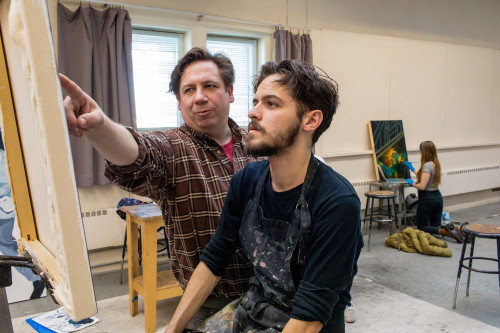
At MICA, first-generation college students have long brought their unique experiences, determination, and creativity to our community.
The Celebration event marked the first public event in honor of MICA’s 200-year anniversary
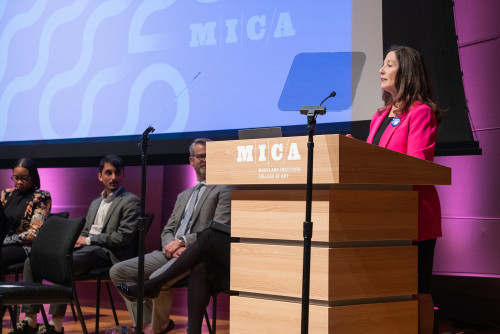
Two hundred years ago, MICA was founded on a bold belief: that creativity matters. On January 10, 1826, the State of Maryland granted a charter to the Maryland Institute for the Promotion of the Mechanic Arts. MICA’s founders had a powerful vision for this city and for a growing nation. They understood that creativity in the fields of drafting, architecture, and the mechanical arts required rigorous education to make a transformational difference in the lives of young people. They believed training could shape culture, drive innovation, and strengthen the economy.
That singular belief is what has carried MICA through generations of change. MICA has endured moments of profound change, most notably when fire destroyed the school’s only building… twice. Yet time and again, supporters stepped forward to pick up the pieces and rebuild.
In the early 1900s, MICA found a permanent home in Bolton Hill, with the newly constructed Main Building, a place that continues to inspire creativity and innovation today.
Across these two centuries, MICA has been shaped by the lives and the ideas of artists, educators, entrepreneurs, and civic, business, and government leaders. I am deeply grateful to be surrounded by this extraordinary community of support.
As I look ahead, I am proud to say that MICA is ready and moving forward with purpose. Because today is the start of the next chapter in MICA’s journey. Together, we are building a new future: for our students, for Baltimore, and for the creative economy that is shaping the future of work, community, and innovation.
For 200 years, MICA has been a place where the Studio is a sanctuary, serving as the singular space where creativity begins, and artists master their practice. It’s where artists explore what is possible through tactile materials that surround them… brushes, pencils, fiber, paper, clay, or even film.
That feeling of sanctuary is unmatched. It is something every student, faculty member, and alumnus recognizes the moment they set foot onto campus and enter a studio. That feeling of connection to all who came before them. To the sculptors inspired by the statues gracing the halls of Main. To the designers who discovered their passion for font and form. To the painters whose art continues to inspire from the walls of this remarkable place.
MICA is art. It is the foundation of who we are and what we will always be.
At the same time, we recognize that today’s environment presents real challenges. Regardless of politics, there is a shared sense of uncertainty in our nation and across the world.
At the federal level, we are seeing the U.S. Department of Education take an increasingly myopic view of professions and their value to society. At the same time, the arts are often challenged for giving voice to the voiceless and for embracing ideas that may run counter to those who are currently in power.
This is compounded by a lingering – and deeply flawed – assumption that art and design education is indulgent or unnecessary. But those of us at the Maryland Institute College of Art, we know better.
Institutions do not endure for two centuries by standing still. They endure by responding, again and again, to the needs of the moment.
Throughout my career, and especially here at MICA, I have seen how the creative process strengthens critical analysis and how the work of our faculty prepares students to question assumptions, synthesize complexity, and transform ideas into action.
What I witness every day at MICA is exceptional. We offer a rigorous foundation in the fine arts, layered with the liberal arts, and extended through deep work in each major. Our goal is to develop the mind of the artist and to help students decide not only what to make, but why—and where their work belongs in the world.
And that is why I am so excited about this bicentennial. We are accelerating what has always been true: MICA is a purveyor of ideas, talent, and impact. We evolve. We experiment. We build. We adapt. And that’s what creatives do.
As we enter our third century, I am excited to share three new and important initiatives that will shape the next chapter of MICA’s innovation and support for students as they move from ideas to action to impact.
Today, I’m proud to announce the relaunch of MICA’s master’s, professional, and continuing education programs. What was formerly known as Open Studies is now the School of Creative and Professional Studies (SCPS).
Learner pathways are changing. Careers are evolving. And the creative economy demands talent that can move fluidly between disciplines, industries, and opportunities.
The School offers flexible learning opportunities:
This is one way we will grow—by building new pipelines, new pathways, and new models of learning—while remaining true to the core of who we are as artists and designers.
The School of Creative and Professional Studies also offers degree-seeking programs designed to strengthen capacity and drive innovation. Many of these programs are asynchronous, allowing students to begin coursework anytime from anywhere. UX
In addition, the School offers modular and master series courses known as Professional Studio.
The School of Creative and Professional Studies delivers programs in leadership and strategy, luxury brand management, product management, creative and emerging technologies, entrepreneurship and venture development, and professional practice education. All these programs are designed for creatives and launched with our alumni, community partners, and employers in mind.
You may ask: Why MICA? The answer lies in our history. MICA was among Maryland’s earliest—and in some cases, the very first—college to offer education in applied science, technology, and engineering, predating formal engineering programs. MICA also pioneered some of the state’s earliest integrations of science, technology, and design to support workforce training for the railroad industry. What we are doing today is reimagining the long-standing commitment to applied arts and design.
According to Forbes, 70% of employers say creative thinking is the most in-demand skill. And what better college than MICA to prepare students of any age to thrive in the creative economy?
This afternoon, I am also excited to share new momentum around the Ratcliffe Center for Creative Entrepreneurship.
 The Ratcliffe Center is where students and alumni learn to transform their creative work into sustainable ventures for their lives and their careers.
The Ratcliffe Center is a catalyst focused on building the next generation of entrepreneurs who thrive in creative careers. It’s where ideas become prototypes, prototypes become ventures, and ventures become real-world impact through mentorship, training, project seed support, and a growing ecosystem.
Many of you are familiar with the UP/Start Venture Competition, and I thank you for serving as coaches and supporters. The competition has helped launch ventures ranging from sustainable design and fabrication to creative technology and storytelling platforms, to community-rooted small businesses.
The Ratcliffe Foundation will continue to support our students through scholarships and fellowships, and we are now introducing an alumni bridge program. Through this initiative, MICA will offer recent graduates who are developing ventures the opportunity and space to continue their projects post-graduation. Participants will have access to studio space, mentorship, and the full support of the Ratcliffe Center, allowing them to move their ventures into the world with strength, strategy, and enduring power.
Creative entrepreneurship at MICA is about agency, the ability to build a life and a career rooted in creative practice. This work is only possible because of generous and sustained support.
As our partnership with the Ratcliffe Foundation demonstrates, meaningful progress is built through collaboration both on and off the campus. The work of the Ratcliffe Center, together with MICA’s Center for Creative Impact, represents a vital part of who MICA is today.
Hold on to this thought because we will have more information later…
Now, the nexus of it all—the first public announcement of a new initiative we have been building with great intention.
MICA will now launch a Design and Innovation Hub.
 Built on innovation, the Design and Innovation Hub will serve as a “maker-in-residence” for the challenges facing our community. The Hub is a collaborative ecosystem — a “third space” — where students, faculty, and partners from business, nonprofit, and public sectors come together to leverage our labs and studios to transform creative ideas into cutting-edge solutions with real-world impact.
How does it work?
Our students move seamlessly from the classroom to internships, into business and community-sponsored projects that address real challenges, whether developing a new product, reimagining a public space, or tackling a social issue.
The pathway looks like this:
from studio to startup,
from classroom to the world,
from idea to action to impact.
The Hub connects programs, spaces, and partnerships, activating creativity in service of meaningful change.
The Hub includes:
At the heart of the Hub is a commitment to scaling experiential learning.
The Design and Innovation Hub provides MICA students with a platform to connect ideas, partners, and possibilities at scale. Yet a platform alone is not enough. To fully realize its promise, students need guidance, mentorship, and clear pathways to move from creative potential to lived purpose.
This is where our faculty, business partners, and leaders of the Hub come together, using creativity to address challenges and needs and bring business ventures from concept to fruition.
And we will also need civic leaders, government leaders, and friends of the college to help make this work.
Simply stated: Partnership is essential to how we move forward.
At MICA, I see a new definition of partnership – one in which the return on investment is driven by deep connection, community-engaged projects, sustainable funding, and mentorship that prepares students for meaningful careers. By developing our students in this way, MICA and our partners will drive growth in Maryland’s creative economy here in Baltimore and beyond.
Let me share a few examples of this type of partnership and the real difference that it is making for MICA, our students, and our community.
To begin, the new Design and Innovation Hub recently received project seed money from Trustee and MICA parent Doug Tsui to hire an experience director for identifying and coordinating projects within the hub.
We have also secured nearly $2 million in project funding to advance and expand our work in the field of Biodesign.
 An anchor of the Design and Innovation Hub is the Center for Creative Impact, which received $1.6 million this year to support its work, most notably its efforts to reimagine the Jones Falls Watershed with city partners.
The other anchor of the Hub is the Ratcliffe Center for Creative Entrepreneurship. As I shared earlier, MICA received a commitment for an additional $4 million this year from the Ratcliffe Foundation.
We have received two notable scholarship gifts totaling $8.4 million.
And here is the point: these investments are not isolated wins. Together, they signal a clear direction and an integrated strategy for MICA’s next century. This is intentional work, grounded in our values and mission, focused on lasting impact and where others find this as compelling as we do.
We are an art and design college nationally ranked in the top 10 with a long-standing tradition of embracing creative entrepreneurship. We are oldest independent continually operating school of art and design in our nation.
MICA is unlike any other institution.
So, as we celebrate 200 years, here is what I hope you carry with you:
We honor the past — absolutely. I extend my gratitude to my predecessors, Fred Lazarus and Sammy Hoi, who were stewards of this institution. We celebrate these moments that made us who we are.
But we did not gather here simply to look back. We are here to design the future: to invest boldly in students, to expand pathways, to shape an ecosystem where creativity drives both commercial and social innovation within the creative economy.
We move forward with confidence — not alone, but with partners — because we know what MICA has always been and what it is prepared to become. I invite you to partner with us to build investments, initiate projects, secure grant funding, and strengthen connections with people and organizations. These partnerships will be multidirectional relationships that create shared value. This is how MICA intends to work moving forward.
To thrive for the next 200 years, we cannot work in isolation. Success depends on collaboration that benefits all.
Today, MICA is in the midst of exciting work. These three initiatives are helping to shape who we are and what we aspire to be. Our mission is to prepare students for meaningful lives and impactful careers.
For now, I’ll leave you with a simple invitation: celebrate with us — and imagine with us. The next 200 years are just getting started.
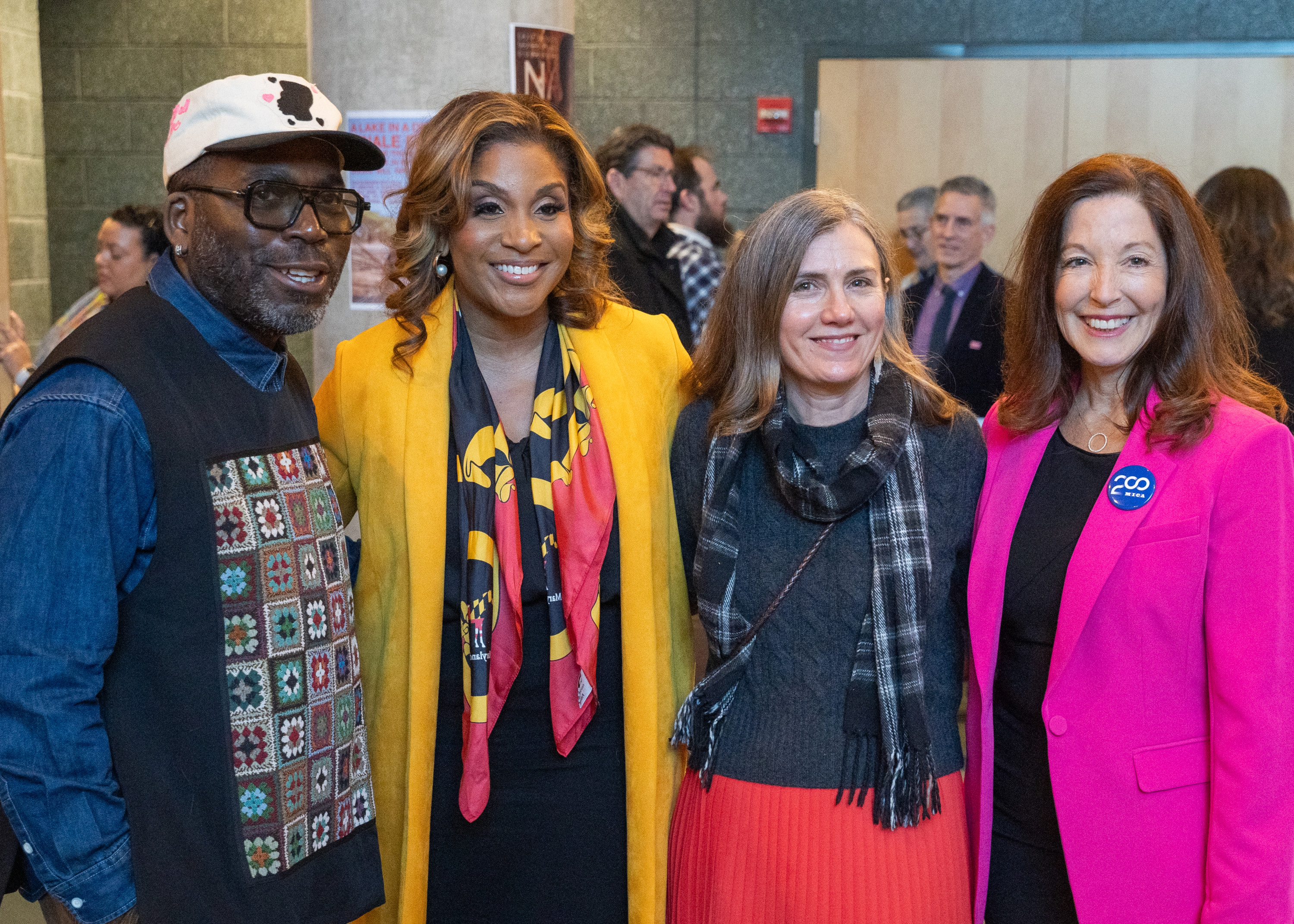 president Mccormick, far right, with guests (from left to right) Derrick Adams, maryland first lady dawn moore, and cara ober, during the kickoff celebration's ending reception.
Join the festivities as MICA honors its 200-year history, recognizes its present success, and looks forward to a bright future. Throughout 2026, the College will be sharing community stories and announcing one-of-a-kind events on campus, in Baltimore, and beyond.