The first set of paints Nadia Tomoney ever owned was contraband.
Her grandfather had given her the watercolors after she became fascinated by the small scenes he painted from his years in the military and the sketches he made of his grandchildren. But in a busy Philadelphia household full of siblings, paint — and the mess that could come with it — wasn’t exactly encouraged. So Tomoney hid the set from her parents.
“I thought, ‘This paint is definitely not something I’m allowed to take, but I’m taking it anyway because my grandpa gave it to me,’” she recalls.
More important than the paints themselves was what her grandfather had shown her: Art could hold a story. “If my grandpa can tell his stories, I can tell my own, too.”
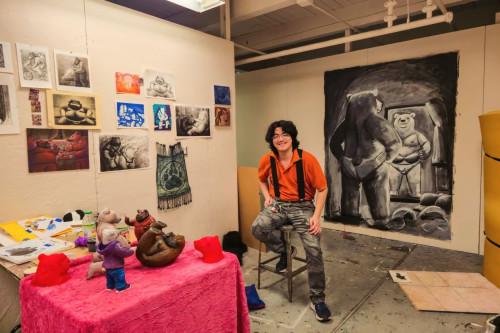
Years later, that idea remains at the center of Tomoney’s work. A painting major who will graduate from MICA in spring 2027, she creates deeply personal work shaped by memory, family relationships, dreams, and the ways one generation leaves its imprint on the next.
A Different Message
Tomoney grew up in Philadelphia and began her college education at the Community College of Philadelphia. When MICA representatives visited the college to speak with students considering their next steps, she noticed something different in their message. Other schools, she says, tended to emphasize careers and earning potential. MICA talked about community, artistic development, and the work students were creating.
Visiting Baltimore helped make the transition easier. The city reminded her of Philadelphia to feel “a little like a second home.” But arriving at MICA also brought uncertainty. Coming from a community college and having been largely self-taught before that, Tomoney wondered how her experience compared with that of her classmates. Over time, that uncertainty gave way to confidence, not simply in her technical abilities, but in the value of her ideas.
“MICA — the professors and the students — taught me to really trust my instincts and enjoy the process of making art,” she says. “I’ve also learned to appreciate my own opinions and instincts more.”
Painting what words cannot say
Tomoney began to think of herself as an artist around age 14 or 15, when she started taking commissions. But something more important was happening at the same time: She discovered that painting could express things she found difficult to put into words.
“I wanted to express myself more and more,” she says. “I’m not the best when it comes to words or telling people how I feel, so I figured my work could be that outlet for me.”
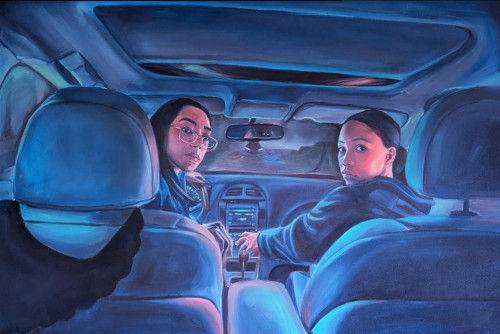
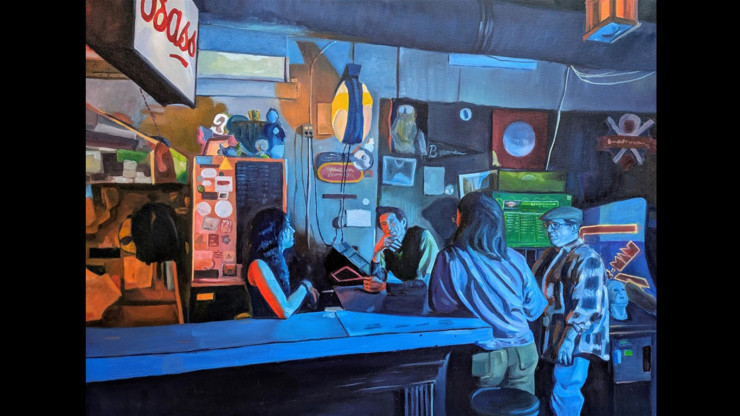
For years, that exploration centered largely on self-portraiture. Tomoney used her own image to consider identity, memory, and emotion, often working in blues and pinks that became part of her personal visual language.
“When a lot of people think of blue, they think of sadness, depression, or something very emotional,” she says. “I want to flip that a little bit. I want to show how beautiful blue can be, even if there is a little sadness to it.”
The selection of colors also reflect the tension between what Tomoney reveals and what she keeps private.
“I want people to see the beauty of me on the outside, but there are some things that affect me in certain ways that I’m not very open about,” she says. “So, there may be a little bit of blue, there are some things underneath, but it’s also very pretty.”
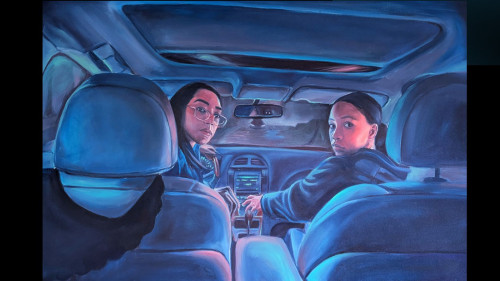
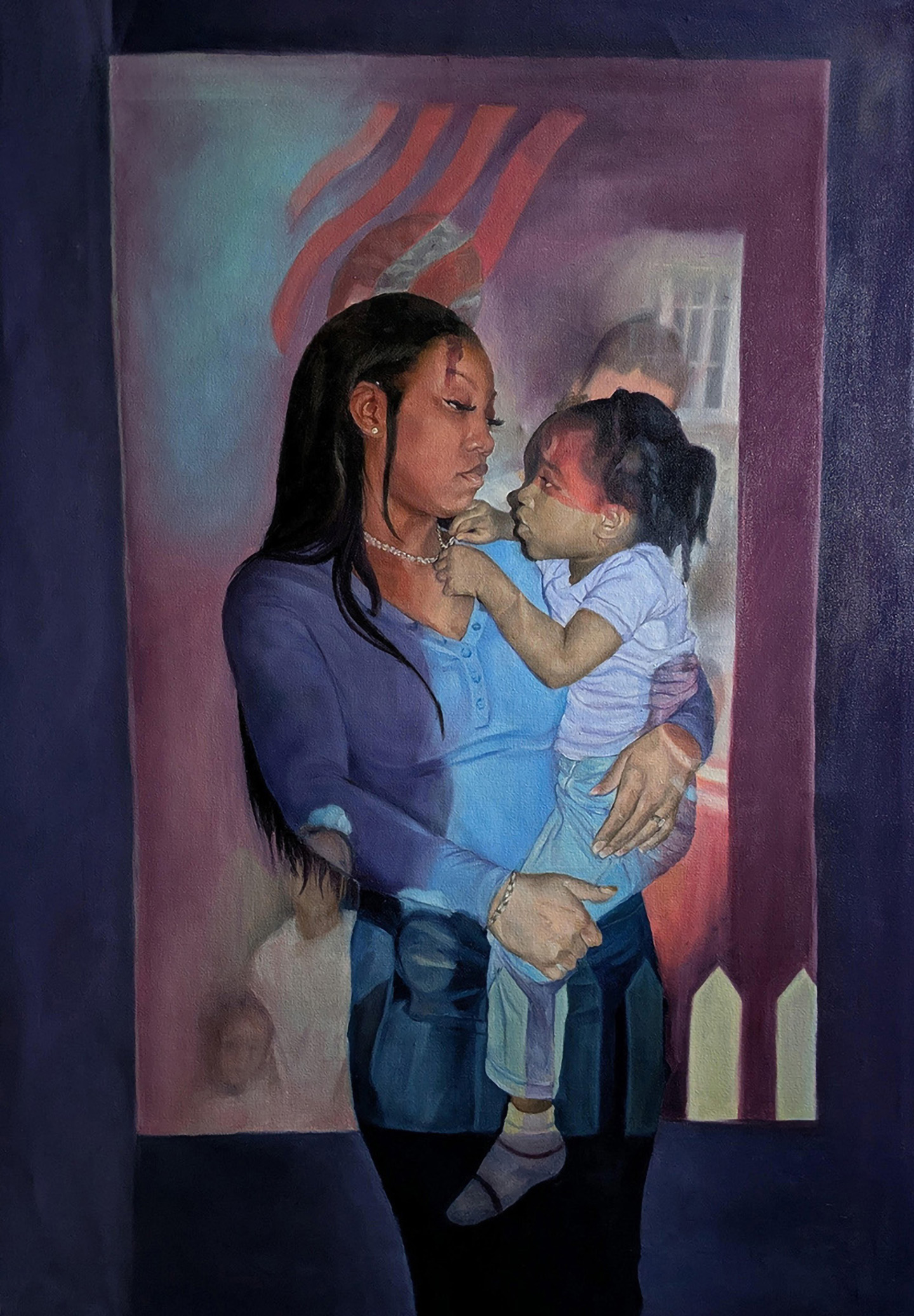 At MICA, Tomoney’s work has increasingly moved beyond self-portraiture toward the family relationships that helped shape her. That shift is especially evident in Heirloom, a painting depicting her older sister and niece. The work began with a deceptively simple assignment from a professor: Create what she considered her best work. She spent about three weeks trying to determine what that meant. Eventually, she realized that rather than attempting to create her most technically impressive painting, she needed to make the one that carried the most meaning.
“I kept thinking about what had shaped me as a person,” she says. “What relationships did I watch growing up that made me act the way I act or show people certain parts of myself?”
Again and again, she returned to the relationship between parent and child. Tomoney chose her sister and niece as the central subjects and began talking with her sister about childhood, how she remembered being raised, how she understood her relationship with their mother, and how those experiences influence the way she wants to raise her own daughter.
The resulting painting contains more than the two figures immediately visible to the viewer. Faded above her sister’s head is an image of Tomoney’s grandmother. The work also incorporates images of her sister and mother when her sister was a child, along with childhood photographs of Tomoney and her sisters. The painting compresses generations into a single image, connecting grandmother, mother, daughter, and granddaughter. For Tomoney, it also marked a turning point.
“I realized that a lot of the emotions I felt weren’t just my own,” she says. “They were things I felt from family members or friends.”
Her earlier self-portraits asked how she could express herself. Heirloom prompted her to consider more deeply what and who had made her the person she is.
“A lot of my strength comes from my family,” she says. “If I didn’t have their support, I don’t know what I would do.”
Even her palette shifts with the subject. The blues and pinks remain closely associated with her self-portraits, while paintings of family tend toward warmer colors.
“The warmer tones feel more comfortable, cozy, and loving,” she says, “and that’s how I see my family.”
Trusting her instincts
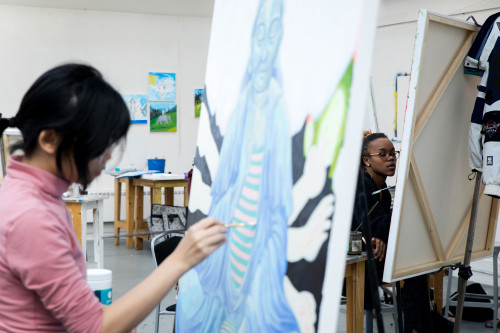
Tomoney typically begins a painting with an idea and a sketch, followed by photographs when needed. Increasingly, she has returned to family albums, using childhood photographs to revisit moments that cannot be recreated. She builds her oil paintings gradually, starting with thin, desaturated layers that help establish the composition and color relationships. Later, she adds thicker, more saturated color.
Her willingness to experiment has been accompanied by a growing comfort with allowing others to encounter and critique work that can be intensely personal. That growing confidence received an unexpected affirmation when Tomoney was selected as one of 40 finalists from about 600 submissions for the AXA Art Prize. For an artist who was homeschooled and says much of her early art education came from teaching herself online, the recognition was significant.
“For the longest time, I didn’t feel like my work could be at the level of being part of an exhibition because I wasn’t exposed to things like that growing up,” she says.
Still, she decided to submit. “Why not just try it and see where it takes you?” she remembers thinking. “If I don’t get it, at least I tried.”
Being named a finalist surprised her, but it also reinforced a lesson she has been learning throughout her time at MICA: Her own experiences and instincts are enough to begin.
“I’ve learned that my thoughts alone are good enough to lead to a successful painting,” she says.
Next steps
As MICA celebrates its 200th anniversary, Tomoney is preparing for what comes next. After graduating, she hopes to exhibit in local galleries while exploring another side of the art world. A curatorial class has sparked an interest in gallery work and in considering how artworks interact when placed alongside one another. At the same time, she plans to continue building her career as a painter, following an impulse that began with a watercolor set secretly tucked away at home.
Her grandfather painted his memories. Tomoney is painting hers, while discovering that memory rarely belongs to one person alone. Family histories overlap. Relationships echo across generations. The stories people inherit become part of the stories they tell.
For Tomoney, the canvas is where those stories can speak.
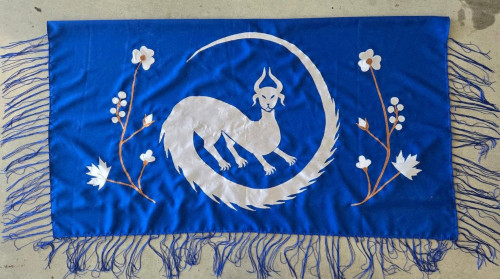
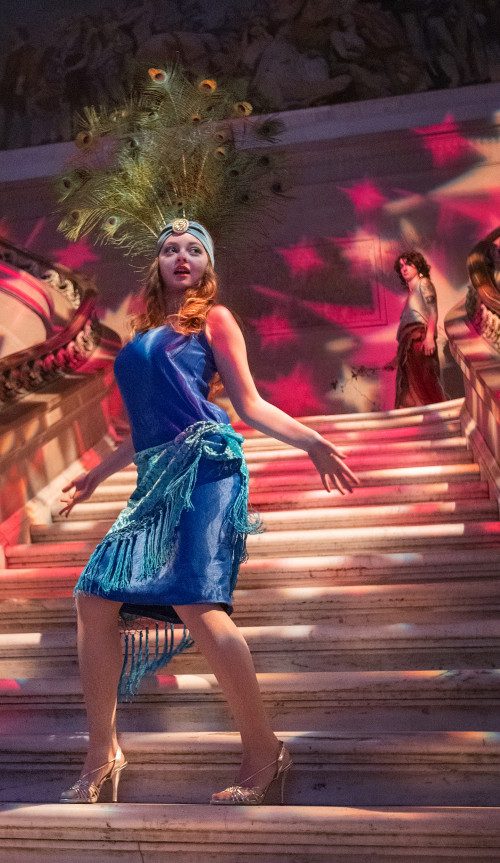
Above: “Heirloom,” 2026. Oil on canvas, 48 x 36 inches. Below: Additional work by Nadia Tomoney. All images courtesy of the artist.