Thank You Week: Board of Trustees
As we begin a week of reflection and gratitude, we celebrate the dedicated leaders who help shape MICA’s future and express our heartfelt appreciation…
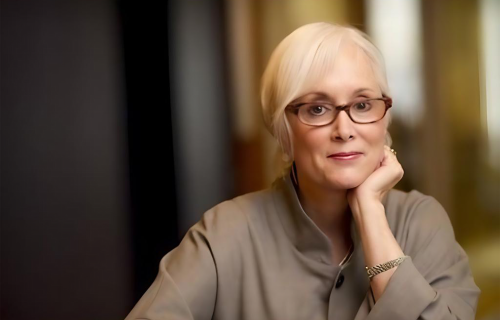
Debra Rubino ’92 (Photography MFA), MICA Board of Trustees, former Vice President of Strategic Communications
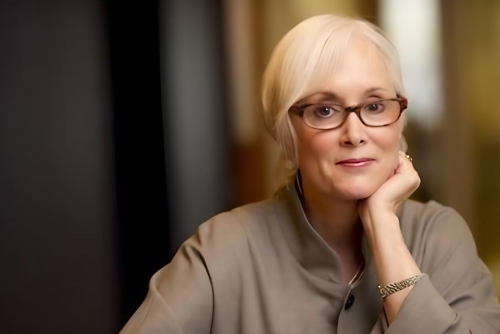
When Rubino first arrived in Baltimore in 1988, she received a memorable piece of career advice. New to the city and weighing two job offers — one at MICA and another at Johns Hopkins — she asked a longtime Baltimore doctor which one he thought she should take.
“Oh, I would definitely take the one at Hopkins,” he told her, “because at [MICA], you might not even get your paycheck.”
“There was never, ever a problem with the paycheck,” Rubino says with a laugh. “But that was sort of my introduction to being here in Baltimore.”
She chose MICA.
Nearly four decades later, the choice has shaped both her professional and creative life. Since 1988, Rubino has experienced MICA from nearly every angle: staff member, graduate student, alum, senior administrator, and, today, member of the Board of Trustees. Along the way, she earned her MFA in 1992, built a career in strategic communications, and remained a practicing artist. Through all those roles and through enormous changes at both MICA and in Baltimore, one thing has kept her connected.
“What keeps me connected to MICA is the ethos and the fact that it is an institution that really believes in the power of art and design,” she says. “I feel that has helped me define my entire life.”
An English major in college, Rubino had also been pursuing photography when she arrived at MICA. The possibility of becoming part of an arts community drew her to the College, and the experience gave her something she would carry long after earning her MFA.
“I feel like I really need a creative life,” she says. “And I think the confidence to lead that creative life was born [at MICA].”
Her artistic practice has evolved over the years. Photography remained its foundation, but she eventually moved into printmaking, initially incorporating photographic images, and later working with found and natural objects, including birds’ nests and stones. But what attracted her to both photography and printmaking was, in part, uncertainty.
With film photography, she loved the delay between taking a photograph and discovering what she had captured. There was no screen offering an immediate preview. Instead, there was the darkroom, the contact sheet, and finally the moment when an image emerged from the chemical bath.
“It was always thrilling to me and always surprising,” she says. “It never was exactly what I thought it would be.”
She found something similar in printmaking. Working with natural materials meant she often could not predict exactly what a finished piece would become.
“I love that idea that something unexpected emerges,” she says. “That is really what I think is such a compelling aspect of art making and viewing art.”
Today, she has returned primarily to photography, trading the black-and-white images that once characterized her work for experiments with color. She also has changed her expectations for what happens after an image is made.
The same curiosity that informed Rubino’s art also influenced her career in communications. She points to Studs Terkel’s 1970s oral history Working as an early influence. What struck her about the book was its attention to ordinary people talking honestly about their work and lives. They weren’t offering polished endorsements. They were telling genuine stories.
At MICA, she found those stories everywhere. Her office was in the Fox Building, putting her in regular contact with students. Their conversations revealed not only what students were making but how they thought. Those encounters helped shape her approach to institutional communications. Rather than relying on broad claims about an institution, she believed individual experiences could reveal what mattered about it.
“Stories and messages really define the personality and the value of an institution, but they have to be honest,” she says.
A statistic about hundreds of successful first-year students may be impressive, she notes, but the story of one student changing and growing creates a different kind of connection.
“The stories of what happens in the studio classrooms, the stories of what happens in the real world, or [the stories of] starting work — whatever it is,” she says, “I think that really illustrates what’s important.”
Rubino eventually left MICA for leadership roles at Goucher College and Open Society Institute-Baltimore, but her connection to the College and the city remained.
She was among six people who helped launch what became the Baltimore Collegetown Network, an effort rooted initially in a simple problem: Baltimore had a wealth of colleges and universities but lacked an easy way for students to move among them. The solution began with transportation and a shuttle connecting institutions. But the idea quickly became larger than transportation. Senior leaders from colleges and universities began exploring ways their institutions could collaborate. Then-MICA president Fred Lazarus was an enthusiastic supporter.
For her, the experience also demonstrated what artists can contribute beyond traditional ideas of art making. Artists, she says, are not simply “single individuals painting at an easel.” Their creative thinking can become part of collaborations across disciplines, including, for example, MICA artists working alongside Johns Hopkins engineering students.
“Some of the most creative, interesting solutions happen when you merge,” she says.
That belief in connection helped draw her back to MICA in 2015, when then-president Sammy Hoi recruited her as vice president of strategic communications. Rubino was particularly interested in the College’s growing emphasis on diversity, equity, and inclusion and its desire to build deeper relationships with Baltimore, interests that connected with her social justice work at Open Society Institute-Baltimore.
“It was a very different place from the institution I left,” she says. “There were surprises. There was a lot of excitement at that moment, so I was glad to be back home again.”
The MICA Rubino returned to looked very different from the one she joined in 1988.
When she first arrived, MICA had far fewer buildings and was not truly a residential institution. She remembers the communications challenge when MICA built its first residence hall. Previously, the lack of dormitories could be framed as part of developing an artist’s independence: Students learned from the beginning how to find a place to live and navigate the city.
Once MICA began building student housing, the story had to change. The emphasis shifted toward building an artist community. Since then, the physical campus and academic programs have expanded dramatically. The culture has changed, too. Yet Rubino believes something fundamental has endured.
“The core — the heart of MICA — still remains the same,” she says.
Now, as a trustee, Rubino views that balance between continuity and change from another vantage point. Her decades-long relationship with MICA gives her a reservoir of institutional memory, but she sees that history not as an argument against change but as a foundation for it.
“You recognize what you cherish and want to continue, as well as the real need to change,” she says. “For an institution to survive and thrive, I don’t think it can stay in the same place.”
As MICA marks its bicentennial and looks toward its next century, Rubino returns to the idea that first drew her to the College: the value of a life surrounded by art and artists. She is concerned that art and culture are not always afforded the respect they deserve. That makes protecting MICA’s foundation in the fine arts even more important, she says, not by preserving the institution unchanged, but by allowing that foundation to support whatever comes next.
“What I value, and what I hope to keep talking about in this leadership position, is the need to really honor the past and to honor the fine arts,” Rubino says, “and then to really move in a powerful new direction without losing that base.”
For someone who has spent nearly four decades watching MICA change — and changing alongside it — that may be the most fitting vision for its third century: hold onto what matters, remain open to what emerges, and leave room for the unexpected.

Join the festivities as MICA honors its 200-year history, recognizes its present success, and looks forward to a bright future. Throughout 2026, the College will be sharing community stories and announcing one-of-a-kind events on campus, in Baltimore, and beyond.