Thank You Week: Board of Trustees
As we begin a week of reflection and gratitude, we celebrate the dedicated leaders who help shape MICA’s future and express our heartfelt appreciation…
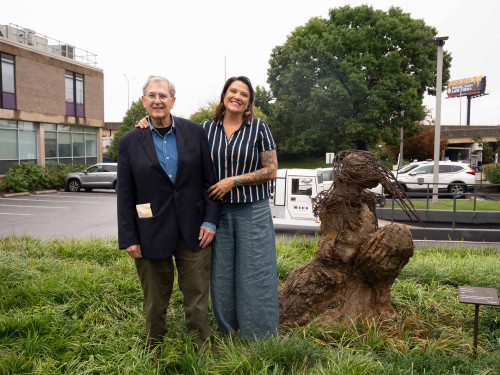
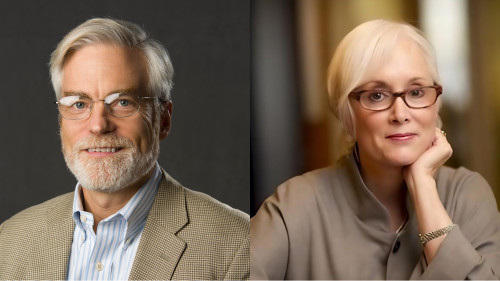
David Wallack, MICA Board of Trustees

Before his career in investment management, before his role as a trustee and treasurer at MICA, David Wallack carved stone. After college, where he studied medieval history and art, Wallack spent two years working with his hands, shaping blocks of material into precise forms. That early connection to craft never left him, even when his career path eventually led him into the world of finance.
“I’ve always had an affinity for creative things and creative people,” he says.
That affinity deepened when he moved to Baltimore more than 35 years ago. Wallack admired the city’s cultural institutions and wanted to play an active role in supporting their future. When the opportunity arose to join MICA’s investment committee in 2015, he accepted without hesitation. Within a few years, he became a trustee and now serves as the college’s treasurer.
“It was a sense of responsibility,” he explains. “A love for the arts, a love for this institution. MICA is a leading institution in Baltimore and nationally. I wanted to see it thrive.”
Wallack has served on other boards, but from the beginning, he recognized that MICA operated differently.
“Academia is its own environment,” he notes. “You have to balance so many constituencies—students, alumni, faculty, staff, donors. While students are our key constituency, all of these voices shape the future of the college. MICA embodies that complexity.”
That shared governance, while sometimes messy, is part of what makes the college unique. It reflects a culture of collaboration where creativity thrives not only in classrooms and studios but also in the ways the community makes decisions together.
Asked what distinguishes MICA most, Wallack doesn’t hesitate: resilience.
“If you look at MICA’s history, there have been episodic periods of change and challenge,” he says. “The school has continually reinvented itself to meet the needs of Baltimore and the wider world.”
That resilience, he adds, is what places MICA in rare company: the oldest continuously degree-granting fine arts college in the country, one of only 75 U.S. colleges older than 200 years.
Wallack has seen that resilience up close. The years of the COVID-19 pandemic tested every aspect of higher education, and MICA was no exception.
“It was incredibly adverse for colleges like ours, where so much depends on teaching and personal contact,” he recalls. “It was financially challenging. The board had a lot of work to do to make sure we had the right people in place. While we were fortunate to hire Cecilia McCormick, it took everyone at MICA—faculty, staff, students, trustees—coming together to find our center and move forward.”
That spirit of collaboration mirrors moments from the college’s long history. In 1903, when a fire destroyed the Main Building’s predecessor and wiped out nearly everything—records, works of art, classrooms—the city and local philanthropists rallied. Within weeks, classes resumed in borrowed spaces, and with support from Andrew Carnegie, the new Main Building rose soon after, hailed as one of the most beautiful academic structures in the country.
MICA’s ability to turn adversity into opportunity is also evident in the wartime years. During World War I, the college offered classes in camouflage, preparing soldiers to protect themselves on the frontlines. During World War II, MICA students designed posters that became part of the national war effort.
These stories, uncovered by Wallack in MICA’s archives as he helps the school prepare for the bicentennial, reinforce his conviction that resilience is the college’s defining trait.
For Wallack, resilience is not just a historical theme but a guiding principle for MICA’s future.
“When I joined the board, I was a rank amateur in higher education,” he admits. “But what I’ve learned is the importance of always being willing to change, evolve, and adapt. That’s what MICA has always done, and that’s what we must continue to do.”
Looking ahead, Wallack hopes MICA never loses sight of its roots. “We began as an institution focused on teaching people how to draw,” he says. “That emphasis on fine arts fundamentals became central to our identity. Not all competitors share that identity, but for MICA, it’s deeply embedded in our DNA. I hope we hold on to that.”
At the same time, he acknowledges the importance of global reach. Today’s student body already reflects the world, drawing artists and designers from every continent. Alumni carry MICA’s influence into careers across industries and geographies. The challenge, Wallack believes, is to continue extending that reach while remaining grounded in the fundamentals.
As he reflects on MICA’s bicentennial, Wallack returns again and again to one word: resilience. From its founding as the Maryland Institute for the Promotion of the Mechanical Arts—training draftsmen and craftspeople for Baltimore’s industries—to its current role as a leading college of art and design with global influence, MICA has endured, adapted, and flourished.
Time and again, MICA has faced moments when its future was uncertain. Time and again, it has emerged stronger. That, Wallack argues, is what makes the college different.
For Wallack, serving as trustee and treasurer is both a responsibility and a privilege. It connects his lifelong love of art and craft with his expertise in finance, while allowing him to play a role in shaping the future of an institution he believes is vital to Baltimore and beyond.
“MICA is like no other school,” he says. “Its history, its resilience, its creativity—all of it makes this place unique. And if the past 200 years have shown us anything, it’s that MICA will continue to adapt and thrive for the next 200.”

Join the festivities as MICA honors its 200-year history, recognizes its present success, and looks forward to a bright future. Throughout 2026, the College will be sharing community stories and announcing one-of-a-kind events on campus, in Baltimore, and beyond.