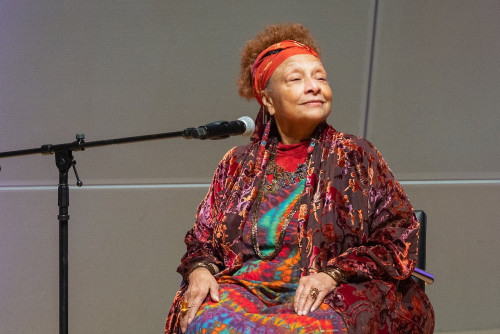
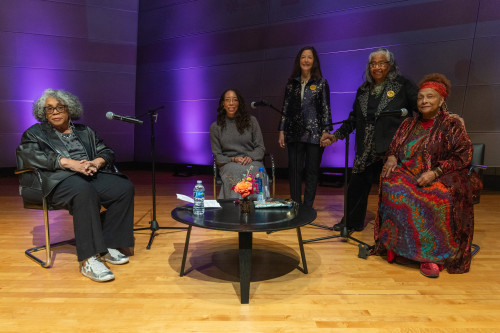
In Baltimore, where art, history, and community intertwine along city blocks and across generations, few names resonate as deeply as Joyce J. Scott. A 1970 MICA graduate (Art Education, BFA), Scott has spent more than five decades transforming beads, glass, fiber, and performance into a fearless artistic language, one that confronts injustice while infusing beauty, humor, and healing.
Internationally recognized as a MacArthur Fellow, she remains deeply rooted in the city that shaped her. A self-described “Sandtown girl,” Scott was creating long before she received formal training. Born in 1948 to parents who journeyed north during the Great Migration, she inherited a lineage of makers, quilters, potters, storytellers, and craftspeople who understood art as a means of survival. Guided by her mother, Elizabeth Talford Scott, a nationally recognized and widely collected textile artist, she learned to sew, bead, and imagine freely, developing a practice that would ultimately reshape contemporary understandings of craft and sculpture. Today, she lives in nearby Upton, close to the Sandtown neighborhood where her creative life first began.
At MICA in the late 1960s, Scott arrived intending to paint but quickly discovered a broader calling. Immersed in the political urgency of the Civil Rights movement and encouraged to explore across media, she experimented with clay, weaving, printmaking, and sculpture, developing the technical fluency and confidence that still define her work. After earning her BFA, she continued her studies in Mexico and earned an MFA/Crafts from the Instituto Allende, beginning a lifelong journey of artistic exploration shaped by travel, collaboration, and cultural exchange.
Scott is best known for her mastery of the off-loom peyote stitch, a free-form bead-weaving technique she elevates into powerful sculptural forms. Thousands of luminous glass beads, sometimes joined by blown glass, found objects, or textiles, become vessels for autobiographical memory, political witness, and cultural storytelling. Her works draw viewers in with dazzling surface beauty before confronting them with themes of racism, sexism, violence, and inequality.
“I’d like my art to induce people to stop raping, torturing, and shooting each other,” Scott has said. “I don’t have the ability to end violence, racism, and sexism. But my art can help [others] look and think.”
Across jewelry, figurative sculpture, printmaking, installation, and performance, Scott’s practice refuses categorization. Humor and irony mingle with grief and reverence; spirituality meets sharp social critique. Whether memorializing collective trauma or celebrating resilience, her work insists that art can be both aesthetically radiant and morally urgent.
That conviction has carried her onto a global stage. Her work resides in major public collections, from the Baltimore Museum of Art and the Smithsonian’s National Museum of African American History and Culture, to the Metropolitan Museum of Art and museums across the United States and beyond. Major retrospectives have traced the arc of her career, including Kickin’ It with the Old Masters, which drew more than 100,000 visitors, and the sweeping 50-year retrospective Joyce J. Scott: Walk a Mile in My Dreams, launched in 2024 and traveling nationally. She has also performed nationally and internationally with “The Thunder Thigh Revue” and “Ebony and Ivory.”
Honors have followed: awards from the National Endowment for the Arts, the Louis Comfort Tiffany Foundation, and Anonymous Was a Woman; the Smithsonian Visionary Artist Award; and, in 2016, the John D. and Catherine T. MacArthur Foundation Fellowship, often called the “genius grant.” Yet for Scott, recognition is inseparable from responsibility. Having attended school through scholarships, she established the Joyce J. Scott Endowed Scholarship Fund at MICA to support future generations of artists, especially those historically excluded from opportunities.
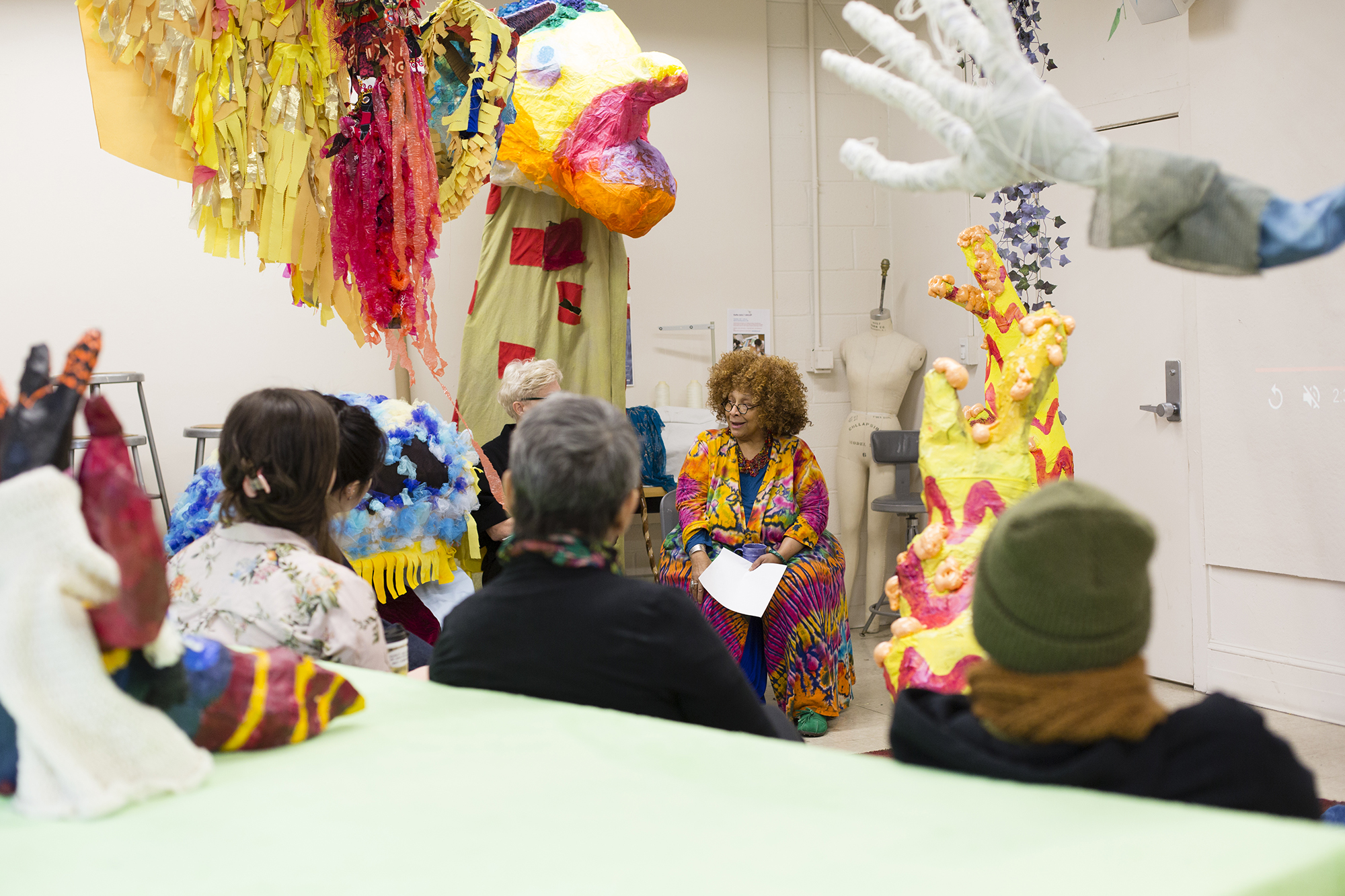
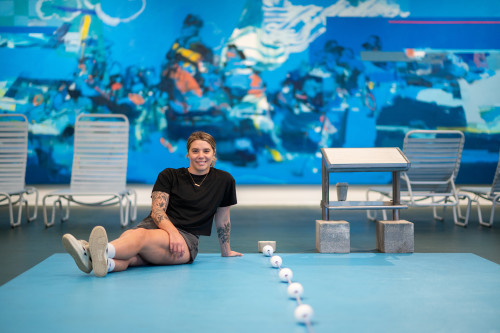
Scott, center, amongst works and students in MICA’s Fiber department.
Throughout her career, Scott has remained committed not only to artistic excellence but to community access. She has taught, led residencies, collaborated with artisans and glassmakers around the world, and exhibited in galleries where working-class audiences could encounter and collect art. Her performances, often infused with storytelling, music, and comedy, extend that accessibility, using wit as a doorway into difficult conversations.
As MICA commemorates its bicentennial, Scott sees endurance in adaptation. Art, she believes, connects disciplines, generations, and ways of knowing. It is both ancient and urgently contemporary. And to students just beginning their creative journeys, her message is disarmingly simple: never stop.
“To be creative is miraculous,” she says. “You are needed. You are valuable. If you can’t find a niche, make one.”
Looking back across a lifetime in art, Scott does not claim solitary achievement. Instead, she speaks of inheritance, of standing on the shoulders of those who came before, of carrying forward light entrusted to her.
Her mother once told her, “Do not hide your light.”
Two centuries into MICA’s story, Joyce J. Scott continues to let it shine.