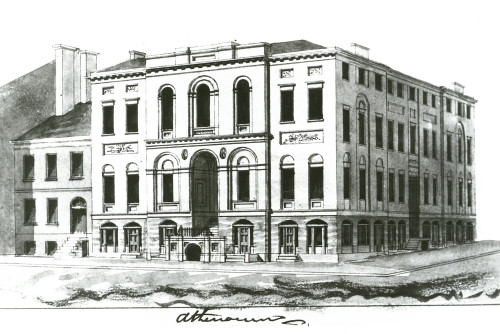
On February 7, 1835, flames consumed the Athenaeum—the Maryland Institute’s first home—destroying classrooms, library, scientific apparatus, records, and collections. The loss was total. What had been a lively center for learning and public exchange vanished in hours, leaving the Institute without a home, without resources, and without a clear path forward.
The Institute’s First Home (1826–1835)
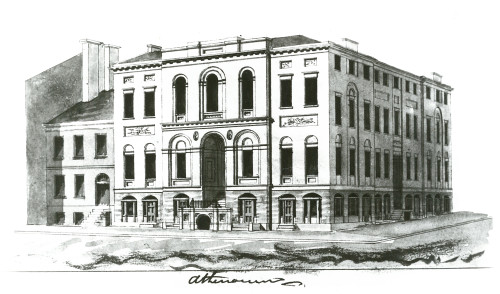
Even before its charter was officially in hand, the Maryland Institute rented quarters in Baltimore’s Athenaeum, a Greek-style building that stood at a prominent downtown corner. In its rooms, the Institute began shaping a new kind of civic education—one that paired knowledge with practice and welcomed the larger public into its mission.
Inside the Athenaeum, the Institute offered:
- Public lectures on science and emerging technologies, alongside programs in music, architecture, history, and literature
- A library to support study and experimentation
- A drawing school focused on practical skill-building
- Exhibitions showcasing inventions and the work of mechanics, artisans, and students
The Institute’s first public lecture took place just days after incorporation in January 1826, and the program quickly gained momentum. Crowds frequently overflowed the Athenaeum’s meeting spaces. Lectures were designed to be accessible — priced “within the means of all” — and audiences included not only working mechanics and students, but also professionals and members of the general public. Women, rare participants in such settings at the time, were present as well, making up a notable share of attendees.
A City Marked By instability
The Athenaeum’s destruction did not happen in isolation. The mid-1830s were marked by financial instability and rising unrest, and the months after the fire brought even more volatility. By August, Baltimore was gripped by uprisings and “… postponement of [the Institute’s] renewal until a more convenient season, was unavoidable.” Soon, the nation would plunge into the Panic of 1837, deepening the economic crisis and making rebuilding impossible.
A Twelve-Year Hiatus—and a Vision That Endured
With the Athenaeum gone and no viable way to raise funds, the Maryland Institute entered a twelve-year hiatus. The struggle was not unique. Mechanics’ institutes across the country faced similar threats to survival during the prolonged economic downturn.
And yet — despite the devastation — something persisted. As one account later reflected:
“But the spirit which had prompted [the Institute’s original] undertaking was not dead. The project… still kept its place in their hearts and minds.”
That stubborn continuity mattered. In 1847-1848, supporters reorganized the Institute and renewed its mission in arts and technical education. The public response to an opening exhibition and lecture series in 1848 made the next step clear: the Institute needed a larger, permanent home.
Moving Toward Centre Market
Momentum for renewal led to plans for a new, ambitious facility above the rebuilt Centre Market. The location, near major civic buildings and a bustling commercial corridor, signaled the Institute’s renewed public purpose. The Board, which included architects and builders, embraced the idea of a space “worthy of high expectations.” Among those involved in early design was Robert Cary Long Jr., a founding member of the reorganized Institute.
Why February 7 Still Matters
The anniversary of February 7 is a reminder of resilience. The Athenaeum was the Maryland Institute’s first home: a hub of lectures, learning, experimentation, and civic participation. Its destruction could have ended the story. Instead, it became a chapter in a longer narrative, one in which the Institute found a way to begin again.