First-Generation Journeys
At MICA, first-generation college students have long brought their unique experiences, determination, and creativity to our community.
Laura Bacon, Creative Entrepreneurship / Community Engagement, Director, Baltimore Creatives Acceleration Network (BCAN), Interim Director, Ratcliffe Center for Creative Entrepreneurship (RCCE)
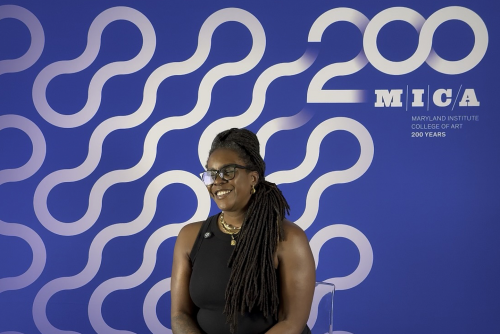
Laura Bacon, Director of the Baltimore Creatives Acceleration Network (BCAN) and Interim Director of the Ratcliffe Center for Creative Entrepreneurship, embodies MICA’s conviction that creativity and entrepreneurship are inseparable forces capable of shaping both individual lives and entire communities.
That belief is rooted in her own journey. Born and raised in the greater Baltimore area, Bacon grew up with MICA as a cultural landmark, an institution everyone in the city recognized. When the opportunity came to join the College, it felt like a natural next step—one that allowed her to merge the strands of her professional life: her work in education, her experience in entrepreneurship, and her love of the arts.
“It was an opportunity to bring together entrepreneurial work, education-based things I’d been doing in my career, and my love of the arts and creativity in general,” she recalls.
What makes MICA distinct, Bacon believes, is the way its environment fosters creativity. The College sits alongside Baltimore’s Station North Arts District, where galleries, murals, and performance spaces create an atmosphere of constant inspiration. “You see artists walking around; it feels like a little MICA enclave here in the city,” she says.
That location dovetails with Baltimore’s thriving entrepreneurial spirit. As Bacon discovered, creative entrepreneurs are the fastest-growing group in the city, with one of the highest percentages nationwide. “It feels like a really fertile place to develop a business and to do it with creativity in mind,” she explains. For her, creativity and entrepreneurship are synonymous. “I don’t know who’s opening businesses without creativity,” she adds with a smile.
Bacon’s philosophy of entrepreneurship is intentionally broad. She believes that some creatives want to transform their practice into a business, while others approach business through a creative lens and simply seek to live a creative life sustainably. What unites them, she says, is the need for an entrepreneurial mindset. “It’s essential for everyone, especially young people in today’s world.”
At BCAN, Bacon oversees MICA’s community-facing entrepreneurship work, supporting Baltimore’s creative entrepreneurs by connecting them with resources, mentorship, and networks. She sees BCAN as a way of strengthening the city’s creative ecosystem while also showing that Baltimore belongs to its artists, whether or not they are MICA students. In the years ahead, she envisions BCAN playing an even larger role as an advocate for the creative economy across Maryland.
The Ratcliffe Center complements this mission on campus. Through both curricular courses and co-curricular programming, it offers students practical experiences that prepare them for life after graduation. Pitch competitions, “Day in the Life” shadowing opportunities, and internships provide snapshots of entrepreneurial practice. Bacon emphasizes that the Center “practices what it preaches,” offering stipends and support that benefit both students and the small businesses they join.
The impact of this work is already visible. Bacon points to recent MICA graduates who have served as staff at the Ratcliffe Center. These young alumni, she explains, have learned how to “portfolio” their lives—balancing jobs, artistic practice, and further education. “They’re finding ways to support their creative lives,” she says. “It makes me proud to witness that.”
She also shares the story of an alumna who once participated in BCAN programs and competitions and will return in 2025 to run the creative market at MICA’s Creative Entrepreneurship and Social Innovation Conference. “I love the full-circle nature of that,” Bacon says, noting how many alumni remain connected to MICA’s entrepreneurial network long after graduation.
As MICA celebrates its Bicentennial, Bacon reflects not only on the importance of the milestone but also on the ongoing nature of history. “Milestones like 200 years are important to pause and celebrate, but honestly, it feels historic every day,” she says. From adapting to current events to reshaping the curriculum for emerging careers, she sees MICA as constantly evolving.
Her vision for the future is bold. She believes the world is on the cusp of another industrial revolution, one that will demand adaptability, creativity, and resilience. In that landscape, she sees MICA uniquely positioned to lead, showing what it means to be a creative who cannot only make art but also build a sustainable life. Global engagement is part of this future, with the Ratcliffe Center building connections from Denmark to Italy, sharing MICA’s best practices while learning from others around the world.
When asked what message she would leave for alumni, students, and the Baltimore community during this historic moment, Bacon doesn’t hesitate.
“Make your mark. You’re the only one who can make it,” she says.
In many ways, that message distills MICA’s enduring difference. The College is more than a place to study art and design; it is a community that shows students and alumni they belong, that their creativity matters, and that their ideas can shape the future. For Bacon, that is what makes MICA like no other.

Join the festivities as MICA honors its 200-year history, recognizes its present success, and looks forward to a bright future. Throughout 2026, the College will be sharing community stories and announcing one-of-a-kind events on campus, in Baltimore, and beyond.