Keeping Globe’s Story Alive
Bold colors. Legendary music. A Baltimore legacy that lives on.
Allison Tipton ’11 (Graphic Design BFA) / Manager, Globe Collection and Press at MICA
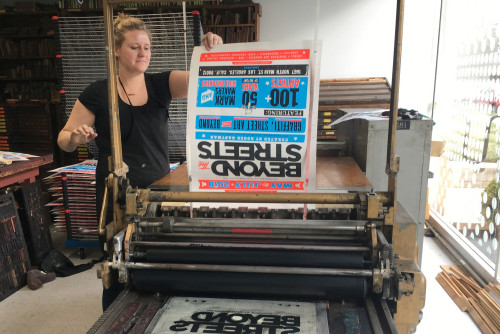
For Allison Tipton, the journey from MICA student to manager of the Globe Collection and Press began with a field trip, a room filled with wood type, and an unexpected discovery that would shape her career.
As a student studying graphic design with concentrations in book arts and printmaking, Tipton visited Baltimore’s legendary Globe Poster Printing Corporation, a company whose vibrant, boldly colored posters had advertised concerts, performances, and cultural events for generations. What she remembers most vividly is walking into Globe’s composing room and seeing cabinets stacked upon cabinets, every drawer filled with wood type.
“At MICA at the time, in our letterpress shop, we had a couple of drawers of wood type,” she recalls. “For me as a novice printer, seeing all that type was like hitting the gold mine.”
That moment sparked a connection that would help bring Globe’s historic collection to MICA and ultimately keep Tipton in Baltimore, where she continues to preserve its legacy and share the craft of printing with students.
Originally from rural Connecticut, Tipton arrived at MICA intending to pursue graphic design, attracted by the discipline’s combination of creativity, organization, and structure. But while she enjoyed designing digitally, she found herself frustrated by the disconnect between what appeared on a computer screen and what emerged from a printer.
“I wanted control of the process from start to finish,” she says. “And letterpress and type, the typesetting process, allowed that kind of start-to-finish control.”
Typography quickly became her passion. Letterpress also offered something for her that a computer couldn’t: a physical connection to the work. Setting type, mixing ink, operating presses, and moving through a print shop engaged her whole body in the creative process. For Tipton, the hands-on nature of letterpress brought a sense of immediacy and connection to the creative process that digital design could not replicate.
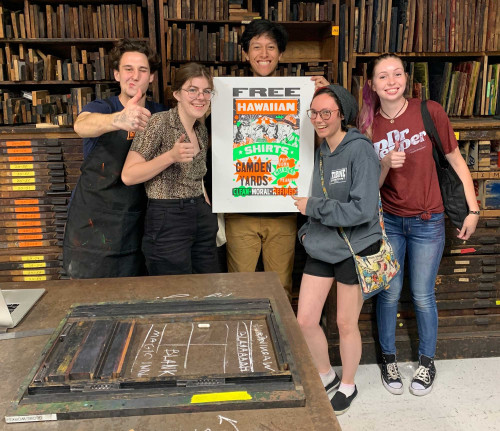
Tipton’s introduction to Globe Printing came through a MICA letterpress class that included a visit to the historic print shop. Captivated by its remarkable collection of wood type and printing equipment, she became more involved through an internship and eventually joined fellow students in the effort to bring Globe’s collection to MICA. What began as an opportunity to preserve an important piece of Baltimore’s cultural heritage would ultimately evolve into a defining professional commitment.
After graduating in 2011, Tipton intended to leave Baltimore, but the collection’s relocation was still underway. She agreed to stay through the summer to help complete the move, taking a position at another local print shop while continuing her work with Globe. What was meant to be a temporary stay became a lasting commitment. Fifteen years later, Tipton remains in Baltimore, preserving the collection that first inspired her as a student.
Globe’s posters are instantly recognizable for their electrifying colors, dynamic typography, and inventive compositions. They helped define the visual identity of American entertainment, particularly the rhythm and blues, soul, and Motown performers of the 1950s and 1960s.
“People know what Globe is even if they don’t know what to call it,” Tipton says. “Everybody’s seen a Globe poster.”
Many of Globe’s midcentury designs are created using precision cutting tools rather than brushes. The resulting compositions demonstrate how technical limitations can become sources of artistic innovation.
For Tipton, Globe’s significance extends beyond its distinctive graphic style. Its posters document generations of cultural experiences, from Baltimore performances to concerts across the country. Particularly notable is Globe’s influence on Washington, DC’s go-go music scene, where its bold, colorful posters became a visual expression of the genre. Though closely associated with DC’s musical identity, this iconic design style has its roots in Baltimore, underscoring the city’s far-reaching influence on American popular culture.
Today, Tipton’s work involves more than caring for historic materials. She is also helping preserve the specialized knowledge required to produce them. An invaluable partner in that effort is longtime Globe printer Bob Cicero, whose firsthand experience spans decades of changing printing technologies.
Cicero witnessed Globe’s evolution through letterpress, screen printing, and offset printing. His knowledge provides context that the physical collection alone cannot convey. For Tipton, capturing that experience is urgent.
As printing technologies evolve, traditional skills can disappear. She points to copperplate engraving as an example of a craft whose techniques have been lost and subsequently relearned. Preservation, in her view, means keeping both the objects and the processes alive.
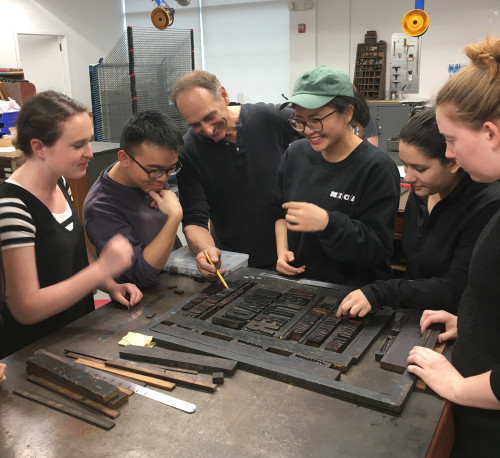
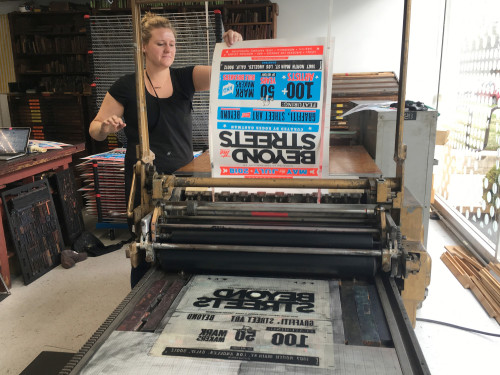
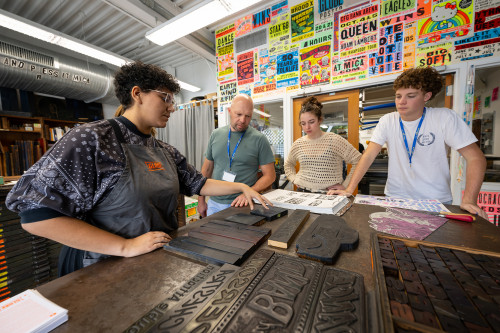
Tipton now shares that philosophy with MICA students through workshops, internships, and hands-on experiences in the Globe Press shop. Students who have learned about kerning, leading, and tracking on computers discover what those concepts mean when every letter is a physical object. For students accustomed to screens, the experience can be transformative. It also creates a sense of ownership. From choosing type and colors to operating the press and returning each letter to its drawer, students participate in every stage of production.
For Tipton, Globe is not simply an archive of beautiful posters. It is a living connection between generations of makers, a testament to Baltimore’s cultural influence, and a reminder that the most meaningful traditions endure when they are shared. And sometimes, a lifetime of creative purpose begins by opening a drawer of wood type.
Join the festivities as MICA honors its 200-year history, recognizes its present success, and looks forward to a bright future. Throughout 2026, the College will be sharing community stories and announcing one-of-a-kind events on campus, in Baltimore, and beyond.