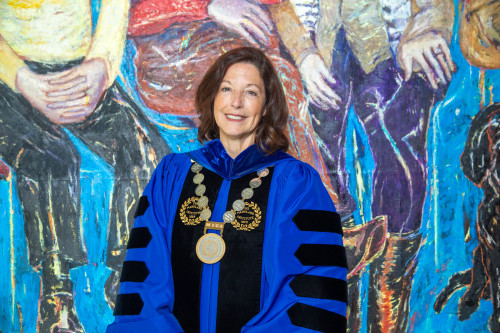
Convocation 2026: Speech by President Cecilia M. McCormick
Good morning.
Convocation is one of my favorite moments on the academic calendar. It is a time of new beginnings, where you can feel that sense…
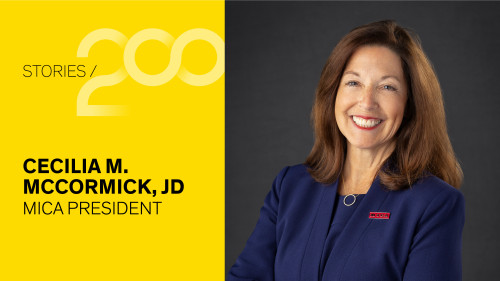
Cecilia M. McCormick, JD, President
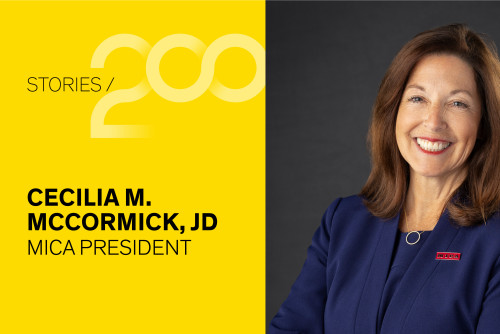
Ask Cecilia McCormick how she became president of one of the nation’s premier colleges of art and design. The story doesn’t begin with paintbrushes or sketchbooks. It begins with a first-generation college student who learned that education could change the course of a life.
That conviction has guided every chapter of McCormick’s career, from law school to executive leadership at several universities, and, eventually, to the presidency of the Maryland Institute College of Art (MICA). It also explains why, as MICA celebrates its bicentennial, she talks as much about opportunity, careers, and student success as she does creativity. For McCormick, those ideas are inseparable.
An art education should inspire imagination, she believes, but it should also prepare graduates to build meaningful careers, strengthen communities, and adapt to a rapidly changing world. It’s a philosophy well-suited to an institution entering a defining moment of its own.
Founded in 1826 to prepare students in mechanical drawing and drafting for an industrializing America, MICA has continually reinvented itself alongside the nation’s evolving creative economy. Now, as advanced technology reshapes creative work and families increasingly ask what a college degree is worth, McCormick believes the institution is once again being called to answer the moment.
The role wasn’t one she ever expected to hold.
McCormick’s professional path wound through law, university administration, and executive leadership, where she became known for helping institutions strengthen operations, build long-term sustainability, and position themselves for the future.
So, when MICA approached her nearly three years ago, accepting the presidency felt like the next opportunity to apply the experience she had gained throughout her career. “What better place to go?” she remembers thinking.
The answer was about joining an institution whose history reflects the kind of leadership she values: honoring tradition while continually evolving to meet changing realities.
Long before she occupied a president’s office, McCormick understood the power of education. She grew up as one of eight children in a family where college wasn’t assumed; it was cherished. Neither of her parents had the opportunity to pursue the education they wanted, but they were determined their children would.
“From a very young age, it was instilled in me that education creates opportunity,” she says.
McCormick was one of the first in her family to earn a college degree. Experiencing that opportunity firsthand shaped her own future and her understanding of what colleges owe their students.
Throughout leadership roles at Johns Hopkins University, Elizabethtown College, Philadelphia University, Thomas Jefferson University, and now MICA, she has remained focused on one simple idea: meet students where they are and help them discover what they can become. That philosophy extends well beyond inspirational language.
“When you meet people where they are, give them opportunities and watch them grow,” she says. “you see remarkable transformation and growth.”
Under McCormick’s leadership, MICA has strengthened collaboration across campus, expanded the use of student-success analytics, and built systems that identify students who need help before small challenges become barriers to graduation.
“It takes a team,” she says. “It starts in the classroom, but it extends far beyond it.”
Helping students graduate, however, is only part of the equation. McCormick is equally determined to ensure they leave prepared to thrive.
Parents ask the question almost immediately. Students do, too. “Will an art degree lead to a job?”
McCormick doesn’t shy away from the conversation. She believes artistic excellence will always remain the heart of a MICA education. But she also believes today’s graduates need entrepreneurial skills, financial literacy, professional networks, and the confidence to navigate careers that rarely follow a straight line.
“Their passion is their art,” she says. “What they have to pair that passion with is an intentional understanding of how to create opportunities for themselves.”
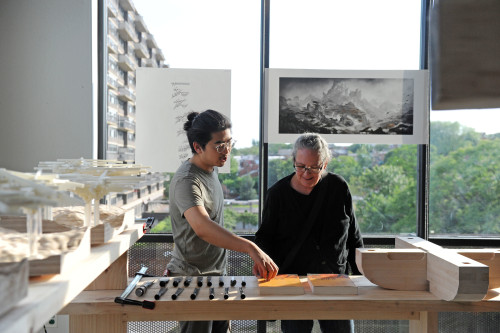
That belief has reshaped how students experience MICA. Through initiatives including Creative Experiential Learning, the Design + Innovation Hub, the Ratcliffe Center for Creative Entrepreneurship, and the Center for Creative Impact, students begin addressing real-world challenges long before graduation.
Some design public murals or product packaging. Others develop branding campaigns, improve pedestrian safety, explore ways to reduce food waste, or help restore oyster habitats in the Chesapeake Bay. Projects like these strengthen portfolios, but just as importantly, they build confidence, professional relationships, and practical experience.
Today, McCormick notes the shift in creative careers extends far beyond galleries and studios into healthcare, technology, environmental sustainability, transportation, and countless other fields.
“Our graduates develop unique ways of thinking, solving problems and approaching challenges,” McCormick says.
Those uniquely human abilities, she believes, are becoming even more valuable. “Creativity is the one resource that cannot be automated, outsourced, or depleted.”
For McCormick, creativity isn’t confined to classrooms. It thrives in a connected and collaborative community. One phrase in MICA’s mission statement captures her vision: “Thrive with Baltimore.”
Having spent much of her career in both Baltimore and Philadelphia, she understands that colleges and cities flourish together. She sees MICA as an anchor institution that can strengthen neighborhoods through public art, collaborative partnerships, and projects that improve quality of life while giving students valuable professional experience. That creativity means working alongside government agencies, businesses, foundations, and nonprofit organizations.
The same collaborative approach shapes MICA’s partnerships with elementary, middle, and high schools, introducing younger students to design thinking while preparing future educators to bring creativity into classrooms throughout the region.
Whether guiding institutional restructuring, strengthening long-term financial sustainability, or launching new initiatives, McCormick has learned that leadership begins with trust.
“There is already enough uncertainty in life. Whenever we can reduce uncertainty by communicating clearly, we’re helping people.”
That approach has guided MICA through a period when nearly every college is confronting demographic shifts, financial pressures, and changing expectations about the value of higher education. For McCormick, however, those challenges aren’t reasons to retreat; they’re reasons to evolve.
When McCormick talks about legacy, she isn’t interested in transforming MICA into something different. She wants it to become more fully itself.
“For me, success means leaving MICA stronger than when I arrived.”
That means a financially sustainable institution with deeper ties to Baltimore, broader public understanding of the value of artists, and graduates prepared to create beautiful work while making meaningful contributions to their communities and professions. The stereotype of the “starving artist,” she believes, belongs to another era.
Today’s MICA graduates become painters, sculptors, and ceramic artists. They also design digital experiences, improve transportation systems, strengthen public health initiatives, address climate resilience, and help shape industries that many people would never associate with art.
As MICA enters its third century, McCormick sees continuity more than disruption. Every generation has asked artists to respond to a changing world. The tools evolve. The challenges change.
Human imagination endures.



Join the festivities as MICA honors its 200-year history, recognizes its present success, and looks forward to a bright future. Throughout 2026, the College will be sharing community stories and announcing one-of-a-kind events on campus, in Baltimore, and beyond.