Happy International Students’ Day
Creativity knows no borders. Belonging knows no boundaries.
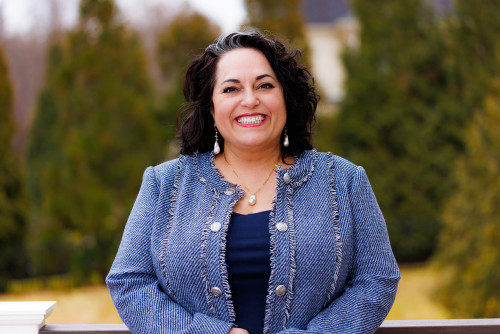
Athanasia (Sia) Kyriakakos ’91 (General Sculptural Studies BFA)
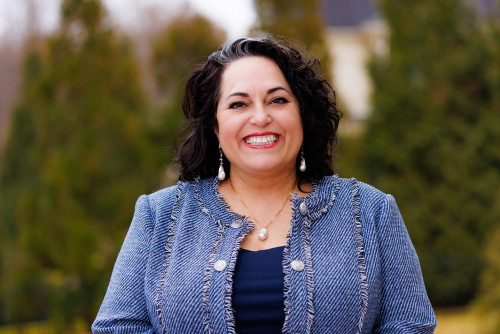
In a Baltimore classroom, the only sound is charcoal scratching against paper. Students are absorbed in their drawings, their attention fixed on the work taking shape beneath their hands. For Athanasia (Sia) Kyriakakos, a sculptor, educator, and Maryland State Teacher of the Year, the moment is extraordinary in its simplicity.
Many of her students face challenges that extend far beyond the classroom, from food insecurity and trauma to gaps in their educational opportunities. Yet here, surrounded by their classmates, they have found a moment of focus, creativity, and belonging.
For Kyriakakos, such moments represent the culmination of a creative journey that has taken her from Baltimore to Greece, across Europe, and onto one of contemporary art’s most prestigious international stages. Along the way, she discovered that her most meaningful artistic medium was not sculpture, painting, or performance, but community itself.
Born in Baltimore to Greek immigrant parents, Kyriakakos spent much of her childhood navigating two worlds. Her parents operated Mamma Mia’s, a restaurant near Johns Hopkins Hospital, but concerns about neighborhood violence prompted the family to return to Greece when she was six. She spent the next decade there, immersed in traditions that later would profoundly influence her artistic practice.
At 16, Kyriakakos returned to Baltimore, where she enrolled at Parkville High School. Two dedicated art teachers recognized her talent and encouraged her to pursue it. She took every art class available, sometimes repeating courses simply to keep creating. Although art schools across the country were recruiting her, her parents expected her to remain close to home. College meant opportunity and financial security, but the family’s plans did not include a career as an artist.
Then she discovered MICA. Within a week, Kyriakakos and her family arrived on campus with a hatchback overflowing with sculptures and paintings. After an admissions interview, a counselor enthusiastically offered her a place. Her mother’s response to the admission’s representative was unforgettable: “No money, no art.”
Fortunately, MICA offered Kyriakakos a nearly full scholarship.
Enrolling in the newly established General Sculpture Studies program, Kyriakakos embraced its interdisciplinary possibilities, exploring materials, processes, and ideas that stretched beyond conventional sculpture.
After graduating in 1991, Kyriakakos confronted an uncomfortable reality: Her artistic education had given her extensive technical skills but few professional credentials. Moving to Connecticut with her husband, fellow MICA alumnus and painter Morgan Showalter, Kyriakakos immersed herself in local galleries, art guilds, and nonprofit organizations. She learned the practical business of being an artist: organizing exhibitions, communicating with galleries, and building professional relationships.
But an unexpected teaching assignment would transform her understanding of art’s possibilities. When a friend became ill, Kyriakakos reluctantly agreed to substitute for a weekend art workshop serving teenage girls in a struggling Connecticut neighborhood. She arrived at a flooded basement space carrying supplies for papermaking. After ringing a school bell in the alley, she watched girls emerge from nearby homes, some still wearing bathrobes, and carrying breakfast.
Together, they made paper for hours, often in silence. “It was an amazing experience,” she recalls. The experience awakened something familiar. In her Greek upbringing, people gathered around shared activities: women wrapping dolmades, relatives sewing, families exchanging stories over coffee or late-night conversations. Creativity and community were inseparable.
“People come together, and a circle forms,” she explains.
Soon afterward, Kyriakakos enrolled in teacher education at Central Connecticut State University, this time recognizing that teaching and making art could enrich one another.
That realization deepened during graduate studies at the School of the Art Institute of Chicago. Having spent years creating artwork rooted in her identity as a Greek American woman, Kyriakakos began questioning whether art could move beyond personal expression to become a shared experience.
A professor challenged her understanding of performance, suggesting that even an ordinary conversation could constitute a work of art. Kyriakakos began exploring the rituals of her childhood, particularly the Greek tradition of reading fortunes in coffee grounds. She recreated her grandmother’s porch, inviting visitors to drink coffee, exchange stories, and contemplate their hopes and anxieties. These intimate encounters became artworks in themselves.
“For the time [visitors] spent with me, they became part of my extended family,” she says. “What they took away wasn’t necessarily an object. It was the experience of being together.”
Her work increasingly incorporated textiles, storytelling, domestic rituals, and participation, reflecting the generations of women whose hands had shaped her own understanding of creativity.
A Fulbright award took her back to Greece to investigate these traditions more deeply. What began as a yearlong research opportunity evolved into an extended period abroad and an international artistic career. In 2003, Kyriakakos represented Greece at the Venice Biennale. Her contribution to the Greek Pavilion drew upon another cultural ritual: sharing and interpreting dreams.
Traveling across Europe by train, she invited strangers to describe what they had dreamed the previous night. Their stories became the foundation of a multimedia installation combining video, translation, and an architectural projection environment. The project brought an everyday human experience into one of the world’s most prominent contemporary art exhibitions. For Kyriakakos, the conversations themselves were as important as the finished installation.
By the time she appeared at the Venice Biennale, Kyriakakos had achieved much of what she once imagined artistic success would mean. Her work was exhibited internationally, she received public recognition, and collectors were buying her pieces. Yet the experience also prompted difficult questions.
“There must be more to life than this,” she remembers thinking.
Kyriakakos had become disillusioned with the competitive nature of parts of the international art world, which contrasted with the collaborative spirit she had encountered at MICA.
As she and Showalter considered starting a family, her priorities shifted. Their daughters brought new meaning to responsibility and belonging. Eventually, the couple decided to return to Baltimore, where their children could grow up near their grandparents. The homecoming was humbling. After years of international travel and exhibitions, the family faced financial uncertainty and the challenge of rebuilding their professional lives. But Kyriakakos’ commitment to community would soon find a new expression.
When she returned to teaching, she deliberately sought a position in Baltimore schools. Her first assignment was in West Baltimore, where she encountered students facing profound social and economic challenges. Despite her international experience, she quickly realized that she had much to learn.
“I had to stop talking and start listening.”
The lesson echoed everything her artistic practice had taught her: Meaningful relationships begin with attention, empathy, and a willingness to understand another person’s experience.
Since 2011, Kyriakakos has dedicated her career to teaching in Baltimore, earning recognition as both Baltimore City Teacher of the Year and Maryland State Teacher of the Year. But beyond the accolades, her greatest concern remains the opportunities available to her students and the barriers that too often stand in their way.
At Mergenthaler Vocational-Technical High School, she teaches Foundations of Art, introducing students to creative possibilities many have never had the chance to explore. For some, discovering an artistic talent in high school comes too late to build the portfolios required for admission to competitive art programs.
“I might have a student for three months,” she explains. “They create three beautiful pieces of art, but three pieces aren’t enough to get into art school.”
Experiences like these have shaped her belief that educational opportunity should not depend on a student's circumstances or when they happen to discover their potential. This reality has pushed her to look beyond her own classroom for answers.
Through two Fulbright awards, including one focused on teaching and educational experiences in countries such as Colombia, Kyriakakos explored how communities around the world approach learning, opportunity, and civic responsibility. Her tenure as Maryland State Teacher of the Year broadened that perspective even further, bringing her into conversations about education policy at the national level. What she encountered, however, was a troubling disconnect between the priorities of policymakers and the everyday realities of students and teachers. Frustrated by that divide, Kyriakakos decided to take an unexpected step: She ran for Congress.
Challenging an established opponent with greater name recognition and financial resources, she knew the odds were against her. But winning was not her only measure of success. The campaign offered a platform to advocate for education and an opportunity to show her daughters and students what it means to stand up for something you believe in, even when the outcome is uncertain.
What emerged was a grassroots effort built on the same sense of community that had long defined her work as an artist and educator. Former students, fellow artists, relatives, friends, and supporters from across the political spectrum joined the effort. Campaign shirts were made in a cousin’s basement. Friends printed flyers at home. Students contributed photographs and videos. With limited resources but a shared commitment, the campaign became a collective undertaking.
“That was another kind of community,” she reflects. “It was about our children and our future.”
Today, whether inviting strangers to share their dreams, gathering visitors around a coffee table, organizing a political campaign, or guiding teenagers through drawing exercises, she is practicing the same essential art: creating spaces where people can connect.
And perhaps nowhere is that legacy more visible than in a classroom filled with young people, quietly making something of their own. For a moment, the world beyond the classroom falls away. There is only charcoal moving across paper, the concentration of students and the possibility of discovery.
In that simple observation lies the philosophy of a lifetime: Art’s greatest power may be its ability to bring us together.
Join the festivities as MICA honors its 200-year history, recognizes its present success, and looks forward to a bright future. Throughout 2026, the College will be sharing community stories and announcing one-of-a-kind events on campus, in Baltimore, and beyond.