Happy International Students’ Day
Creativity knows no borders. Belonging knows no boundaries.
Rhythm Singhal ’27 (Graphic Design BFA)
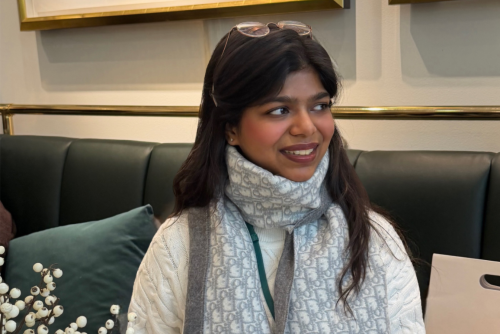
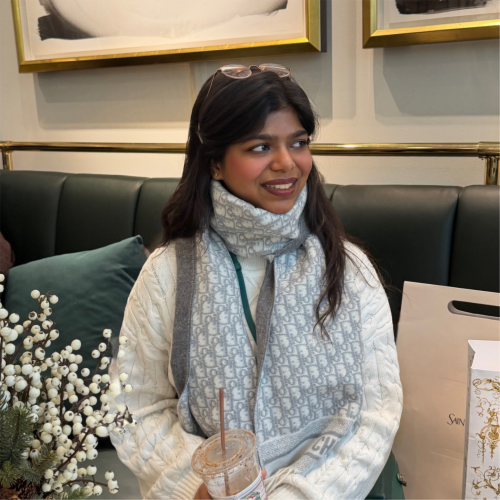
When Rhythm Singhal first arrived in Baltimore from Raipur, India, she was chasing both a dream and a question. What does it mean to be an artist in a global world, where creativity must speak across languages, cultures, and mediums?
“I did look at other colleges — like USC and some in the U.K. — but MICA stood out because of how warm and welcoming the community felt,” she recalls. “Everything about MICA gave me this sense of open-mindedness and inclusivity. I felt like this was a place where I could grow.”
That instinct — to follow warmth and community as a compass — has guided her journey ever since. She has learned that the power of design lies not just in form or function, but in its ability to connect people, a belief that echoes MICA’s 200-year legacy of art in service of community. Now a junior majoring in Graphic Design, with minors in Product Design and Creative Entrepreneurship, Singhal has already made her mark as a C.V. Starr Scholar, Fellow in the Office of Mission and Community Involvement, and Director of Communications for MICA’s Student Voice Association (SVA).
For Singhal, choosing MICA was more than an academic decision; it was a leap of faith. Moving halfway across the world at 18 meant leaving behind familiar places, languages, and family traditions to enter an entirely new creative ecosystem.
Once she arrived, Singhal realized her initial impressions were not just surface-level branding. They were real. “From the first day, people were so open and friendly. Everyone smiled and talked to me, which made me feel like I already belonged. It really did feel like a home away from home.”
That sense of belonging has been central to Singhal’s experience. It gave her the confidence to explore, take risks, and translate her cultural perspective into a visual language that others could understand.
For many artists, the early college years are a time of discovery and self-definition. For Singhal, they also brought clarity about what distinguishes MICA’s approach from that of other art schools.
Through a MICA-funded grant, she traveled with faculty and classmates to a design conference in Kansas, an experience that revealed just how different MICA’s educational philosophy truly is.
“At other art institutes, I noticed that students were being shaped to sell their work, to create for the market,” she says. “But at MICA, people create to make an impact. Students here make art that’s personal, expressive, and often tied to Baltimore or their own communities.”
That distinction, she believes, is essential. “The motivation isn’t just commercial; it’s about change, emotion, and storytelling. That’s what makes MICA different. It develops you as an artist, not just as someone who sells a product.”
Her professors, she believes, model this mindset in their teaching: encouraging students to explore social issues, identity, and collaboration, not simply technique. “We learn how to think critically, how to take feedback, and how to build something that has meaning.”
That same ethos inspired one of Singhal’s most ambitious projects yet: SLASH, a student-led fashion magazine she’s developing to celebrate creativity and identity across campus.
“MICA students are some of the most creative and expressive people I’ve ever met,” she says. “You can see it in how they dress; it’s so individual, colorful, and bold.”
Without a formal fashion major on campus, Singhal saw an opportunity to create something new: a platform that honors the school’s distinctive sense of style while also teaching students the real-world skills of collaboration and production.
“SLASH will feature students, faculty, and staff from all majors — photographers, writers, designers — working together to highlight wearable creativity,” she explains. “It’s a professional experience, too. We’ll handle photography, art direction, layout … everything.”
But beyond the skill-building, SLASH represents something deeper: a way of capturing the MICA spirit, that blend of individuality, community, and joyful experimentation that spills out of every studio and corridor.
“We want to show the side of MICA that people don’t always see,” Singhal says. “The energy, the personality, the process, how art and identity meet every day.”
If SLASH embodies MICA’s creative energy, Singhal’s work with the Office of Mission and Community Involvement channels its sense of purpose. As a fellow, she uses design to advance community engagement by translating abstract concepts into accessible, inclusive visuals.
“Design is incredibly powerful,” she explains. “It influences how people think, act, and feel. It’s part marketing, part psychology. The colors, typography, and composition, all of it can inspire action or empathy.”
That understanding — of design as both an art form and a social tool — shapes how she approaches every project. “My fellowship helped me see that design isn’t just about aesthetics; it’s about impact. It’s about communicating ideas that matter.”
She brings that same conviction to her communications role for SVA, where she helps connect students with campus leadership. SVA serves as a bridge between students and administrators, hosting events like Ice Cream with the President and town halls that invite honest dialogue.
“We collect feedback, host conversations, and meet with MICA’s leadership to make sure students feel heard and represented,” she says. “It’s about making space for every voice. That’s what being part of this community means.”
As a C.V. Starr Scholar and part of MICA’s vibrant international student community, Singhal has found support and kinship among peers who, like her, have traveled far to study art in the United States.
“MICA has a strong international student presence, especially from Asia and South Asia,” she says. “We share similar experiences of coming here for the first time and learning together. That sense of shared understanding really helps.”
Those connections, she adds, remind her that creativity transcends geography. “I’ve made close friends through that community, and we support each other, not just socially, but artistically. It’s a big part of why I feel at home here.”
As MICA celebrates its Bicentennial, Singhal sees the school’s history not as a fixed legacy, but as a living, evolving community. “I hope MICA never loses its sense of community and engagement,” she says. “The traditions bring people together. But it’s also about how we learn: how we critique, how we listen, how we grow as artists and as people.”
That learning process — communal, experimental, compassionate — is what she believes defines MICA. It’s also what will sustain it for the next century.
“MICA is like no other because it values people for who they are — their voices, their creativity, and their courage to express themselves,” she says. “It’s a place where art connects people, not just ideas.”

Join the festivities as MICA honors its 200-year history, recognizes its present success, and looks forward to a bright future. Throughout 2026, the College will be sharing community stories and announcing one-of-a-kind events on campus, in Baltimore, and beyond.