When Mars Pursley first began thinking seriously about college, art school was not part of the plan.
By junior year of high school, Pursley had already decided to study English at a college in Toronto. Growing up around higher education, her mother worked as an English adjunct, made college feel familiar. But as application season approached, Pursley began questioning whether the path she had chosen was one they actually wanted.
“I started thinking, ‘What is it that I actually want to do? What am I doing when I’m actually happy?’” Pursley recalled.
The answer kept leading back to the art room.
Pursley loved being around art teachers and other creative people and was fascinated by comics, animation, and visual art. Still, becoming an art student seemed almost impossible. Pursley had not spent years preparing a portfolio and worried that the realization had come too late.
A high school art teacher disagreed.
“She was like, ‘No way. It is never too late. We will focus your entire senior year on just preparing a portfolio,’” Pursley said.
That year became almost entirely about art. Pursley visited several colleges, but none quite felt right. Then her grandmother drove her from Pennsylvania to Baltimore for a MICA open house.
“I stepped on campus and I just knew,” Pursley said. “‘This is it. This feels right.’”
Even after being accepted to every school she applied to, Pursley could not shake that feeling. Inevitably, she chose MICA. What Pursley did not know was that another significant change was waiting once she arrived.
She entered MICA intending to major in Illustration, imagining a future in comics and animation and perhaps eventually working as a showrunner for a studio such as DreamWorks or Nickelodeon. But doing illustration every day produced an unexpected reaction.
“I was fine at it, I guess, but I was so miserable,” Pursley said. “Every assignment felt like pulling teeth.”
Professor Linnea Poole, adjunct faculty, graduate studies office, noticed. In Contemporary Visual Languages, Poole challenged Pursley to stop approaching assignments through the lens of the career she thought an artist was supposed to have.
“She said, ‘How about for the final you do something that you actually like?’” Pursley recalled. At first, the question was baffling. Then Pursley went home and looked around the room. There were moccasins they had made the previous summer. There were ribbon skirts they had sewn. Suddenly, the answer was obvious.
“I thought, ‘Wait. She’s right. I don’t like illustration. What I like is fiber. I like sewing and beading and handling material and transforming it.’”
Pursley returned to an unfinished bandolier bag, completing it with felt appliqué, beadwork, and elements of traditional Potawatomi storytelling. The experience changed the trajectory of her education. Pursley declared a Fiber major before even taking a Fiber course. That ability to see oneself differently has become central to Pursley’s understanding of MICA.
In high school, Pursley describes being extraordinarily shy, anxious about talking to strangers, and deeply concerned with gaining other people’s approval. Public speaking would have seemed unimaginable. MICA offered few opportunities to disappear.
Professors challenged Pursley to articulate her ideas, present sketches, discuss influences, and explain her thinking. Pursley initially dreaded it. Gradually, though, the fear faded.
A federal work-study assignment in MICA’s Admissions Office added another layer of confidence.
“Suddenly, people believed in me,” Pursley said. “They were like, ‘You can do this thing. Go do it.’ I had never really had anyone treat me that way, just assume that I was capable. And so, eventually, I just became capable.”
Today, Pursley speaks publicly, has developed a large circle of friends, and has even spoken at MICA’s convocation about transformation.
“The person I’ve become after coming to MICA is so completely unrecognizable from the person I was before,” Pursley said. That transformation is artistic as well as personal.
An enrolled member of the Citizen Potawatomi Nation, Pursley grew up learning traditional skills from family members and others in the tribal community. She learned to sew, make moccasins and bags, and create beadwork, skills connected not simply to making objects, but to participating in community and culture. Some of it also seemed instinctive.
Pursley remembers being about 12 years old, sitting among adults during a moccasin-making workshop and quickly understanding the process.
“This is so corny, but there’s this sort of way that fibers just speak to me,” Pursley said. “I can understand where something wants to be taken and what it wants to become.”
At MICA, those traditions have moved closer to the center of Pursley’s artistic practice. Beadwork remains a favorite medium because of both its creative versatility and its cultural history. Natural dyes offer another connection between art and Pursley’s understanding of responsible land stewardship.
But learning to look closely at the land and to think about responsible harvesting and the origins of materials shaped how Pursley sees both the natural world and artmaking.
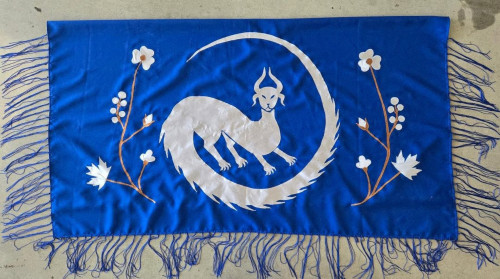
The bandolier bag that helped prompt the switch to Fiber reflects those overlapping ideas of culture, identity, and transformation. Pursley created a white rabbit surrounded by woodland florals, drawing inspiration from reservation-era designs while introducing personally meaningful imagery. The rabbit represented Pursley at that moment: small, scared, and inexperienced, but nevertheless willing to step forward.
Two accompanying felt appliqué pieces extended the story. A turtle represented Turtle Island, the past and where Pursley comes from. A flame represented the Seven Fires Prophecy and the hope of cultural healing and renewal.
“The project is really just about using that language of the bandolier bag to tell a story about my journey so far,” Pursley said.
MICA also helped Pursley understand that Potawatomi identity did not need to remain something quietly held apart from her work. Before college, Pursley described her heritage as something she was proud of but kept close. Within Fiber, professors and classmates responded to culturally rooted ideas with questions: Tell me more. Why is this important? Those invitations mattered to her.
“It’s changed from being something that is like a little fun fact into being a very central part of who I am in my practice, and how I think about the way that I interact with the world,” Pursley said.
Increasingly, that practice extends beyond making art to teaching others. In January 2026, Pursley led a two-needle flat-stitch beading workshop for Citizen Potawatomi members in Northern Virginia. It was the first workshop she had taught independently, and Pursley entered the room wondering whether she could explain something that had become almost intuitive. Then, about an hour into the workshop, something happened.
“I realized I wasn’t helping anyone anymore,” Pursley said. “They all just picked it up. And I was like, ‘Wow. I taught it. They know how now.’”
The experience reinforced an idea Pursley encountered again during the 2026 Potawatomi Leadership Program in Oklahoma: Cultural knowledge survives when people are willing to pass it on. That responsibility is increasingly shaping Pursley’s idea of the future.
She envisions becoming an educator, whether in a college classroom, through community workshops, or in another less formal setting. She hopes to learn more traditional crafts and then teach those skills to others.
Pursley also has begun thinking differently about leadership: The most powerful leaders encountered through the Potawatomi Leadership Program were not necessarily people holding formal positions. They were the people who welcomed others into drum circles, workshops, meals, and conversations.
“What I learned is that what it looks like to be a leader is to live in community with those you’re seeking to lead,” Pursley said.
For an artist whose MICA journey began with discovering the work she actually wanted to make, that lesson seems fitting. Making, teaching, cultural preservation, and community are becoming inseparable parts of Pursley’s vision.
“I see myself being a conservator of culture,” Pursley said. “I see myself preserving craft, and I see myself continuing to be a community educator.”