Credit
Photo by Mitro Hood
Jerrell Gibbs ’20 (LeRoy E. Hoffberger School of Painting MFA)
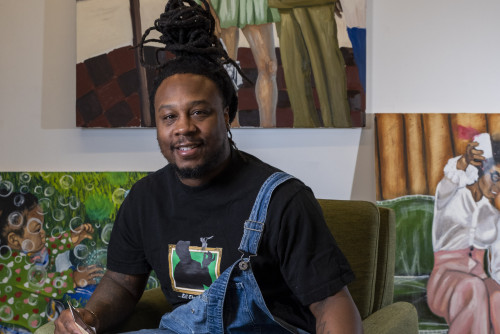
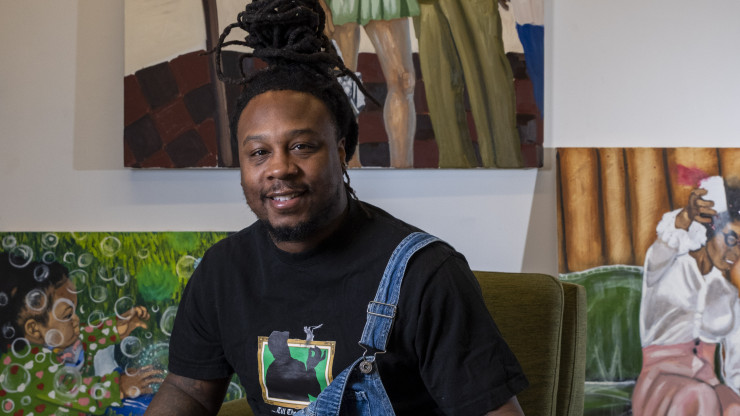
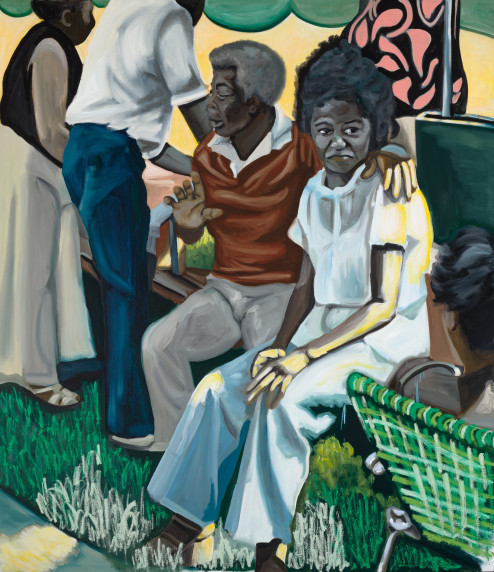
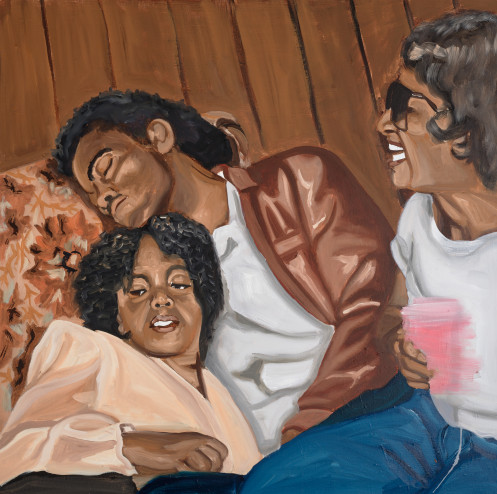
For Jerrell Gibbs, a painting can do more than show us what something looked like. It can return us to a place. He wants a viewer to sense the atmosphere of a family gathering, the familiarity of a living room, or basement, the warmth of people spending time together. When Gibbs painted the late Congressman Elijah Cummings, he approached the portrait with that same ambition. He wanted those who had known Cummings to encounter something beyond a likeness.
“I wanted them to kind of feel him,” Gibbs says. “I wanted them to look at the painting and be able to smell his cologne.”
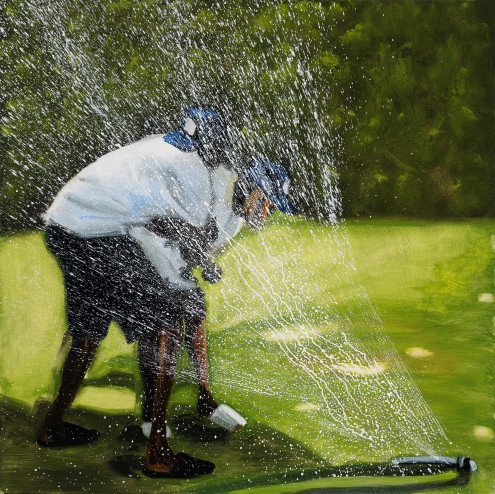
That desire to make paint carry memory, sensation, and lived experience runs throughout Gibbs’ work. Drawing frequently from family photographs, the Baltimore-born artist turns cookouts, gatherings, and seemingly ordinary moments into paintings that ask viewers to slow down and look again.
“The everyday is worthy because we all experience it,” he says. “We all share it.”
It is an idea Gibbs has refined over years of painting, including his time at MICA, where graduate study gave him the freedom to experiment, fail, and reconsider what he already possessed as an artist.
By the time Gibbs arrived at MICA as a graduate student, he had studied elsewhere and had already begun building an artistic community in Baltimore. But he recognized that if he wanted to take his work further, he needed to put himself in a place where being comfortable was not the goal.
“I absolutely aimed to take myself seriously,” he says. “If I wanted to continue to grow in this profession, I knew I needed an opportunity to fail and to be in an environment where people would challenge me creatively and help grow my practice to another level.”
MICA was in his backyard, but proximity was not the only draw. Gibbs understood that the community he had developed in Baltimore could support him without necessarily pushing him in the ways he needed. Graduate school offered something different: sustained scrutiny of the work and the chance to discover what separated technical ability from an artistic voice.
Among his cohort, Gibbs encountered accomplished painters still searching for what they wanted their work to say. The experience made him recognize the value of something he already had: a life outside the studio.
“I already had [experience], because I was living life before going to graduate school,” he says of finding his voice. “So, all of my time in the studio was focused on, ‘How do I become better?’”
For Gibbs, substance and skill became inseparable. Technique mattered, but so did having something authentic to bring to the canvas. He had already begun finding that substance in an unlikely archive: family photo albums discovered in his aunt’s basement.
Finding inspiration in this most unlikely of places, Gibbs used the photographs with a particular purpose. He wanted to paint images of Black people experiencing joy, affection, and community, scenes that complicated representations he saw circulating in news and social media.
“I was focused on counteracting a narrative about Black people through the photos that I was seeing,” he says. “I was making paintings about Black people enjoying time together, loving each other, and spending time with family and friends.”
Over time, his relationship to those photographs changed. The figures and their stories remained important, but Gibbs became increasingly interested in what paint itself could do. Rather than simply translating a photograph onto canvas, he began asking how color, surface, gesture, and atmosphere could evoke the sensation of a memory. That evolution also opened the paintings to viewers whose families and experiences might differ from Gibbs’ own. A cookout is specific, but it is also familiar. So are crowded living rooms, basements, and relatives gathered together. The details belong to one family, while the experience can belong to many.
“There’s beauty in the mundane if you take enough time to really focus on it, slow down, and pay attention,” Gibbs says.
He compares that act of looking to passing a tree every day. From a distance, he observes how the mind registers a tree: brown trunk, leaves, familiar shape. But upon closer observation he finds that sustained attention reveals gray, purple, red, and orange in the bark, insects moving across its surfaces, and details overlooked in the rush to get somewhere else.
“You’d be surprised by how much information we miss because we’re just moving on,” he says. “When you take the time to slow down and appreciate the things that you see and experience every day, I think we all can get a little more excited about who we are and where we are.”
That attention to ordinary life carries particular significance in Gibbs’ depictions of Black people, especially Black men. Rather than defining his subjects through struggle or turning them into symbols, he is interested in the simplicity of allowing people to exist fully within familiar human experiences.
“[I view my work as] the normalization of Black people,” he says. “It’s not about us being fetishized. It’s about simply depicting an experience that we all share and making the Black experience just as human as anybody else’s.”
Baltimore is embedded in that project. Gibbs was born and raised in the city, studied there, and continues to live and work there. His source photographs document Baltimore families and Baltimore experiences. Even the closeness among the people in his paintings reflects something he recognizes as distinctly connected to home.
“In Baltimore, we’re very close,” he says. “It’s a small city. Once you know one person, you know pretty much everybody.”
That interconnectedness gives his work its familial character without Gibbs having to consciously manufacture it. The stories come through the perspective of someone who knows the city from the inside.
“Everything that I’m infusing into these works originated here,” he says.
Seeing years of those works gathered together has allowed Gibbs to recognize how much his practice has shifted. Earlier paintings were often centered on the people depicted. Increasingly, he says, the experience itself has become the subject.
“Seeing my work together as a history really makes me aware of the evolution of my practice,” Gibbs says. “It makes me understand the importance of the work that I’m doing and the value behind it.”
That evolution has taken him from focusing primarily on the figures themselves to considering the memory surrounding them.
“It’s less about the figures in the works and more about depicting a memory in a way that’s relatable and receivable to those who experience it and view the work.”
Fatherhood has reinforced that movement toward patience and attention. Having children, Gibbs says, changed his relationship with time. He is less interested in rushing toward the next accomplishment and more conscious of inhabiting the present, partly because parenthood makes the passage of time impossible to ignore.
“Kids will make you [understand time] because you don’t want them to get older,” he says. “You value being where you are, and you make the most of every opportunity that you have today.”
He has learned to extend the same patience to painting. It is advice he gives his children and increasingly gives himself: Do the best work possible today; tomorrow’s work will grow from it.
That long view also shapes how Gibbs thinks about artistic legacy. For him, legacy does not begin with reputation or the market. It begins with authenticity. He sees his artistic legacy as being true to himself. Artists can lose something, he believes, when they chase trends, markets, or whichever conversation appears most urgent. Staying rooted in one’s own experiences creates another possibility: work that remains believable because it emerged from something genuine.
“When you’re locked into who you are, it’s truth,” Gibbs says. “People respect that. People can relate to it.”
His own ability to stay that course has depended on others. Gibbs points to his wife, who once gave him oil paints for Father’s Day, and to the larger community who has continued to invest in him and his work. Their support, he says, has been a form of validation and a reminder that an artist’s journey is rarely solitary.
“It takes a village to make things happen,” he says.
Perhaps no contribution to that village has proved more consequential than the one his aunt left behind.
Gibbs once felt frustrated that earlier generations had not left his generation enough to inherit and build upon. With time, he came to see that history differently. The generations before him had done the work necessary simply to bring the next generation to a starting point. Then he found the albums in his aunt’s basement.
“This is it,” he remembers thinking. “This is my gift that she left behind for me.”
The inheritance was not money, property, or something easily assigned a monetary value. It was his Aunt Ella’s collection of photographs, a record of people gathering, loving one another, and living ordinary lives. Those images became source material for paintings, a connection to family history, and, eventually, something Gibbs could pass to his own children.
“These albums have afforded me the opportunity to create a life that I could never even imagine,” he says. “This is the gift that she gave me.”
Asked what he would say if his aunt could walk into the room and see what became of the photographs she preserved, Gibbs has a single word.
“Congratulations.”
Then he considers it for another moment.
“I think she’d be really proud.”
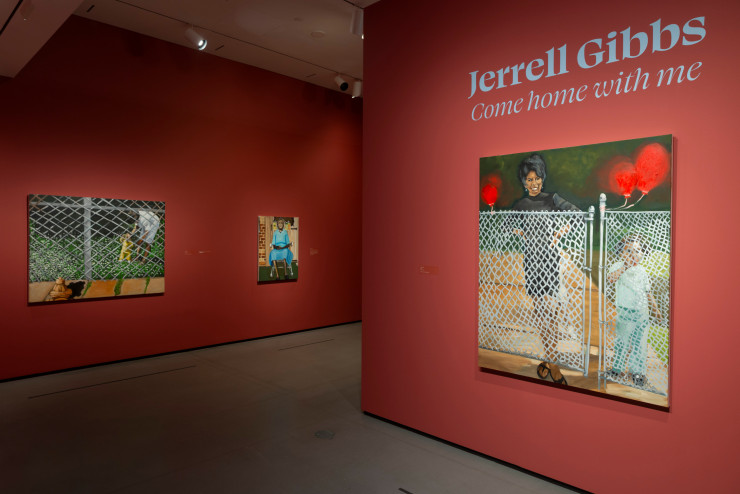
Jerrell Gibbs’ Come Home With Me is on view at the Baltimore Museum of Art through May 2027. The exhibition brings together works that reflect Gibbs’ exploration of family, memory, and everyday life, subjects rooted in the photographs and experiences that have shaped his practice.

Join the festivities as MICA honors its 200-year history, recognizes its present success, and looks forward to a bright future. Throughout 2026, the College will be sharing community stories and announcing one-of-a-kind events on campus, in Baltimore, and beyond.
 + Enlarge