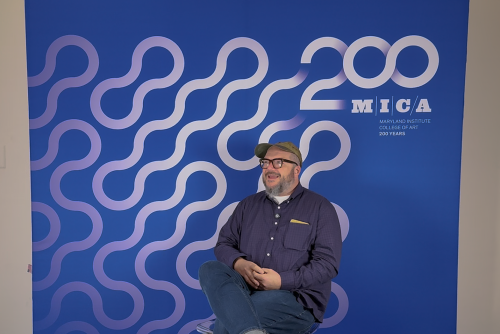
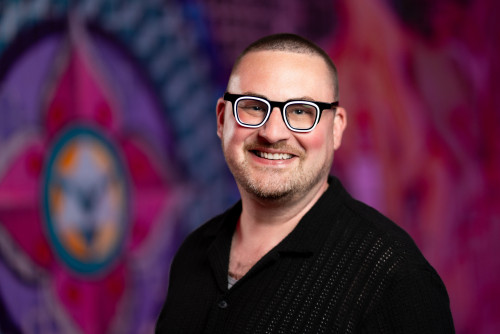
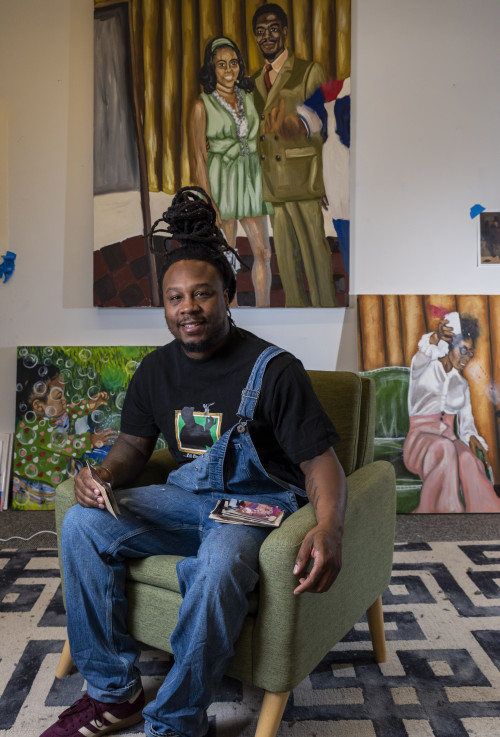
When C. Ryan Patterson first toured MICA as a high-school junior, he thought he knew what he wanted. Growing up in South Florida, he imagined his art-school experience unfolding in the center of a major metropolis — maybe New York, maybe Boston — a place pulsing with energy and possibility. But as he traveled up the East Coast visiting campuses, he found himself asking the same question at every stop: “What opportunities do students have to get off campus and engage beyond the walls of the institution?”
When he arrived in Baltimore, that question was finally answered. “MICA’s community art program — and just the student life I saw walking around the city — really drew me in,” Patterson recalls. “Students were organizing their own galleries, hosting pop-up shows, holding events off campus. I thought, ‘This is the place I want to be.’”
Finding a Home in Baltimore
Baltimore felt big enough to be exciting and small enough to be knowable: a city of neighborhoods, artists, and constant creative exchange. For Patterson, who had grown up in the suburbs, that was exactly what he was looking for. “I remember walking the streets of Mount Vernon when I first came to campus,” he says. “Those early impressions became touchpoints for my whole time here. Twenty years later, I’m still here.”
That sense of rootedness has defined Patterson’s life since. After earning his BFA in General Sculptural Studies in 2006, he stayed in Baltimore and is now the Public Art Program Director for the Maryland State Arts Council (MSAC), where he helps artists bring creative projects to communities across the state. In many ways, his career traces directly back to the values that first drew him to MICA, a belief that art should live in the world, not just on the walls of a studio.
Learning by Doing, Together
Patterson entered MICA convinced he wanted to be an illustrator. “I wanted to draw comics, to make cool, literal work,” he says with a grin. “But during my foundation year, I realized how fascinating the sculpture department was. Conceptual art felt foreign to me, but also full of opportunity.”
He began exploring materials, installation, and collaboration, guided by professors who pushed him to think more expansively while meeting him where he was. “Being around students and faculty who challenged my ideas of what art could be — but also guided me through that process — was powerful,” he says. “They didn’t dismiss me for not knowing the ‘right’ answer. That’s something I carry with me now: pushing people to take risks while reminding them it’s okay not to know everything at first.”
That pedagogical generosity — the freedom to experiment, fail, and grow — is something Patterson sees as distinctly MICA. “It’s an environment where you’re expected to push boundaries, but you’re supported while doing it,” he says. “That balance between rigor and compassion is what makes MICA different.”
Art as a Common Language
For Patterson, MICA’s Community Arts Program was the crucible where classroom learning and real-world practice fused. Teaching after-school art in Baltimore neighborhoods exposed him to a different kind of education, one that was reciprocal, rooted in shared experience.
He recalls two stories that still shape how he thinks about public art today. The first happened during his freshman year, when he was teaching art to elementary students. “I was walking to pick up a package off campus, and a man stopped me on the street. He said, ‘My daughter told me you teach her art. I just wanted to thank you.’ That moment stuck with me, realizing art can bridge so much.”
This experience — improvisational, collaborative, deeply human — became the foundation of his philosophy as a cultural leader. “Art can open dialogue and create opportunities that wouldn’t exist otherwise,” Patterson says. “That’s what MICA taught me, that making art is also making connections.”
Carrying MICA’s Ethos Forward
Today, in his work with MSAC, Patterson channels that same ethos. “Our mission is that every Marylander should have access to the transformative power of the arts,” he says. “I’ve stayed in Baltimore and worked in arts administration because of that belief. My work has always been mission-driven, and that started at MICA.”
He sees a direct through-line from the DIY spirit of his student days to his leadership today. “When I was at MICA, I lived in the Copycat Building, which was this warehouse where artists built stages for concerts, hosted shows, and even built greenhouses in their lofts. It was all creative energy, but rooted in community,” he says. “That sense of if you want something to happen, make it happen — but do it responsibly — still guides me. Public art isn’t just about putting something out in the world. It’s about collaborating, understanding who’s impacted, and honoring the people who live with that work every day.”
That perspective — the fusion of self-initiative and social accountability — reflects MICA’s enduring difference. “It’s a school that doesn’t just teach you to make art,” Patterson says. “It teaches you to understand the world your art will live in.”
Artist and Place
As MICA approaches its bicentennial, Patterson hopes the next generation of students continues to embrace that relationship between artist and place. “I hope [present and future students] keep MICA’s tradition of giving back to Baltimore, of being part of the city’s fabric,” he says. “MICA is woven into Baltimore’s creative ecosystem and economy. You can walk five minutes from campus and meet someone influenced by the school. That connection is special; it’s what makes MICA like no other.”
For him, the school’s history isn’t something to preserve in amber; it’s a living thread that ties generations together. “The artists who come out of MICA are builders of communities, of systems, of culture,” he says. “That’s been true since the beginning. I think about the students today organizing pop-ups, curating shows, starting collectives — it’s the same spirit I saw 20 years ago, and probably the same one that’s been here since 1826.”
He pauses, thoughtful. “Baltimore gave me a place to grow, and MICA gave me the tools and the community to make that growth meaningful. I think that’s what every student should find here: a sense of belonging and purpose that keeps echoing long after you graduate.”