First-Generation Journeys
At MICA, first-generation college students have long brought their unique experiences, determination, and creativity to our community.
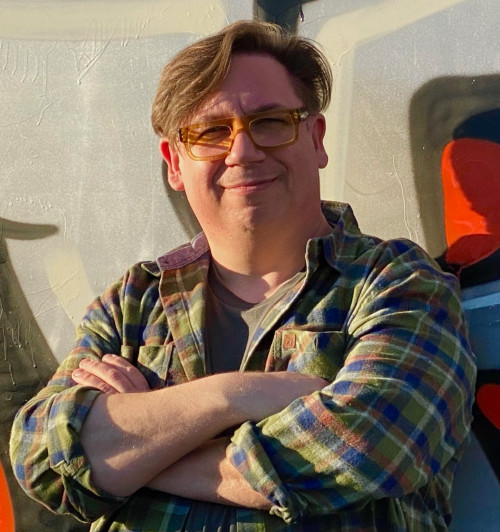
Nate Larson, Full-Time Faculty, Photography
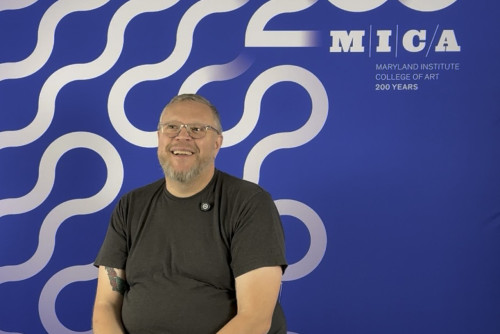
Nate Larson was, by his own admission, an outsider. When he arrived at MICA for a job interview in 2009, he had no prior connection to the College. His background was rooted in the Midwest: an undergraduate degree from Purdue, an MFA from Ohio State, and teaching positions in Chicago and Rochester. But something clicked almost immediately.
“I remember having dinner with faculty during my interview,” Larson recalls. “We got into a spirited discussion about whether digitally altered images could still be ‘true.’ I thought, ‘OK, these are my people’. That sense of passionate, respectful debate about art and philosophy told me I’d found the right place.”
Seventeen years later, Larson has become a cornerstone of the Photography Department, now serving as area head and Assistant Chair of Media Arts. Along the way, he’s built a reputation not just as an award-winning artist and educator, but as someone who embodies the MICA ethos: curiosity, community, and a belief in art’s power to shape both individuals and societies.
Larson’s initial encounters with MICA reflect a broader story that has unfolded across two centuries of the institution’s history: talented individuals arriving from elsewhere, finding themselves at home in a community dedicated to art and design, and then shaping that community for future generations.
“I’d taught at RIT, and I had opportunities there and here,” he explains. “But there was something about MICA that just felt right. Instinctual. This wasn’t about prestige or programs; it was about people and culture. It was a recognition that the questions MICA asked were the questions I wanted to be wrestling with, too.”
Even small details underscored the school’s singular character. Coming from large universities where athletics dominated campus life, Larson was struck by MICA’s humor about its lack of sports teams. “There was a shirt in the bookstore when I started that said MICA Football: Undefeated Since 1826. I still laugh about it. It felt like a wink at our difference, and I loved that.”
Larson’s own academic path ran through comprehensive universities, where art often played a supporting role rather than the central one. MICA’s uniqueness became clear once he began teaching.
“This was the first time I’d been immersed in a dedicated art school environment,” he says. “What struck me immediately was the focus and intensity of the students. It’s amazing that at 18 years old, people here choose to become artists or designers. That’s bold.”
That boldness is tempered by a culture Larson describes as “gentle.” Unlike the harsh critiques he witnessed in his own undergraduate training—where professors literally marked up student work with Sharpies—MICA, he believes, cultivates the whole person.
“At MICA, the approach is nurturing and holistic,” he says. “We see the student as more than just their work. That gentleness doesn’t mean a lack of rigor; it means a commitment to growth, to helping people become who they are meant to be.”
This ethos plays out not only in classroom critique but in the culture of experimentation across disciplines. Larson’s courses have evolved with the times, from electronic media and culture to New Media 4D. His own studio practice—primarily still photography, but increasingly interconnected with audio, video, and new technologies—mirrors that boundary-crossing spirit.
“It’s never about saying, this is what I do,” he explains. “It’s about asking, ‘What is the right tool to communicate the idea?’ That fluidity is something I see MICA students embrace every day.”
Over the years, MICA’s culture has not only shaped Larson as an educator but has also extended into his work as a practicing artist and community collaborator.
Baltimore itself has been a catalyst. “The city is fascinating and complicated,” he says. “And it constantly pushes me—and my students—to think about what it means to live and work in a place, and how we contribute positively to community.”
Following the 2015 uprising after the death of Freddie Gray, Larson spent seven years in partnership with Jubilee Arts, an organization led at the time by a MICA alum. Together, they created projects that gave young people tools for expression and storytelling. He also collaborated with students at Commodore John Rodgers School, co-creating a published photography project documenting the school’s life.
“These collaborations often start with a simple phone call or a conversation,” Larson reflects. “Baltimore is open to those connections. The challenge is always resources, but the willingness is there, and that makes this city special.”
The synergy between his studio practice and his teaching also demonstrates MICA’s impact. A long-term project in Argentina not only deepened his own artistic inquiry but evolved into a study-abroad opportunity for MICA students, linking global artmaking with the school’s educational mission.
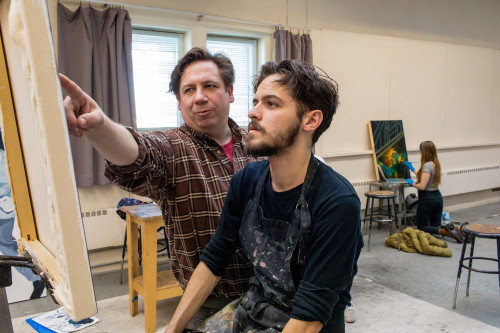
Inside the classroom, Larson works to build cultures of respect and curiosity that extend far beyond campus. In his Senior Thesis class, he recently co-created critique guidelines with students. The principles they articulated—ask questions, don’t make assumptions, be curious, don’t impose your own practice—reflect a deeply MICA way of engaging.
“That wisdom came from [the students],” he says with pride. “I added one suggestion: instead of saying you should, try what if or have you considered. That small shift makes critique a conversation rather than a directive. That spirit of curiosity is what I want them to carry with them into their own communities and careers.”
For Larson, one of the most rewarding parts of his MICA journey is his ongoing relationship with alumni. As the manager of the department’s Instagram account, he takes special care to highlight former students’ exhibitions, grants, and accomplishments.
“There’s that old saying about a rising tide lifting all boats,” he says. “That’s how I see our alumni network. The more our graduates succeed and are visible in the world, the stronger MICA’s reputation becomes, and the better it is for all of us.”
Seventeen years into his tenure, Larson still recalls the moment he knew he belonged here: that dinner-table debate about digital truth. “It wasn’t about winning an argument,” he says. “It was about realizing that at MICA, people care enough to have the conversation. That’s what makes this place different. That’s why I stayed. And that’s why I believe MICA will keep carrying that spirit forward into its next 200 years.”

Join the festivities as MICA honors its 200-year history, recognizes its present success, and looks forward to a bright future. Throughout 2026, the College will be sharing community stories and announcing one-of-a-kind events on campus, in Baltimore, and beyond.