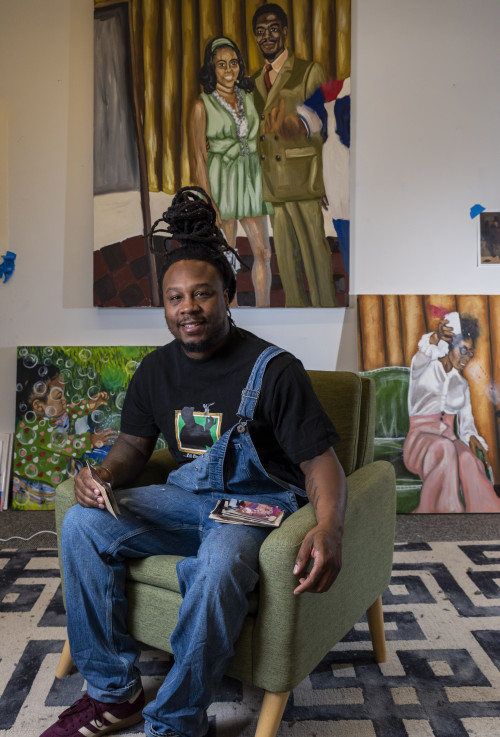
When Joseph Taylor first arrived at MICA from New Orleans, he carried with him the restless curiosity of an artist unwilling to be boxed in. “Growing up, I was always a pretty well-rounded artist,” he says. “I loved painting and drawing but was also drawn to sculpture, ceramics, printmaking, the whole nine yards.”
That openness — a hunger to keep asking questions, to move between mediums — found a home in MICA’s General Fine Arts program, a major designed for students who refuse to pick just one direction. “The GFA program is beautifully self-directed,” he explains. “There are so many directions you can take each year. It just felt right for me to keep that creative momentum going.”
For Taylor, that freedom has become something deeper than exploration. It’s become a way of understanding art itself, as both personal and philosophical, as a reflection of who he is and how he sees the world.
From the Crescent City to Charm City
Taylor grew up surrounded by the cultural density of New Orleans: music on every corner, architecture steeped in history, and an unspoken invitation to create. Yet when it came time for college, he sought a place where that energy could evolve into something new.
The decision to move a thousand miles north wasn’t easy, but MICA’s combination of academic rigor, creative freedom, and proximity to a living arts ecosystem sealed the deal. Baltimore, in all its complexity, offered a new kind of classroom for Taylor.
“MICA stood out because it offered both the freedom to explore as an artist and the opportunity to develop curatorial skills,” he says. The Curatorial Practice minor became a bridge between his interests, connecting his studio work to the ideas that shape art institutions and audiences.
“I was excited about the Baltimore Museum of Art and other nearby cultural institutions,” he recalls. “The idea that I could study, visit museums, and engage with working artists all within walking distance, that was huge.”
Learning to Think Through Making
Once on campus, Taylor quickly discovered that MICA’s promise of freedom came with something more: accountability to one’s own creative process. In the Body, World, Machine course, Taylor encountered an idea that would reshape his understanding of art.
“[Our instructor] encouraged us to think of art as an extension of the self,” he says. “We created bodily sculptures — physical extensions of who we are — and that helped me understand my work as something deeply connected to my inner life.”
That revelation — that the studio is not just a space for making but for becoming — changed everything. “It pushed me into a more philosophical headspace,” Taylor says. “I began to see my art as a reflection of my inner world, not just an external product.”
Later, critiques with faculty helped him translate that insight into practice. “[Our instructor] told us, ‘Your studio practice is about you. It’s not always about making something every day. Sometimes, it’s about feeding yourself emotionally.’ That was liberating.”
It was the kind of wisdom that can only come from MICA’s culture of intense critique balanced by deep care, a community where challenge and support coexist. “That perspective helped me stay grounded,” he adds. “It taught me that rest, reflection, and curiosity are part of the creative process too.”
Building a Philosophy of Belonging
Taylor’s senior thesis, Meet Me at My Place, brings all those lessons together. The project explores memory, distance, and identity through objects, using the language of home to bridge his life in Baltimore with his roots in New Orleans.
“When I went home over winter break, being in my childhood house, where I was surrounded by photos and mementos, helped me see how different my life at MICA had become,” he says. “It made me think about belonging. In a way, my thesis became a love letter to New Orleans.”
One question haunted him during that process: “Why go back somewhere that might be underwater in ten years?” His art became the answer, not a literal one, but an emotional one. “My work is about love, loss, and the meaning of home,” he says.
Through it all, MICA’s ecosystem gave him both structure and flexibility. “The culture here gives you permission to explore,” Taylor says. “As a GFA major, I felt like a creative secret agent, moving between buildings, talking with students in animation, sculpture, illustration. That cross-pollination kept things fresh.”
That interdisciplinary ethos is what makes MICA unlike any other art school. It’s a place where painters wander into sound studios, curators learn to weld, and theory lives alongside practice. “MICA’s academic side is incredibly strong, more than people realize,” Taylor says. “Things I learned as a freshman resurfaced in my thesis years later. It’s like all the classes came together into this beautiful, chaotic harmony.”
Being Seen and Supported
For Taylor, being at MICA wasn’t just about creative growth; it was also about being recognized for his potential. “As a first-generation college student from New Orleans, financial support made all the difference,” he says.
He received multiple scholarships for artistic excellence, opportunities that allowed him to focus on making art rather than worrying about tuition. “MICA saw my value and invested in my potential,” he explains. “It wasn’t charity — it was, ‘We see you. Don’t let this stop you.’ That recognition made me feel deeply seen.”
That sense of belonging — of being truly seen — is something Taylor hopes every future MICA student can experience. “It gave me the freedom to explore, the support to belong, and the perspective to see that creativity can be a way of life, a future.”
Carrying MICA’s Spirit Forward
For Taylor, that future is already here. His own trajectory — blending art, philosophy, and curation — embodies a MICA education that refuses to separate theory from life. “The people I’ll lean on as a curator or artist are my classmates, professors, and future alumni,” he says. “It’s not just networking; it’s knowing people are rooting for you. That gives me confidence to keep going.”
The same spirit that inspired MICA’s founders — a belief in art as both inquiry and expression — continues in students like him who merge curiosity with conviction.
“MICA taught me that my art could be both personal and philosophical,” Taylor says. “It’s about looking inward and outward at the same time.” And in that ongoing conversation — between past and future, between self and world — Taylor has found his voice.