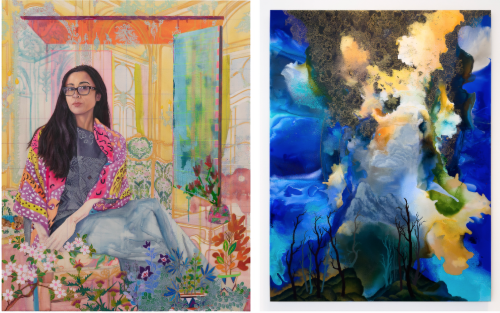
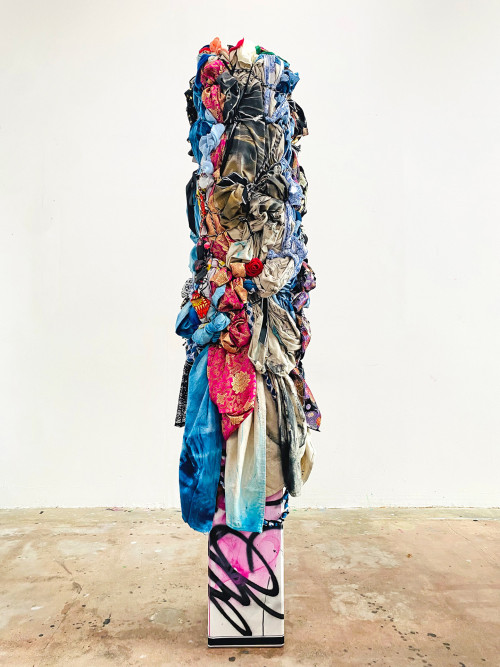
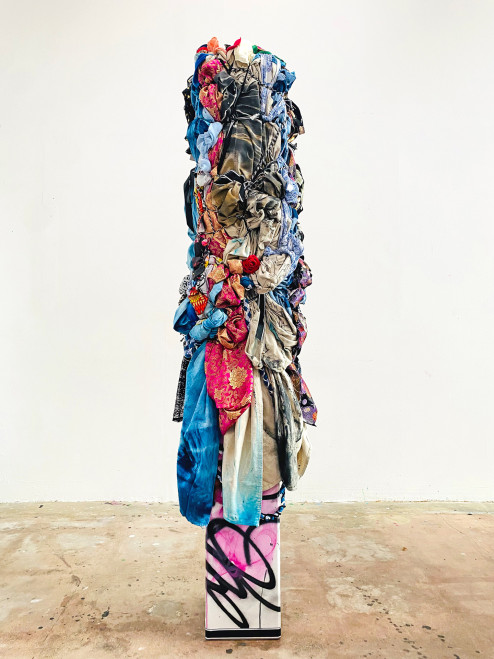
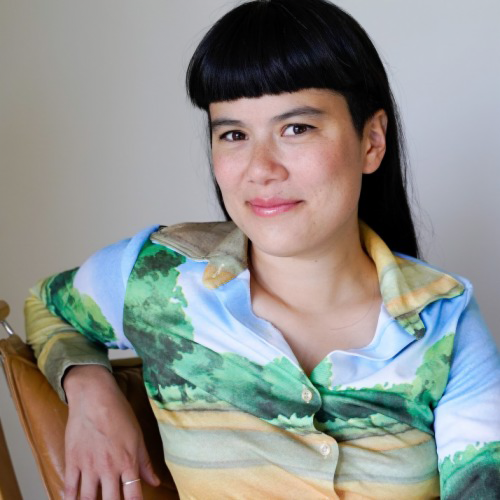
Bale Variant No 0027 (Charm City Girl Stele)
Artist
Shinique Smith ’92, ’03 (General Fine Arts BFA, Mount Royal School Of Art MFA)
Date
2022
Nannette Blinchikoff, Donor/Friend, Former president of Maryland Arts Equity Foundation (MAEF)
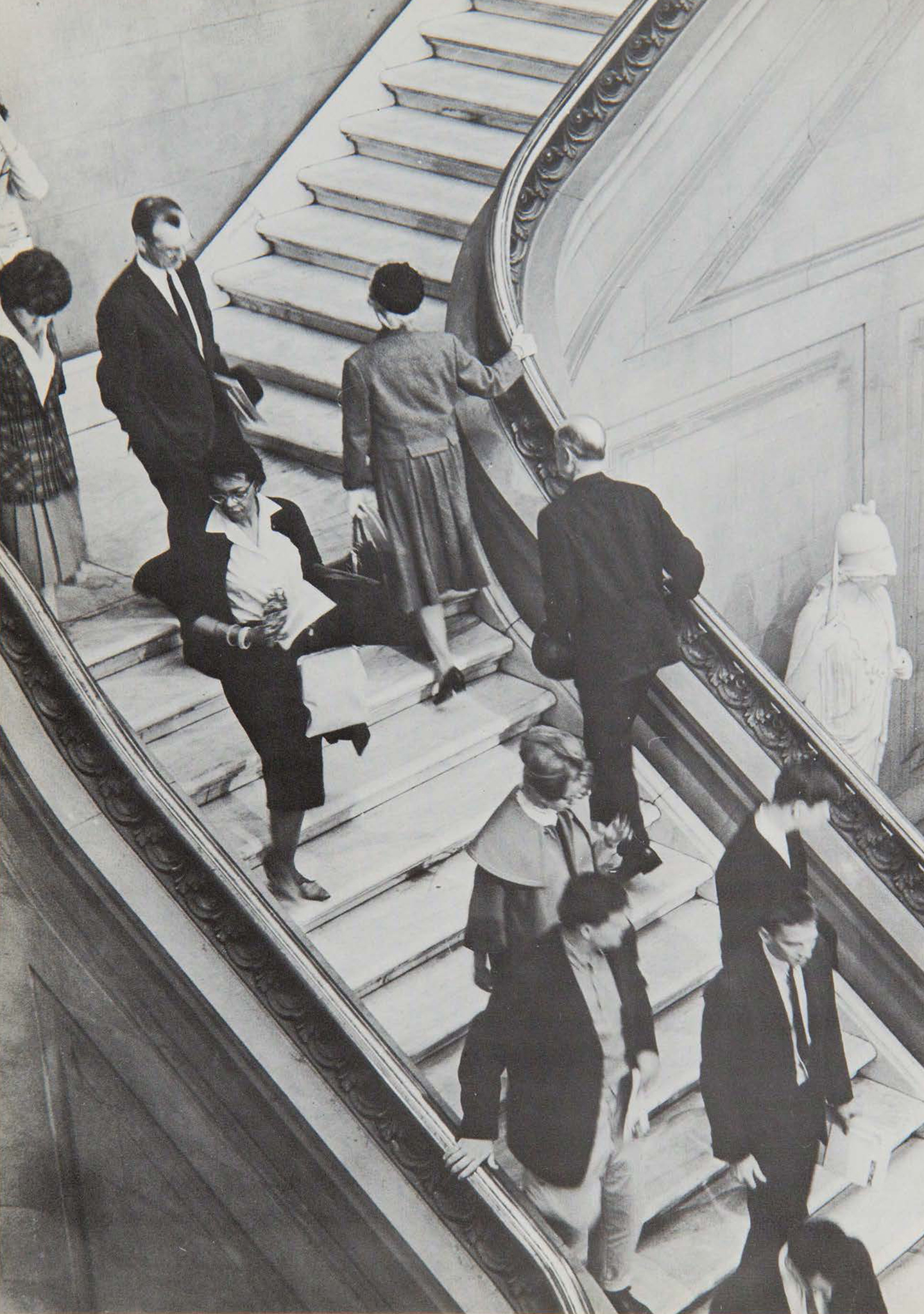 When Nannette Blinchikoff talks about MICA, she doesn’t begin with the decades she spent leading a statewide arts nonprofit, or the thousands of dollars in scholarships she helped deliver to young artists. She begins with a staircase.
“I remember walking down the staircase at MICA back in the 1960s,” she says, smiling at the memory. “I was just a teenager taking summer classes, and it was so much fun to be there. I didn’t even have the vocabulary yet to say, I belong here, but I felt it.”
That early brush with MICA, made possible by a scholarship she received as a high-school student, was brief but formative. She never enrolled as a degree-seeking student, a reality she still speaks of with candid wistfulness. “I wish I could have become an alumna,” she says. “The dollars just weren’t there for me.” Instead, she went on to earn her undergraduate and graduate degrees from Towson University. But even as her academic path shifted, something about MICA stayed lodged in her imagination.
“I was always around people connected with [MICA],” she says. “It kept circling back into my life, even when I wasn’t looking for it. And it felt like every time it showed up again, I was a little closer in.”
That slow, spiraling return eventually led her not just back to MICA but into the center of something that would change opportunities for generations of young artists in Maryland.
In the early 1980s, Blinchikoff was deep into her graduate thesis work at Towson. She had been creating bronze sculptures, exhibiting regionally, and wrestling with a question most young artists face in every decade: “Yes, I’m making work. But how do I get anyone to see it?”
Her thesis turned into a project to help artists market and advocate for themselves, a topic that, at the time, was barely on the radar in academic art programs. One of the people who encouraged her to keep going was Ina Helfrich, an artist and member of the Maryland artist community who later became a mentor and collaborator.
“Through that thesis, I started building resources — books, lectures, tools — for artists to be taken seriously in the world,” she says. “Ina told me, ‘You need to come share this with others.’ That terrified me; I’d never lectured before, but I said yes. And the room was full. They wanted to know how artists could build power, not just talent.”
That moment put Blinchikoff in the orbit of the Maryland Artist Equity Foundation (MAEF), a nonprofit that Helfrich was shaping into an artist-driven philanthropic force. Its mission: give scholarships to high-school seniors with artistic talent, and do it without attaching strings of privilege, pedigree, or need-based qualifiers.
“Art first. That was the rule,” Blinchikoff says. “We wanted students to be judged on the work they made, not the money they had.”
From its founding in 1983, MAEF was animated by a principle that also runs through MICA’s centuries-old history: artists deserve support before they are proven, and because they are emerging, not after the world has already validated them.
“That’s the connection,” she says. “MICA always cared about the student who was becoming an artist, not just the one who already was.”
Under Blinchikoff’s leadership (she would go on to serve sixteen years as MAEF’s president), the foundation became a statewide force. Every high school in Maryland received an annual poster announcing the scholarship. The foundation’s board included museum directors, city and state officials, and arts leaders. A yearly masked ball raised funds; students received awards based on artistic merit alone. In its final years as an independent nonprofit, the foundation was awarding $25,000 annually.
And all along the way, MICA was there.
“Whenever we needed space, support, visibility, a connection, Fred Lazarus said yes,” she says of the longtime MICA president. “He showed up. That mattered.”
The foundation also began attracting donors who wanted their contributions to solve specific problems: funding a Baltimore City student to attend MICA’s summer program; purchasing classroom art supplies for public-school teachers who had been paying out of pocket; and opening doors that were otherwise locked by economics.
“We didn’t want to just hand out checks,” she says. “We wanted the money to move where artists actually live — in classrooms, in communities, in early opportunities that change direction before a student ever arrives at college.”
By the mid-2000s, MAEF was struggling with a challenge familiar to many volunteer-driven nonprofits: too few people doing too much work. Blinchikoff, who had been president for nearly two decades, knew MAEF needed a future that didn’t require a constant rescue.
“And that’s when I thought: The answer is MICA,” she says. “Because they already believed in what we believed. They already served the students we cared about. And they would outlive us.”
In 2008, MAEF formally merged with MICA. The remaining funds endowed a scholarship program that now continues under the MAEF name, but with something new added: financial need, an element the original bylaws did not permit but that the founders always wished they could include.
“We finally got to support the students we couldn’t support in the early days,” she says. “Students who didn’t just have talent, but needed someone to say, ‘You can afford this path.’”
MICA now awards the MAEF scholarships annually. The foundation lives on, not as a history preserved, but as a mission activated.

Join the festivities as MICA honors its 200-year history, recognizes its present success, and looks forward to a bright future. Throughout 2026, the College will be sharing community stories and announcing one-of-a-kind events on campus, in Baltimore, and beyond.