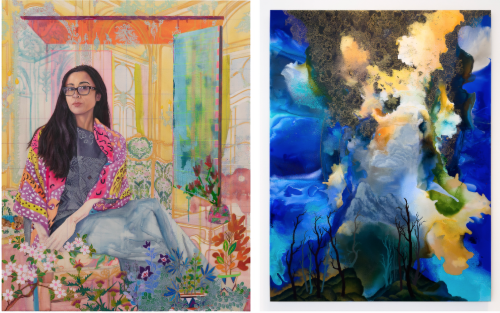
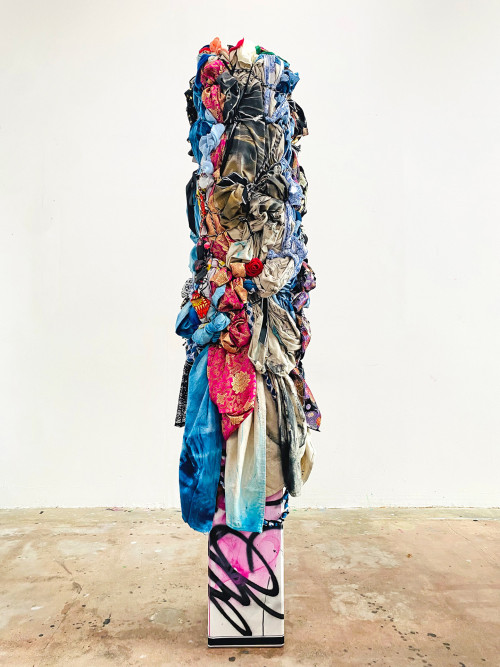
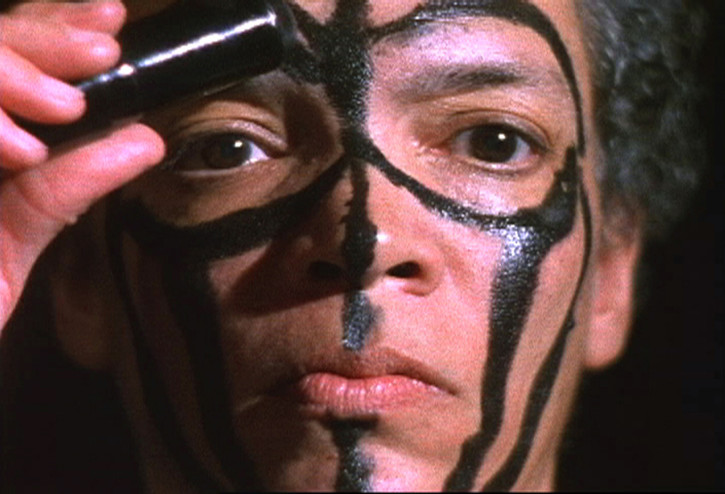
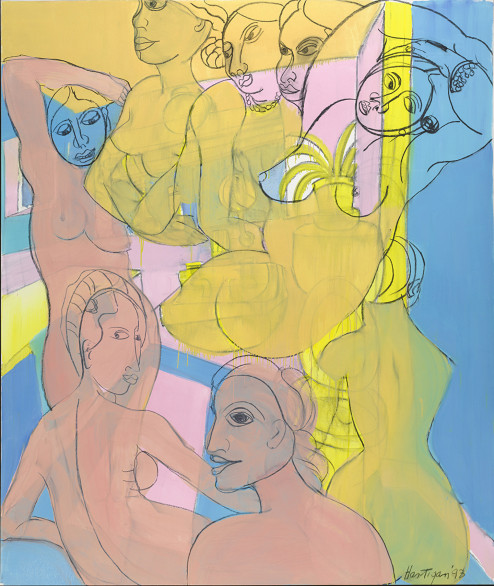
Bale Variant No 0027 (Charm City Girl Stele)
Artist
Shinique Smith ’92, ’03 (General Fine Arts BFA, Mount Royal School Of Art MFA)
Date
2022
Frank Hyder ’72 (General Fine Arts BFA), Annual Fund Supporter
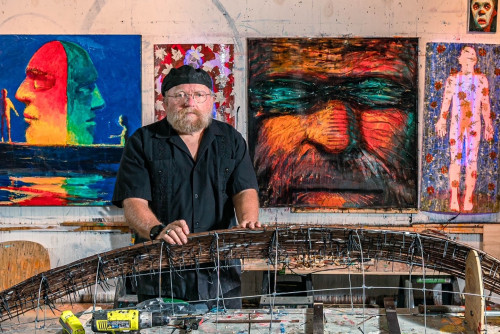
There wasn’t a time in his life when Frank Hyder didn’t know what he was going to be. “If you had asked me when I was nine years old what I was going to do with my life, I would have told you, ‘I’m going to be an artist,’” he says. “Even though I didn’t know much about what an artist was, I knew that’s what I was going to do.”
That certainty carried him from a childhood spent sketching in Philadelphia to the halls of MICA, where he arrived in the late 1960s, an era pulsing with change and creative experimentation. It was a time when Baltimore itself was shifting, when the city’s streets and MICA’s studios both thrummed with possibility.
More than fifty years later, Hyder’s story traces the arc of what makes MICA like no other school: a place where imagination, diversity, and artistic courage intersect to shape lives and, in Hyder’s case, to shape a global career that bridges continents and cultures.
Hyder’s first brushes with art came through people who lived and breathed it: a portrait painter who opened his eyes to the human form, and the author of the famed guidebook, Speedball Textbook, who taught him the art of woodcuts when he was barely seven. The lesson didn’t end there: the author was so taken with the young Hyder’s talent that he featured him in one of his instructional books. In that moment, art stopped being an abstract dream and became something tangible, something real that he could be.
But when he arrived at MICA in the early 1970s, he discovered something bigger. “I was stunned by the opportunities,” he recalls. “I had thought you could be a portrait artist or maybe one other kind [of artist]. But at MICA, I met people who were incredibly imaginative and curious. That was exactly what I was looking for. I didn’t want someone to tell me how to be an artist; I wanted to see how they were artists so I could say, ‘That’s not me. This is me.’”
That sense of discovery was transformative. “You’re born an artist — it’s inside you — and MICA allows you to find your voice,” Hyder says. “The best teachers didn’t tell you what to do; they encouraged you to do you. Each classroom was like its own language, like living in an international city.”
During Hyder’s years on campus, the faculty represented a breadth of experience rare in art schools at the time. Walking from one classroom to another, he says, was like traveling between countries. “No other school I looked at had anything like that. It was as if every room spoke a different language, and all of them were fluent in art.”
Two of those “languages” shaped him for life. One was spoken by Albert Santiano, a drawing instructor whose enthusiasm filled the halls. “He encouraged monumental formats and experimentation,” Hyder says. “His drawings were everywhere on campus. It made drawing feel vital.”
The other belonged to James Hennessy, a painter who had studied under Richard Diebenkorn and exhibited at MoMA. On the first day of class, Hennessy stood before his students and said something Hyder never forgot: “If I had Rembrandt, Rubens, Picasso, and Matisse all painting from the same model, I could recognize something in each painting that comes from that model, but no two would ever look alike.
Over the next five decades, Hyder built a remarkable international career, with more than 200 group exhibitions and 100 solo shows, rooted in that early MICA foundation. “Everything important I learned came from my first year,” he says. “Basic design, material use, understanding form. Those are universal foundations.”
What MICA instilled in him, he explains, was a global sense of art as a shared language. “We studied the art of China, Greece, South America, and New York,” he says. “Art connects across time and culture, not just place.”
That understanding shaped Hyder’s later work across continents, from Philadelphia and Miami to Venezuela, where he became part of a vibrant artistic community. Today, the New York gallery that represents him is equally international, showing artists from China, South America, Africa, and Asia. “That’s where I belong,” he says. “When I walk into a room and see artists from all over the world, that’s when I think, this is it. This is art. This is the world.”
Hyder’s life remains intertwined with MICA, not only through memory but through mentorship and generosity. A former faculty member himself, he established the Frank Hyder Studio Art Prize to support emerging artists, an act rooted in his own journey. “I had no idea how to get to college,” he says. “My parents didn’t even finish high school. I worked 100 hours a week in the summers to afford tuition. I was helped by the school’s then-president, who even bought one of my paintings. So now that I have resources, I want to give back.”
He tells a story that captures his philosophy: “There was a religious group in the 19th century that, when people began stealing tomatoes from their fields, said, ‘Let’s plant more tomatoes.’ That’s how I see it: people are hungry, people need help, so help them get it.”
For Hyder, that same generosity defines MICA’s spirit. “Trends and techniques will change, but MICA’s mission to nurture talent, imagination, and purpose shouldn’t,” he says. “It’s not a job training center. It’s a place to help people become who they were meant to be.”
Even the ground MICA stands on, Hyder notes, carries that history of openness and outreach. Before it became the College’s campus, the site was home to a diplomat who worked with Abraham Lincoln to find safe passage for freed slaves to Latin America. Later, the Jenkins family, whose memorial church still stands nearby, donated the land to rebuild MICA after a fire in 1900. “There’s always been a spirit of generosity and global vision on that land,” Hyder says. “You can still feel it.”
From his early woodcuts to his monumental Janis Project installations, two-faced sculptures exploring duality and connection, Hyder’s work reflects the same curiosity that first brought him to MICA. That relentless curiosity, he believes, is MICA’s enduring gift. “When I walk into the Main Building today, I still feel those ghosts, the spirit of creativity and openness,” he says. “As long as MICA remembers that its mission is to celebrate artists and imagination, it will continue to change lives.”

Join the festivities as MICA honors its 200-year history, recognizes its present success, and looks forward to a bright future. Throughout 2026, the College will be sharing community stories and announcing one-of-a-kind events on campus, in Baltimore, and beyond.