Juan Bastos did not arrive in Baltimore looking like an artist. He’ll tell you that himself, with a laugh. In the early 1980s, the Venezuelan-born transfer student came east after time at Georgetown University and Montgomery College, still searching for direction. He had considered applying to ArtCenter College of Design in Pasadena. He had even sent a portfolio. But when his parents relocated to Bethesda, he wanted to stay close to home, and his path shifted.
That shift became decisive at a Corcoran Museum portfolio day, where Theresa Lynch, a representative from MICA, reviewed his work and urged him to visit MICA.
That visit changed everything.
“When I arrived [at MICA] and I saw the [Main] building, I thought, ‘I don’t need to go to Italy anymore. I feel that I’m in Florence,’” Bastos recalls. “It was love at first sight.”
The revelation extended beyond campus. While Washington had polish, Baltimore offered atmosphere. Its architecture, its shadows, its history, these felt closer to the Europe he had imagined. “The entire city breathes a bohemian artistic feel,” he says. For Bastos, Baltimore wasn’t simply a setting for art. It was a place where art already lived.
Connecting and Settling
By the time Bastos arrived at MICA, he was eager but unfocused, moving fluidly across sculpture, photography, illustration, and design, testing possibilities without committing to one. Practicality initially guided him. “I have to make a living,” he remembers thinking, weighing his options between graphic design and illustration.
But MICA pulled him elsewhere. “The stronger department was Fine Arts,” he says. “That’s when I switched.”
The decision unfolded gradually, less a pivot than a recognition. Bastos had long been immersed in art. He studied architecture in Bolivia before coming to the United States and, even earlier, took lessons with relatives who were painters. As a child, he moved easily among artists of different ages, absorbing a creative life that blurred boundaries between discipline and community.
At MICA, that sense of belonging sharpened and intensified. For the first time, he was surrounded by peers who were as serious, and as talented, as he was.
“At Montgomery College, I was always the best one in my class,” he says. “But suddenly I got [to MICA] and thought, ‘Oh, there is some other talent here.’”
It was exactly what he needed. “You push yourself,” he says. “And that’s extremely important.”
Discipline and Direction
At MICA in the early ’80s, drawing was not simply foundational, it was communal. “It’s the basis of everything,” Bastos says. Yet that discipline coexisted with an ethos of exploration. He worked across formats and scales, producing everything from collage to large-scale charcoal drawings, embracing what he now describes as a period of being “all over the map.”
One early disappointment sharpened that realization. Nominated for a Yale summer scholarship, Bastos was not selected. Later, he learned that another student had presented a cohesive body of work, 20 slides focused on a single subject. His own portfolio, by contrast, reflected breadth without focus.
“It showed talent,” he says, “but I was unfocused.”
The lesson lingered: vision matters as much as ability.
Even so, experimentation remained central. Encouraged by MICA faculty to think big, Bastos produced an eight-foot charcoal drawing. Scale, risk, and openness became part of his visual language.
Equally transformative was a quieter moment in portraiture class. There, former MICA faculty member Peter Collier offered a simple instruction: squint.
“Nobody had ever told me,” Bastos says. “Squint to see the model. And it was magic.”
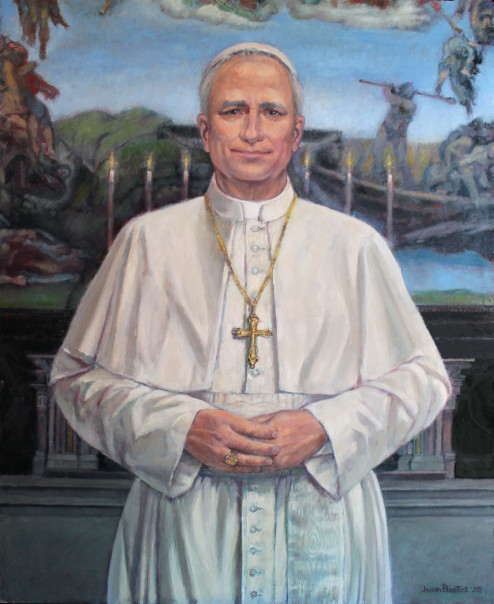
In that moment, he began to truly see — light, tone, structure — and with it, the foundation of his future as a portrait painter.
Making a Life
If MICA shaped Bastos’s artistic voice, it also grounded his understanding of the profession. The school’s “Survival Course for the Artist” introduced a pragmatic reality: talent alone would not sustain a career.
Bastos absorbed the lesson quickly. As a student, he checked bulletin boards daily for commissions to create portraits, illustrations, anything that offered both income and experience. He understood early that an artist must also be entrepreneurial.
In truth, he had already begun. As a teenager in Bolivia, he earned money designing a travel poster for a relative’s agency. In New York, at 21, he set up on the street with a single sample drawing and began doing portraits for passersby.
“It was a great experience to be out there,” he says. “It gives you strength to keep going.”
At MICA, that instinct matured into strategy. One small drawing led to another. A sketches generated commissions that generated collectors. “Something you do for free,” he says, “can develop into a client.”
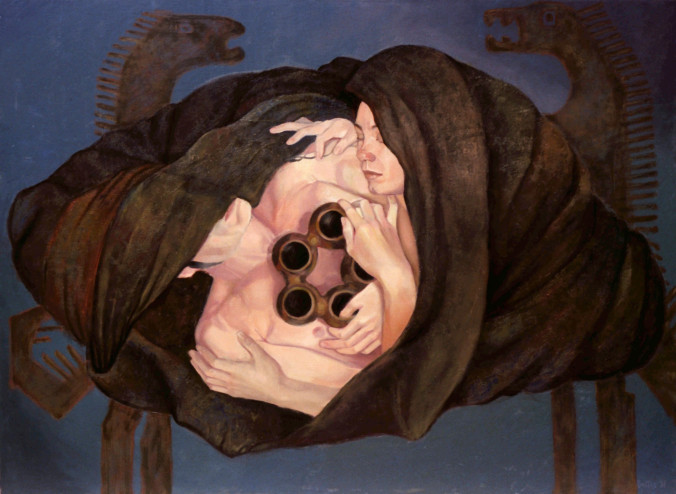
By his senior year, that momentum was visible. For his final exhibition, Bastos developed a sequence of works centered on a ballet dancer and greyhounds, expanding a single idea across media and scale. The culminating painting drew praise from The Evening Sun, which compared his work to Matisse and Degas, and became his first major recognition in Baltimore.
The painting sold for $1,000. Bastos used the money to travel to Europe.
“I was very sorry to let it go,” he says, “but thanks to selling it, I was able to explore and see the world.”