Maryland Institute College of Art Announces Exhibition Opening for Making America Again: So Strong, So Brave, So True
The exhibition runs August 28 to September 29, 2026, in the Sheila & Richard Riggs Gallery at MICA’s Fred Lazarus IV Center.
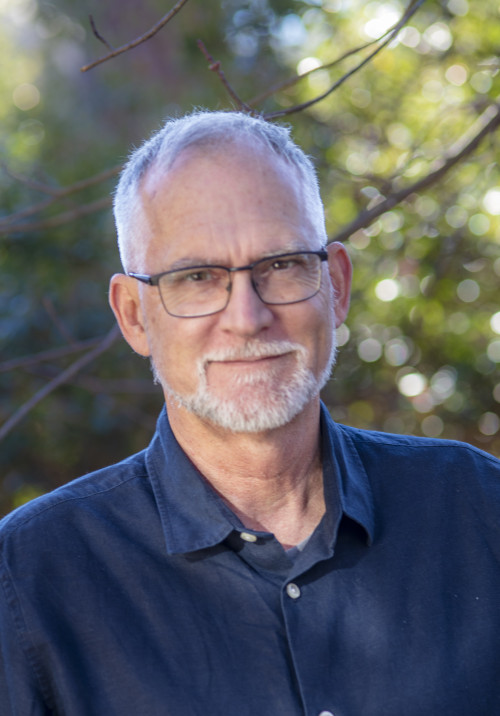
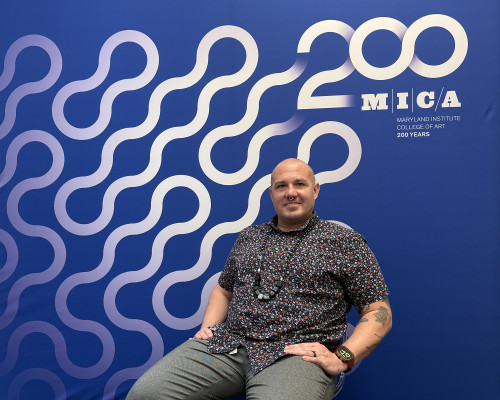
David Hart, Former Director of Alumni & Parent Relations
In the mid-1990s, David Hart used to sit on the front steps of his brownstone on Bolton Street and watch MICA expand, first a few studios at Mount Royal, then an outstretched arm across the bridge into what would soon be called Station North. What began as a view from his stoop became a calling. Within a few years, Hart crossed the threshold not as a curious neighbor but as a staff member, building relationships that would eventually shape his profession, his philanthropy, and his thinking about opportunity itself.
Today, retired from MICA and toggling his time between a quiet house in Vermont’s Green Mountains and a one-bedroom in Brooklyn, Hart insists he’s never really left Baltimore. “There’s still a part of me walking those blocks,” he says. Ask what keeps drawing him back, and the answer comes without preamble: “Opportunity. MICA teaches students to recognize it and to grab it.”
Hart’s MICA story begins, as many Baltimore stories do, with proximity. He lived just three doors down from the main strip of classroom buildings. But curiosity turned into engagement, then into a vocation. As MICA’s Director of Alumni & Parent Relations, Hart became one of the first people nervous parents encountered on Accepted Students Day. They arrived with every kind of background — teachers, plumbers, nurses, doctors — united by one thing: a child who spoke in sketches, colors, and critiques they didn’t always understand.
Hart’s job was to translate. He’d explain how foundation year worked, what a critique really was, and why the studio lights stayed on past midnight. Then he’d connect them with alumni, living proof that an art degree has as many destinations as imaginations.
It was in those conversations that Hart started seeing MICA’s quiet magic: the way it turns the unfamiliar into the imaginable, then into the possible.
When he retired after seven years, he didn’t leave the neighborhood. He opened The Park Café & Coffee Bar — now Your Mama’s Llama — a cozy space steps from campus where faculty edited syllabi, students sketched in the margins of napkins, and neighbors lingered over mugs big enough to warm both hands.
“I don’t know if I’d have done that without MICA,” Hart says. “Being here opened my mind to possibility.”
If MICA taught him to see possibility, it also taught him what to do with it: open the door and leave it open for the next person. That ethic reveals itself most clearly in the scholarship he later endowed.
The Joseph J. Costa, MD, and Janet F. Scholes Memorial Scholarship bears the names of two people he loved, his husband and his mother, and the convictions they shared. Both believed in travel not as leisure but as education: a widening of perspective, an invitation to empathy. And both believed in access for those who may not have had the opportunity to think globally.
The endowment personifies that spirit. It supports students with financial need who have an interest in travel, reinforcing a simple truth: exploration shouldn’t be reserved for the already-advantaged. “Leveling the playing field,” Hart calls it. “Putting wind in a back that needs it.”
And when those students return to Baltimore — or wherever they land next — they bring back more than stories. They return with new material languages, new cultural references, new stakes for their work, a new way of creating. Like the city itself, the scholarship expands the horizon line.
Hart laughs when he admits it’s not his usual instinct to wander through cemeteries, but retirement awakened a historian’s curiosity in him. Now, he finds himself walking graveyards in Baltimore and Brooklyn, drawn not by morbid fascination but by the way place holds memory. Among headstones and weathered oak trees, he traces the work of early Rinehart sculptors — MICA’s artistic ancestors — whose hands carved angels, bridge ornaments, and funerary monuments that have watched generations pass. “It makes one think of where MICA started,” he says, “and where it is now.”
This thread of connectivity that Hart traces unites the chisel to the stylus, the studio to the street, the funeral monument to the biotech lab. He believes MICA has remained rooted while its windows keep opening wider: animation, AI, biomedical design, community-engaged practice, game art, and social entrepreneurship. “If MICA stays rooted but open,” Hart says, “it will thrive.”
Rooted means place. It means staying in Baltimore when other schools fled. It means restoring buildings instead of abandoning them. “The Mount Royal Station alone,” he cites as one example, “what a gift to the city.”
For Hart, that spirit of openness isn’t abstract; it’s lived. He sees it in the artists who design prosthetics at Johns Hopkins, the alumni who launch nonprofits, the filmmakers who turn critique-room listening into policy arguments. And he sees it in himself, opening a café steps from campus because he believed a business could also be a gathering place, a place where community gets made cup by cup.
Join the festivities as MICA honors its 200-year history, recognizes its present success, and looks forward to a bright future. Throughout 2026, the College will be sharing community stories and announcing one-of-a-kind events on campus, in Baltimore, and beyond.