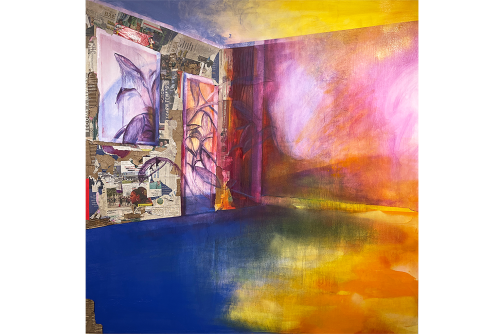
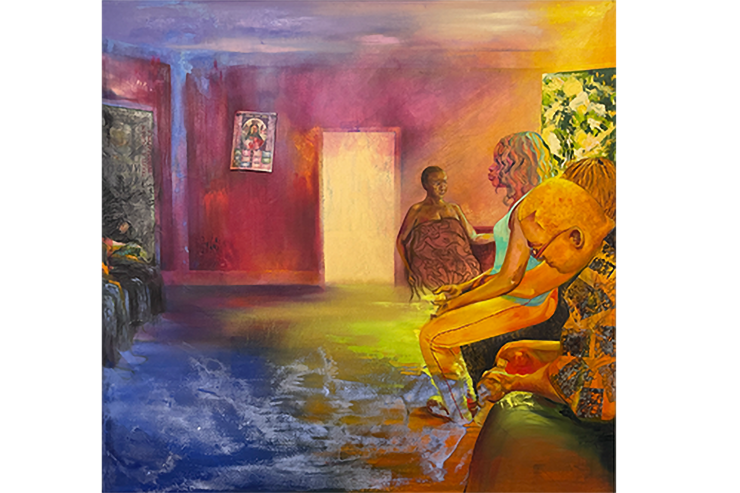
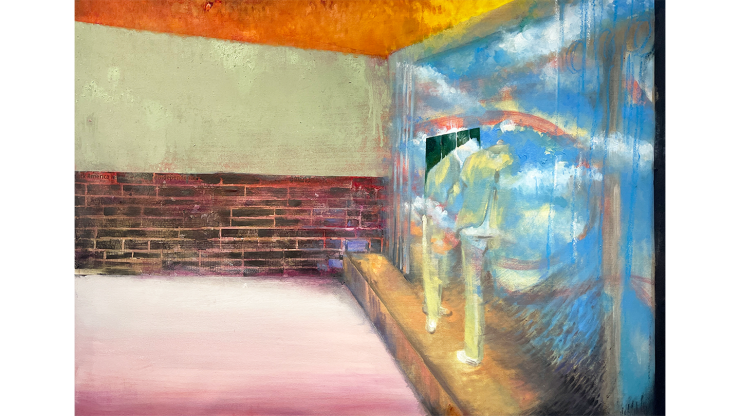
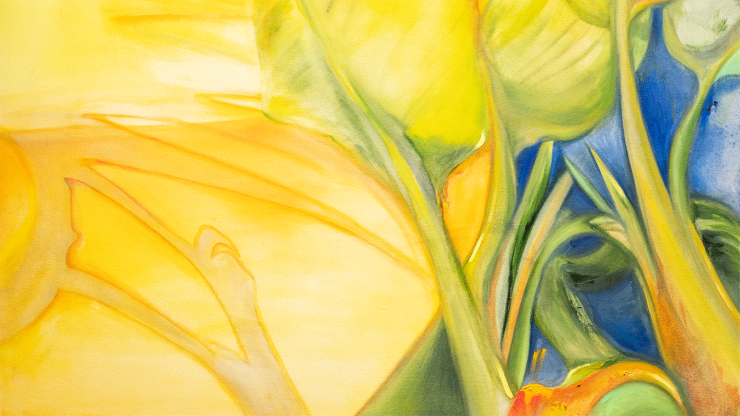
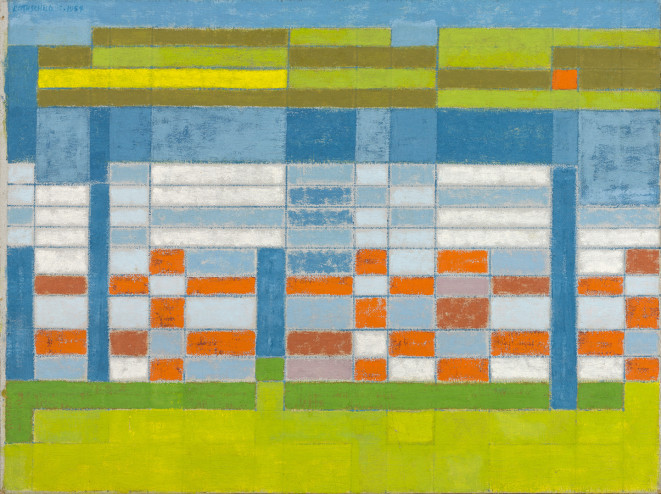
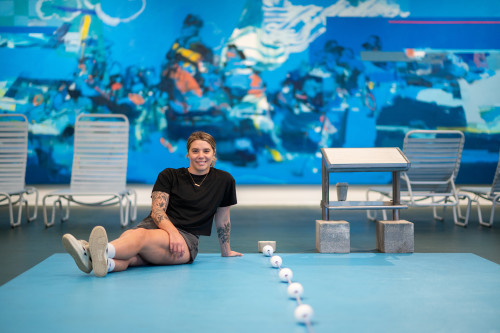
On a gray Baltimore afternoon, the colors in Chidinma Dureke’s paintings seem almost impossible: sunrise oranges that hum, electric pinks that lean toward neon, deep blues that feel like dusk in a city she knows by heart. The canvases are crowded with buildings, food packages, fragments of labels, small gestures of people moving through urban streets. At first glance, the work is playful and lush; stay with it, and themes of migration, belonging, and memory begin to surface.
“I’m a first-generation Nigerian-American,” Dureke says. “Both of my parents migrated from Nigeria in the ’80s. I was born in Washington, D.C., but my story is always about moving between places, between cultures.”
That movement, between Nigeria and the United States, graphic design and painting, activism and entrepreneurship, is what eventually led her to MICA. Now a 2025 graduate of the LeRoy E. Hoffberger School of Painting, Dureke is part of the next generation carrying the institution into its third century. Her story offers a window into what makes the college different and how that difference continues to echo forward.
A Dream that Wouldn’t Let Go
As a child in Prince George’s County, Maryland, Dureke watched her mother run a small publishing company while gently steering her daughters toward “secure” careers. “Doctor, lawyer, engineer, very respected paths,” she recalls with a smile. Dureke, however, was drawn to images.
Her parents met her halfway. They handed her Photoshop CDs and let her experiment. She discovered graphic design, learned that someone could be paid to create book covers, and began to imagine a life in the arts that her family could embrace.
After earning her BFA from Frostburg State University, Dureke knew she wanted more. “I wanted to be a full-time artist, a painter,” she says. Her professors saw the same thing, noticing her sensitivity to color and form and suggesting graduate school. When they mentioned MICA, something clicked.
Dureke visited the campus soon after. The impression was immediate: “I loved the energy and the seriousness. It felt like a prestigious art school — focused, rigorous, inspiring,” she says. Unlike her experience at a broad-based university, MICA felt like a place where art was the center of gravity, not an elective to squeeze in between other demands. “I knew this was where I could grow and take my work seriously. MICA was always the school I dreamed of for my master’s.” This was the beginning of a relationship that would change how she understood her own voice.
Teaching Her to See
Ask Dureke what feels different about MICA, and she doesn’t start with a course or a technique. She starts with people.
“MICA truly has whatever community you’re looking for,” she says. “I’ve always been interested in diverse spaces and diverse stories — race, age, identity — and I found that here.”
In her first year in graduate school, her sister called to ask the practical question any family might have: “So… are they teaching you how to paint?” Dureke laughed. “No one is teaching me how to paint,” she told her. Yet her work was changing dramatically.
The growth, she realized, came not from step-by-step demonstrations but from critique, reading, writing, and theory, with long conversations with faculty and peers about what the work meant and who it was for. MICA was teaching her to see. She learned how to tell stories that were visually arresting and intellectually grounded, rooted in lived experience yet open enough for others to find themselves within them.
“It reminds me of Jamaica’s motto: ‘Out of many, one people,’” she says. “We have more in common than we think. MICA helped me understand how to make work that holds that complexity.”
Baltimore itself became part of that education. Growing up near College Park, she says, people rarely drove to Baltimore unless they had to. Living here as a graduate student, she experienced another story. Walking between classes, she began to notice the quiet poetry of everyday life. She photographed murals, the angle of light on rowhouses, even stray marks of spray paint and debris on sidewalks, details others might overlook. Those textures and colors entered her paintings, synthesizing memories of Nigerian sunsets and the heat of the African grocery store.
From Studio Practice to Nkem Life
During the pandemic, unable to visit her parents, she turned to an African grocery store for comfort and connection. Standing in the aisles, she began reading labels closely and noticed something unsettling: many of the products that carried deep emotional resonance for her family — tinned tomatoes, seasonings, pantry staples —weren’t made in Nigeria at all. Some were produced in France or China yet packaged and advertised using Black faces.
“That fascinated me,” she says. “These objects became metaphors, vessels that mirror Black bodies, tied to consumption, value, and history.” The realization led to a body of paintings and sculptures, and a solo exhibition titled “Shipped and Sold.”
At the same time, MICA’s emphasis on community and collaboration pushed her to think about impact in more public ways. She began curating shows that bridged institutions and neighborhoods, including an exhibition that transformed a church basement in D.C. into a gallery space. She co-founded Nkem Life (“Nkem” meaning “my own” or “my life”) with her sister, a filmmaker.
Through Nkem Life, they tell stories of women from the African diaspora, exploring topics like womanism in Nigerian and African contexts, generational expectations, and shifting ideas of success. Using literary fiction, poetry, and travel writing, they’ve drawn connections between communities in places like Cuba, Jamaica, and Mexico City. Their work was featured in The Washington Post for highlighting the rich African communities shaping culture.
Carrying the Difference Forward
Now, as MICA steps into its third century, Dureke finds herself on the other side of the classroom, teaching the next generation of students in the same institution that once felt like a distant dream.
“It’s full-circle,” she says. “My professors believed in me and saw the gifts I had. Now I get to inspire the next generation of makers and thinkers.”
Her work continues to explore “third spaces,” the in-between territory where immigrant children, in particular, often live. Vibrant canvases wrestling with questions of citizenship and identity; audio recordings from her grandfather’s funeral in Nigeria woven into installations; curatorial projects that turn everyday spaces into sites of dialogue, all of it reflects a practice that is as much about listening as it is about speaking.
“Being a child of immigrants gives me compassion for people who feel unseen,” she says. That compassion now extends to the communities she collaborates with and to the wider network of artists linked to MICA across time.