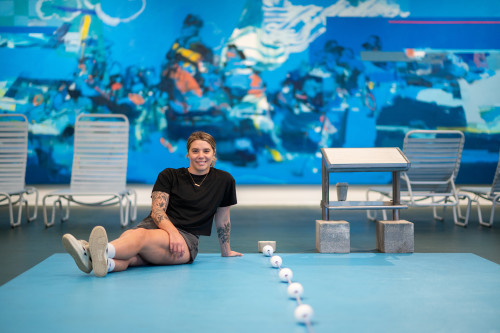
Showing Up

Be willing to give, receive, and be open to the magic to happen.

Nia Parks ’26 (Community Arts MFA)

Nia Parks ’26 (Community Arts MFA)

When Nia Parks first experienced MICA, she wasn’t a graduate student or even in high school. She was a Baltimore grade school student at the Village Learning Place, an after-school center where MICA students volunteered to teach collage.

While most children rushed to recess, Parks lingered over scraps of paper and glue, captivated by the possibilities of layering color and telling a story. “These exercises helped me experiment,” she recalls, “and now I’m a collage artist getting my MFA at MICA.”

Years later, another thread pulled her back. Her middle-school art teacher, Amy Beck Moreno, a graduate of MICA’s Master of Arts in Teaching program, recognized Parks’ spark. She encouraged her to take youth classes at MICA, building early bridges between the young artist’s instinct for expression and the college’s legacy of community-based art.

That sense of belonging — of being seen and guided by a creative lineage — stayed with her. When it came time to pursue graduate study, Parks’ creative journey came full circle. “When I thought about who impacted me and the kind of impact I want to have, MICA was the clear choice,” she says. “Art and activism come together here in a way that feels alive.”

The Force Within

For Parks, the MFA in Community Arts program isn’t simply about making art; it’s about transforming the artist. “There’s a liberatory focus,” she explains. “It’s not just about you as an artist; it’s about you as a person. They force you to grow.”

That growth happens in studio critique and in service learning, in neighborhood projects and classroom reflections. Students are pushed to confront personal assumptions as much as aesthetic choices. “I’ve learned to see my own privileges, like being able-bodied, which I hadn’t really thought about before,” she says.

Within MICA’s Community Arts ecosystem (spanning the MFA program, the undergraduate Center for Community Arts, and the Community Art Collaborative [CAC]), students learn to connect creativity and civic engagement. Together, they live out what Parks calls MICA’s “one mission: thriving with Baltimore.”

“It’s not just a phrase,” she says. “You really feel it. We’re learning that community work doesn’t mean parachuting in; it means building relationships, listening deeply, and understanding how our art can serve.”

Coming Full Circle

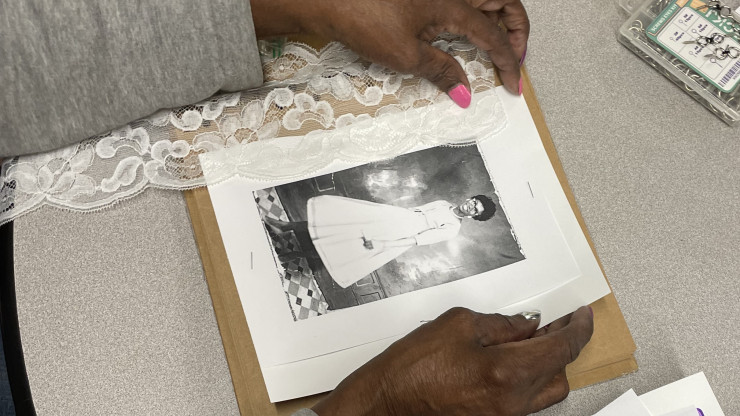
Parks’ own community practice now bridges generations and neighborhoods. Through the France-Merrick Fellowship, she partnered with Bolton North Senior Living to develop intergenerational art experiences, while simultaneously working with Baltimore Youth Arts  (BYA) through the CAC.

“Working with senior citizens, there’s so much wisdom there,” she reflects. “They’d say something that was exactly what I needed to hear. Then I’d go teach youth at BYA and share those same insights. It became this beautiful full-circle exchange: elders to youth, youth back to me, and me back to elders.”

The experience deepened her belief that vulnerability is a form of leadership. “MICA taught me how to be transparent,” she says. “That’s where real community healing happens.”


From MICA’s Digital Magazine

In The Community

A MICA program bridges classroom learning with community engagement that connects art and fosters empathy between intergenerational communities.


Her entrepreneurial spirit, a holdover from her undergraduate studies in studio art and innovation, has also evolved through MICA’s network of creative entrepreneurship programs, including the Ratcliffe Center for Creative Entrepreneurship and the Baltimore Creatives Acceleration Network (BCAN).

“MICA is unique because it treats creative entrepreneurship as community practice,” she explains. “It’s not about profit first; it’s about sustainable, values-based impact.”

Through these resources, Parks began teaching creative entrepreneurship to youth and community members, reframing artmaking as a pathway to both self-sufficiency and civic transformation. “What I learn here, I share outward,” she says. “That’s what it means to be a community artist.”

Forever Baltimore

As she approaches graduation, Parks’ plans are firmly rooted in Baltimore. “I’m a creative entrepreneur, serial entrepreneurship is my thing!” she laughs. “But the program has reframed how I think about entrepreneurship. It’s expanded my focus from personal impact to community impact. I truly believe in thriving with Baltimore.”

Her current thesis explores self-healing as a foundation for collective well-being. “A part of my thesis is about repairing the relationship with yourself,” she says. “When two whole people come together, they build healthy relationships and a community full of people doing that becomes a thriving community.”

The work, she notes, mirrors MICA’s broader mission to integrate art, design, and social impact. “Healing starts on a micro level — with individuals — and grows to a macro level of social change,” she says. “That’s what’s happening [in Baltimore].”

MICA’s culture of collaboration has also transformed her understanding of leadership. “The biggest change is my willingness to collaborate and release control,” she admits. “I used to think control was power, especially growing up in Baltimore. But real power is in collaboration. When I bring what I have and others bring what they have, we create authentic impact together.”

That redefinition of power, rooted in trust and shared creation, is something she hopes to carry forward as both artist and community leader.

Layered with Opportunities

Asked what advice she’d give to future Community Arts students, Parks doesn’t hesitate: “Willingness. Be open and willing to jump into the community.”

She describes MICA as layered with opportunities for connection: classmates, faculty, neighborhood partnerships, collaborative studios, and city-wide events. “The curriculum and opportunities will do their job,” she says. “But you have to show up. You have to be willing to give and receive. That’s where the magic happens.”

As MICA celebrates its bicentennial, Parks’ story offers a glimpse of what makes the institution singular. Since its founding in 1826, MICA has woven together artistic rigor, civic imagination, and deep local engagement, qualities that define its past and propel its future.

For Parks, that legacy isn’t abstract; it’s lived every day in her practice, her partnerships, and her purpose. “I thought I was coming [to Baltimore] for an MFA,” she says, smiling. “But I got a career and a community that will last a lifetime.”

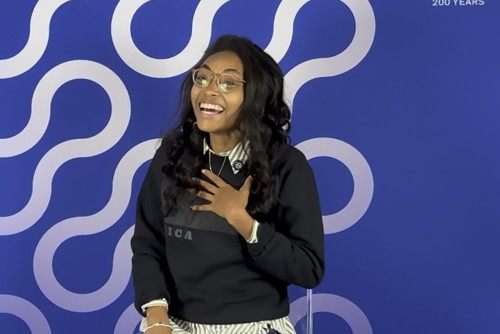
MICA's Bicentennial: Celebrating Two Centuries

Join the festivities as MICA honors its 200-year history, recognizes its present success, and looks forward to a bright future. Throughout 2026, the College will be sharing community stories and announcing one-of-a-kind events on campus, in Baltimore, and beyond.

LEARN MORE


Related MICA Bicentennial

Search for anything and everything at MICA: