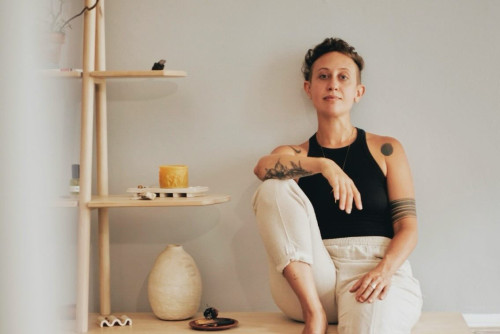
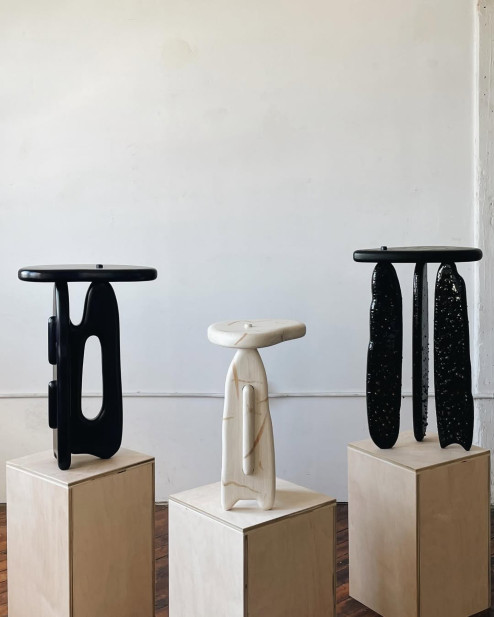
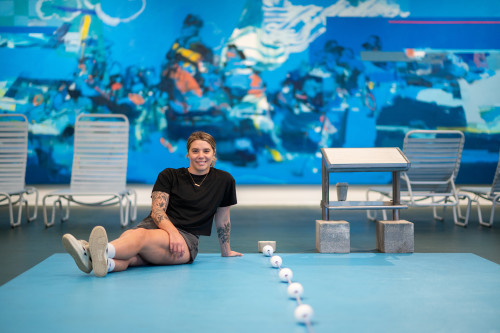
In a light-filled workshop in East Williamsburg, the scent of freshly milled wood lingers in the air. Curved slabs of salvaged maple lean against the wall. A sculptural lamp, carved from a single tree trunk, glows softly in the corner. Here, amid sawdust and sunlight, Allison Samuels has built a practice rooted as much in philosophy as in form.
Samuels is the founder of Two Tree Studios, a woodworking and design studio producing handmade sculptural furniture, lighting, and vessels using hyper-local, consciously sourced materials. They are also the founder and director of The Level Up Project, an equity-driven educational initiative expanding access to creative industries. Across both ventures, Samuels is pursuing something larger than beautiful objects: a regenerative design practice that considers environmental impact, social equity, and the full life cycle of both materials and ideas.
But the path from MICA’s Fiber Department to fine woodworking was anything but linear.
Primed for a Creative Life
Samuels grew up in a home shaped by art and entrepreneurship. Both of their parents attended art school, and one continues to work as a professional organizer. Creativity was not a hobby; it was a viable way of being in the world. “I was always the weird art kid,” Samuels recalls, making up games, constructing clothes from scraps, turning their younger sibling into a model for impromptu fashion experiments.
When it came time for college, art school felt inevitable. Visiting Baltimore as a high school junior, Samuels felt an immediate connection to MICA’s porous campus, its seamless relationship with the city and the sense that creative life extended beyond classroom walls.
“I loved the porousness of the campus in the city,” they say. “It felt right.”
Though they entered MICA without knowing about the Fiber Department, a freshman foundations course shifted everything. Samuels began to see fiber not as a narrow discipline but as a way of thinking about materiality. “Fibers are everywhere,” they explain. “A tree is a fiber. It’s a big fiber.”
That conceptual reframing became foundational. At MICA, Samuels explored gender identity as a construct in their thesis work, mapping identities and designing opportunities for intimate connection beyond prescribed categories. They also completed a concentration in Gender Studies, further shaping their interest in systems, identity, and space.
Equally important were faculty role models, working artists who modeled what a creative life could look like in practice.
“Having professors who were working artists, who cared enough to critique us honestly, that was a game changer,” Samuels says. They learned not only technique, but how to sustain a professional creative practice grounded in integrity.
From Textile Studio to Cabinet Shop
After graduating, Samuels began working at a hand-painted textile design studio where they had interned during college. But after a year and a half, they felt unsettled. Reflecting on what energized them most at MICA, Samuels began to consider landscape architecture or urban design. But first, they decided, they needed to learn how to build.
A Craigslist search led to a cabinet shop in Brooklyn. Samuels started as a finisher’s assistant, sanding surfaces for hours each day. The shop happened to be a high-end operation, and through persistence and curiosity, they worked their way up to cabinetmaker.
Woodworking was not part of their formal training at MICA. Yet in retrospect, it feels inevitable. The conceptual flexibility learned in fibers — the understanding of material as dynamic, relational, and structural — translated seamlessly into working with wood.
In 2017, Samuels began launching their own small business out of their boss’s shop during nights and weekends. Using scrap materials, they created cutting boards and hand-carved utensils, selling them at craft markets and through early Instagram marketing. Custom orders followed. Wholesale accounts grew. Two Tree Studios was born.
The name itself is an homage to a French mentor who would count instructions quickly, “one, two, tree.” Grammatically incorrect and affectionately remembered, the name signals both humor and lineage.
Hyper-Local, Regenerative Design
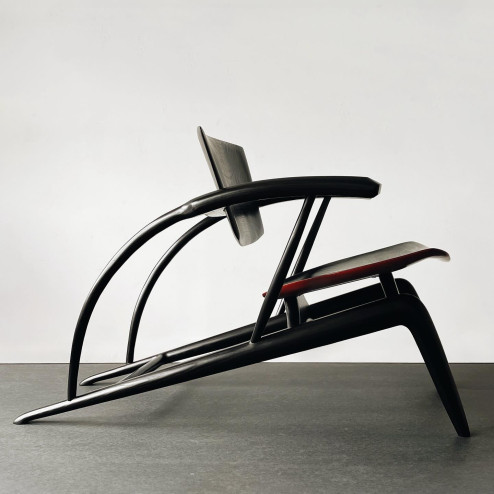
Two Tree Studios specializes in sculptural furniture and lighting crafted from hyper-local, consciously sourced materials. Samuels prioritizes salvaged and storm-fallen wood, reclaimed lumber, and finishes safe enough that “a baby could lick it.”
Initially, their sustainability ethos focused on waste reduction: reusing scrap, compostable packaging, non-toxic finishes. Over time, it evolved into a deeper commitment to regenerative design.