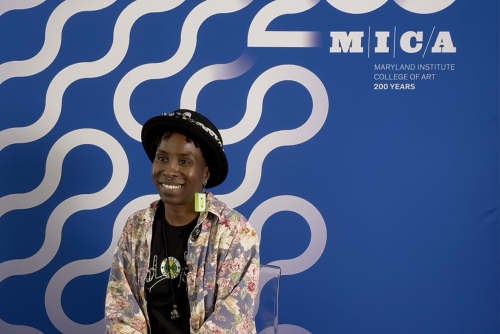
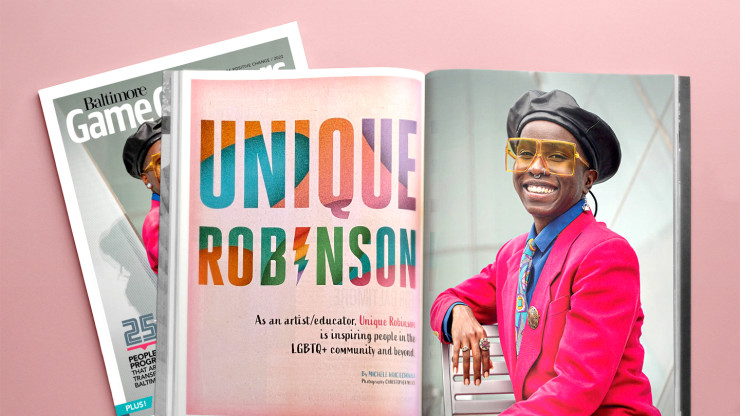
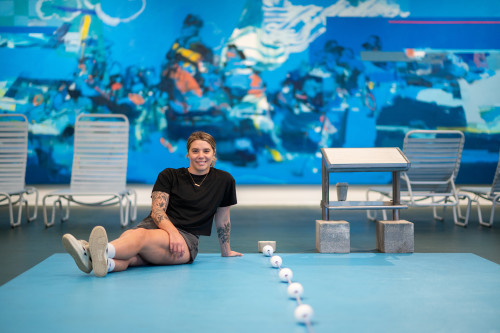
On any given afternoon in Station North, a classroom at MICA hums with poems, questions, and the kind of courage that comes from being truly seen. At the center of it stands Unique Robinson—a poet by calling, a performer by training, and an educator whose roots run deep in West Baltimore. For Robinson, poetry has never been just an art form; it’s a way of moving through the world. As director of MICA’s MFA in Community Arts, she channels that lifelong practice into shaping artists who measure success not only by what hangs on a wall, but by what takes root in a neighborhood.
From Fifth-Grade Spark to Faculty
Robinson’s path began with an unexpected jolt in fifth grade, during a standardized test that revealed what she already suspected: “I am a poet.” The spark never faded. By 14, she was performing across the city, supported by a family who affirmed her voice. Poetry took her to college and then to Mills College in Oakland for an MFA to “legitimize my craft,” not realizing it would also open the door to higher education.
That door swung wider in 2015 at MICA’s Lazarus Auditorium. Robinson had come to perform at a book event when she ran into her eighth-grade art teacher, who was leading MICA’s MAT program. Her former instructor reminded her that an MFA was a terminal degree and connected her with Humanistic Studies. By the fall of 2016, Robinson was teaching creative and academic writing. One seminar in the Community Arts program led to another, the mentorship deepened, and when longtime leaders retired, Robinson stepped into the directorship. The fifth-grade spark had become a vocation.
Showing Up Fully
For Robinson, MICA’s difference is immediate and personal: “I can show up as my full self. Who I am in the world and who I am at work don’t have to conflict.” That freedom isn’t cosmetic. It shapes pedagogy, partnerships, and the confidence students carry into their work.
It also expands what’s possible for faculty. Robinson arrived at MICA as a poet; the college’s studio culture nudged her toward film, music production, painting, and more. “The environment is an incubator of constant inspiration,” she says. Being surrounded by students experimenting across disciplines made experimentation her default, too.
Just as distinctive is MICA’s critique culture in Community Arts. Robinson and her colleagues practice liberatory critique: students define the kind of feedback they need, and critique is designed to support—not collapse—the work. “I’ve seen people shut down in other environments,” she notes. “Here, they’re empowered.” The result is rigor without harm, accountability without deflation.
Artists as Neighbors and Advocates
That approach changes the work itself. In a recent cohort, thesis projects functioned as advocacy as much as art. One student transformed a gallery into a constricted living room, revealing couch surfing as a form of youth homelessness. Another printed testimonies from incarcerated Black women onto prison-issued sheets, creating a pathway the public had to walk through—intimacy as instruction. A third partnered with the Pride Center of Maryland to co-create a fashion line, culminating in a runway show where community members modeled their own stories.
“These weren’t just shows,” Robinson says. “They brought attention to issues people prefer not to see.” In Community Arts, studio practice and fieldwork are interdependent; students build partnerships with Baltimore organizations, then translate those relationships into work that returns value to the city. It’s a two-way street—artists as neighbors, neighbors as collaborators.
Bridging Baltimore and MICA
Robinson’s sense of mission is also personal. As a Baltimore native, she felt the college’s presence long before she felt its welcome. “There has sometimes been a glass barrier between the city and the college,” she says. Directing Community Arts gives her leverage to change that. She invites Baltimore artists in as speakers, guest critics, and visiting artists, and she urges students to get off campus: to Wide Angle Youth Media, Access Art, the Bromo and Black Arts Districts, and the small venues where the city’s cultural engine actually runs.
“I felt like a bridge between these two worlds,” she says. “MICA is in the heart of Baltimore; it should feel connected to it.” That bridge is structural and symbolic. Her presence—Black, queer, Baltimore-born—signals to students what’s possible, especially those who’ve rarely seen themselves reflected at the front of a college classroom. “For some students, I might be the first Black, queer professor they’ve ever had. My presence represents possibility.”
Carrying MICA Forward
As MICA begins to celebrate 200 years, Robinson wants MICA to double down on the qualities that made it singular in the first place: daring, dialogue, and proximity to a city that incubates artists on the margins. “Baltimore is a place where voices that aren’t always heard can be seen and celebrated,” she says. “MICA reflects that spirit.”
For the next century, her wish list is both practical and visionary: expanded scholarships and financial support; deeper community partnerships that share resources, not just headlines; and encouragement for multimedia collaboration that mirrors the messy, generous way artists actually work. Above all, she hopes MICA remains the place where students who feel out of place elsewhere find a home. “It will be challenging,” she tells them, “but you’ll rise, and you’ll be supported. You belong here, now make work that proves it.”
Robinson’s biography, scholarship, and leadership braid into a single throughline: art as a practice of belonging. From a fifth-grade realization to a directorship that treats critique as care and exhibitions as civic acts, she embodies a truth MICA is carrying into its third century—this is a place where art and community are the same conversation. Embrace the invitation, rise to the challenge, and fulfill the promise.