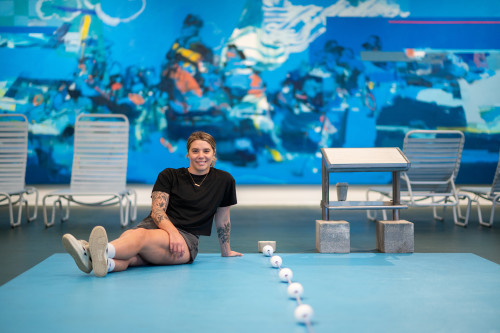
For Natovian McLeod ’15 (General Fine Arts BFA), ’16 (MAT), MICA was not a far-off dream. It was part of the landscape of her childhood. Growing up in Baltimore, she saw the campus in passing, attended Artscape each summer, and absorbed the creative pulse of the city. But pursuing art school was not her original plan. A dedicated track and field runner, McLeod once thought athletics would chart her future. That changed the day an admissions counselor from MICA visited her high school. She looked at McLeod’s portfolio and saw more than sketches and practice pieces. She saw potential.
“She looked at my portfolio and said, ‘Wow, I really think you should consider a future in art and design,’” McLeod recalls. “I hadn’t even thought of myself that way.”
Encouragement also came from her high school art teacher, a MICA alum. Soon after, she began the application process, passed her first portfolio review, received an acceptance letter, and began visiting campus. Those visits—eight in total—often with her family and younger brother—made the difference.
“It felt like home,” she remembers of those tours. “Everyone was friendly, everyone was smiling. I didn’t feel the same anxiety I felt at other schools.” By the time she officially enrolled, she knew MICA was where she belonged.
Space to Explore
McLeod quickly discovered what sets MICA apart: the freedom to explore. A first-year course, now known as Forum, invited students to experiment with multiple media instead of choosing a single discipline.
“That class opened my eyes,” she says. “I always thought of art as just painting, but suddenly I was trying collage, assemblage, mixed media. It was about play, risk-taking, and being gently encouraged to explore.”
That spirit, an inclusive, encouraging culture modeled by practicing artists on the faculty, was unlike anything she had experienced elsewhere. “MICA fosters this environment where students share a belief that art can change the world, whether by building empathy or re-imagining community. That’s what makes it different.”
Teaching, Leading, Inspiring
After completing her BFA in General Fine Arts in 2015 and MICA’s Master of Arts in Teaching program in 2016, McLeod took those lessons into public school art programs. She was soon recognized for her innovative, culturally responsive teaching, earning Maryland’s Elementary Art Teacher of the Year award in 2021.
Her classroom approach was simple but transformative: introduce students to artists who looked like them and came from their neighborhoods. “Seeing artists from their own communities gave students a sense of power and ownership,” she explains. “It made them believe they could make change, too.”
MICA continued to shape her path. Encouraged by mentors who saw her potential, McLeod transitioned from classroom teaching into leadership. Today, as Director of Youth and Community Education in Open Studies, she designs programs that help young people take creative risks.
“In pre-college programs, we don’t expect students to arrive fully trained,” she says. “Even if they’ve never tried animation or design, we encourage them to explore. You never know where your skills might lie. That’s MICA’s way: reminding students that they already have what they need.”
A Legacy of Engagement
As MICA enters its third century, McLeod hopes the institution will deepen its role as a community partner in Baltimore.
“I hope the future of MICA will continue to take time to listen to our neighbors,” she says. “Not just for optics or publicity, but in genuine, collaborative ways—sharing opportunities, hearing what people need, and working alongside them.”
That vision reflects her own journey. At every stage, MICA faculty and staff opened doors she hadn’t imagined for herself. They trusted her with responsibility, saw leadership in her before she did, and created space for her to grow. Today, she does the same for students she mentors and hires.
“MICA believed in me before I believed in myself,” she says. “And now I try to pass that forward.”
Believing in Others
McLeod’s story is both uniquely her own and emblematic of the MICA experience across two centuries. It is the story of a school that invites curiosity, embraces dialogue, and sees art not only as a practice but as a way of building community.
“MICA is like no other because it doesn’t just teach technique—it believes in people,” McLeod reflects. “It insists creativity is a communal act, and it dares to say that art can change the world.”
As MICA celebrates its 200th anniversary, stories like McLeod’s reveal the throughline connecting past, present, and future: the conviction that artists are catalysts, communities are essential, and learning is lifelong.