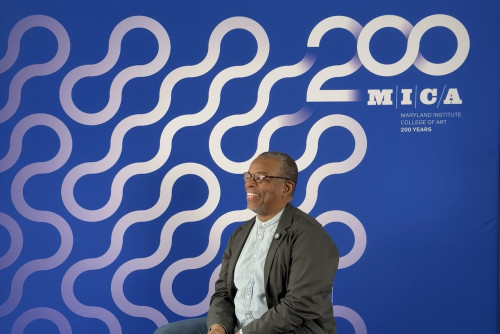
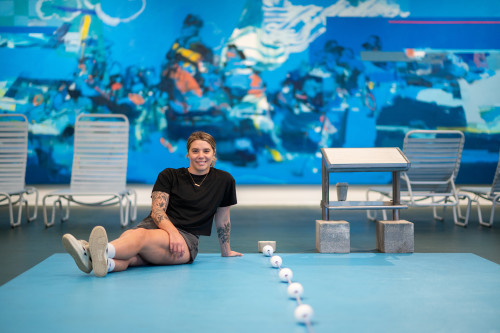
Thirty years to the day after receiving his MFA from MICA, Bill Gaskins stepped back onto campus to lead a program he wishes had existed when he was a student: the Photography, Media & Society MFA. The path between those two moments—student to founding director—traces a set of questions he first voiced at fourteen, when he told his Philadelphia parents that he planned to major in commercial art at Dobbins Tech. They challenged him with three blunt measures of adulthood: How would he make money? How would he make sense? How would he make a difference? Many around him couldn’t imagine those aims coexisting for an artist. Gaskins could, and he set out to prove it.
His proof, now, is institutional. As founding director, he works with graduate students who come to change their lives. He tells them they are not merely seeking employment; they are building employment through enterprise—creative work pursued at such scale and consequence that others must be hired to bring it to life. Over the years, teaching in universities and art schools, people were drawn to his classroom because he demanded revenue, relevance, and respect in equal measure. MICA offered the chance to elevate those values from a single course to a program, and ultimately to a community.
How MICA entered the frame
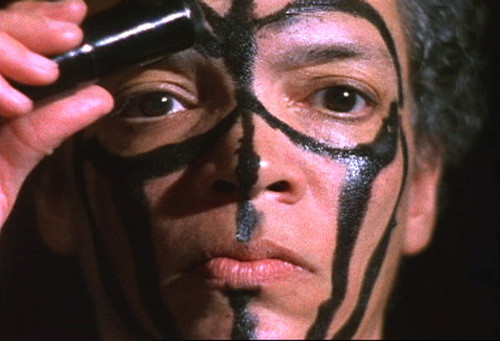
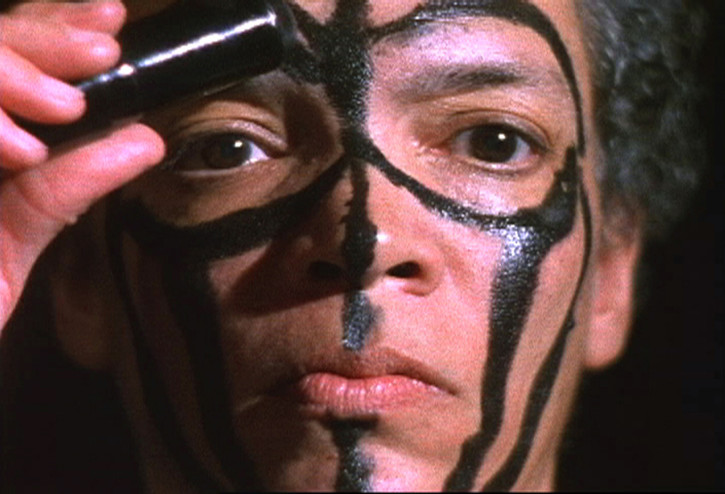
Gaskins’ first MICA chapter began in the mid-1990s. His thesis, Good and Bad Hair, examined race, beauty, and cultural mythology through portraiture and text. The late Will Larson, Gaskins’ undergraduate chair at Tyler School of Art and later director of MICA’s graduate program, encouraged the work’s anchoring premise: photography is inherently interdisciplinary. For Gaskins, that meant riding the Broad Street bus, walking the last stretch, and bringing sociological reading, historical memory, and lived experience into the studio. The more one knows beyond the medium, he says, the more one can bring to it.
When he graduated in 1995, he carried an MFA in one hand and a teaching contract from a major art and design institute in the other. Over the next two decades, he taught at several universities and art schools while building a body of work that interrogates identity, mobility, and American myth.
What feels singular about MICA
When MICA invited him back in 2019 to design a new graduate program, the decision felt less like a return than an expansion. What makes MICA different, he argues, begins with place. The College sits in a city where the intersections of race and rights are, in his words, too tall to get over and too wide to get around. Baltimore does not merely contextualize student work; it insists on relevance.
That insistence is sharpened by institutional memory. He acknowledges difficult parts of the story—the racial covenant that shaped admissions until 1956—alongside choices that changed the trajectory. The arrival of new leadership and the creation of industry-supported fellowships for artists of color made his graduate study at MICA possible. He emphasizes these moves were not charity but acts of self-transformation that desegregated classrooms and the faculty community and expanded what the institution could be.
Curricularly, he sees a refusal of stasis. MICA has worked to close the gap between art and business, to partner with civic leaders across Baltimore, and to keep asking what comes next with answers that matter beyond campus. At the program level, he condenses the difference to three words: revenue, relevance, respect. He once modeled those values within a single classroom. Now he designs a graduate culture around them.
How that difference shapes people and projects
The Photography, Media & Society MFA is built on one demanding premise: artists animate tools, not the other way around. For that reason, the program begins before any lens is lifted. Applicants must name the urgent topic that will anchor their work and demonstrate that urgency without a camera first. They research, write, and persuade, so that when images appear, they surface the depth beneath them through analysis, history, ethics, and lived experience.
Because graduate cohorts in art and design are often majority women, Gaskins also addresses the soundtracks many students carry about who gets to lead. He wants them to replace narratives of limitation with habits of collaboration and consequence. The aim is to move from maker- and art-market motives to mission, vision, and impact. Studios are intentionally porous. Students work with artists and curators, yes, but also with advocates, agencies, and organizations committed to measurable change.
The effects are concrete. In the first group he recruited after returning to MICA, he saw promise in Beverly Price without a BFA who had been incarcerated from ages eighteen to twenty-five. He admitted her. Price has since earned prominent fellowships and residencies—including the Art for Justice Fund and the inaugural Right of Return Fellowship—and was a Frieze Impact Prize finalist. The list, for Gaskins, is more than résumé lines; it is evidence that a graduate program can be a launch platform for consequential lives. “MICA changed my life,” he says. “Now I get to help others change theirs.”
The program’s method mirrors his own scholarly path from Good and Bad Hair to The Cadillac Chronicles to curatorial and public projects. Each treats photography not only as a mirror of society but also as a means to recompose it.
Carrying the difference forward into the next century
As MICA marks its bicentennial, Gaskins reads the milestone as both validation and charge. Two hundred years of persistence prove that the institution’s experiment works; the next century demands that it lead in ways it has and in ways it has not yet dared. For undergraduates, it will remain reasonable to ask what job awaits after commencement. Graduate education, he argues, must ask something larger: What world do you want to live in, and what role are you prepared to take to bring that world into reality, not only for yourself but for those on their way to this one?
He argues the gap between learning and living must shrink: graduate programs should let students change their lives without upending routines while maintaining rigor. Education should prize consequence over credentials, drawing people ready to found enterprises, build coalitions, and test ideas at civic scale. And the future must be imagined with history in view—beginning with a clear-eyed look at the world as it is and, through time, community, and honest reckoning, envisioning the world as it needs to be.